Click to enlarge.
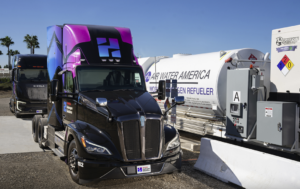
Toyota Motor (NYSE: TM) North America’s Hydrogen Headquarters (H2HQ) division is progress in fueling improvements for heavy-duty fuel cell trucks as it works to bring these changes to Toyota’s commercial fleets in the U.S. Production Toyota-powered trucks are expected to be on the road for commercial operations in 2027.*
“Toyota recently installed two mobile hydrogen fueling devices at North American Parts Center California (NAPCC). The Ontario CA complex is its largest parts distribution facility in the U.S. With the tanks and fuel ready, Toyota’s commercial logistics fleets plan to use the mobile fuelers to support Toyota operations by fueling heavy-duty fuel cell trucks hauling freight from the Port of Los Angeles to Ontario, and throughout the region. A permanent station is planned to be built on location.” H2HQ said in a release.
The station will initially fuel heavy-duty trucks commissioned through Hyroad Energy and will later integrate heavy-duty trucks with Toyota’s own certified fuel cell powertrain. Toyota is collaborating with the U.S. Department of Energy’s National Laboratory of the Rockies (NLR) in Golden, Colorado, to research several initiatives, including 70 MPa high-flow hydrogen fueling for heavy-duty trucks.
“High-flow fueling allows trucks to accept hydrogen fuel at speeds up to 300g/s, or about five times faster than the rate of conventional light-duty fueling technology. It allows heavy-duty trucks to carry energy into the vehicle at an equivalent speed of a 20 MW fast charger. Refueling times are comparable to modern diesel-powered, heavy-duty trucks. Unlike a diesel powertrain, however, fuel cells emit only water.
“Toyota and NLR engineers and researchers have performed multiple rounds of testing per SAE J2601-5 standards, successfully demonstrating that Toyota-powered heavy-duty trucks can be refueled in about eight minutes for a range of up to 450 miles,” H2HQ said.
Over the next several months, Toyota will upgrade its private fueling infrastructure at its H2HQ to the same high-flow standard for testing heavy-duty vehicles. It also plans to install new equipment for light passenger fuel cell electric vehicles in order to evaluate station hardware and share insights intended to improve operations and reliability. When the publicly available permanent station at NAPCC goes online, Toyota plans to provide conventional and high-flow hydrogen fueling for heavy-duty trucks, along with a separate area for fueling light-duty vehicles.
*AutoInformed on

About Ken Zino
Ken Zino, editor and publisher of AutoInformed, is a versatile auto industry participant with global experience spanning decades in print and broadcast journalism, as well as social media. He has automobile testing, marketing, public relations and communications experience. He is past president of The International Motor Press Assn, the Detroit Press Club, founding member and first President of the Automotive Press Assn. He is a member of APA, IMPA and the Midwest Automotive Press Assn.
He also brings an historical perspective while citing their contemporary relevance of the work of legendary auto writers such as Ken Purdy, Jim Dunne or Jerry Flint, or writers such as Red Smith, Mark Twain, Thomas Jefferson – all to bring perspective to a chaotic automotive universe.
Above all, decades after he first drove a car, Zino still revels in the sound of the exhaust as the throttle is blipped during a downshift and the driver’s rush that occurs when the entry, apex and exit points of a turn are smoothly and swiftly crossed. It’s the beginning of a perfect lap.
AutoInformed has an editorial philosophy that loves transportation machines of all kinds while promoting critical thinking about the future use of cars and trucks.
Zino builds AutoInformed from his background in automotive journalism starting at Hearst Publishing in New York City on Motor and MotorTech Magazines and car testing where he reviewed hundreds of vehicles in his decade-long stint as the Detroit Bureau Chief of Road & Track magazine. Zino has also worked in Europe, and Asia – now the largest automotive market in the world with China at its center.







Toyota Installs Two Hydrogen Fueling Stations in Ontario CA
Click to enlarge.
Toyota Motor (NYSE: TM) North America’s Hydrogen Headquarters (H2HQ) division is progress in fueling improvements for heavy-duty fuel cell trucks as it works to bring these changes to Toyota’s commercial fleets in the U.S. Production Toyota-powered trucks are expected to be on the road for commercial operations in 2027.*
“Toyota recently installed two mobile hydrogen fueling devices at North American Parts Center California (NAPCC). The Ontario CA complex is its largest parts distribution facility in the U.S. With the tanks and fuel ready, Toyota’s commercial logistics fleets plan to use the mobile fuelers to support Toyota operations by fueling heavy-duty fuel cell trucks hauling freight from the Port of Los Angeles to Ontario, and throughout the region. A permanent station is planned to be built on location.” H2HQ said in a release.
The station will initially fuel heavy-duty trucks commissioned through Hyroad Energy and will later integrate heavy-duty trucks with Toyota’s own certified fuel cell powertrain. Toyota is collaborating with the U.S. Department of Energy’s National Laboratory of the Rockies (NLR) in Golden, Colorado, to research several initiatives, including 70 MPa high-flow hydrogen fueling for heavy-duty trucks.
“High-flow fueling allows trucks to accept hydrogen fuel at speeds up to 300g/s, or about five times faster than the rate of conventional light-duty fueling technology. It allows heavy-duty trucks to carry energy into the vehicle at an equivalent speed of a 20 MW fast charger. Refueling times are comparable to modern diesel-powered, heavy-duty trucks. Unlike a diesel powertrain, however, fuel cells emit only water.
“Toyota and NLR engineers and researchers have performed multiple rounds of testing per SAE J2601-5 standards, successfully demonstrating that Toyota-powered heavy-duty trucks can be refueled in about eight minutes for a range of up to 450 miles,” H2HQ said.
Over the next several months, Toyota will upgrade its private fueling infrastructure at its H2HQ to the same high-flow standard for testing heavy-duty vehicles. It also plans to install new equipment for light passenger fuel cell electric vehicles in order to evaluate station hardware and share insights intended to improve operations and reliability. When the publicly available permanent station at NAPCC goes online, Toyota plans to provide conventional and high-flow hydrogen fueling for heavy-duty trucks, along with a separate area for fueling light-duty vehicles.
*AutoInformed on
About Ken Zino
Ken Zino, editor and publisher of AutoInformed, is a versatile auto industry participant with global experience spanning decades in print and broadcast journalism, as well as social media. He has automobile testing, marketing, public relations and communications experience. He is past president of The International Motor Press Assn, the Detroit Press Club, founding member and first President of the Automotive Press Assn. He is a member of APA, IMPA and the Midwest Automotive Press Assn. He also brings an historical perspective while citing their contemporary relevance of the work of legendary auto writers such as Ken Purdy, Jim Dunne or Jerry Flint, or writers such as Red Smith, Mark Twain, Thomas Jefferson – all to bring perspective to a chaotic automotive universe. Above all, decades after he first drove a car, Zino still revels in the sound of the exhaust as the throttle is blipped during a downshift and the driver’s rush that occurs when the entry, apex and exit points of a turn are smoothly and swiftly crossed. It’s the beginning of a perfect lap. AutoInformed has an editorial philosophy that loves transportation machines of all kinds while promoting critical thinking about the future use of cars and trucks. Zino builds AutoInformed from his background in automotive journalism starting at Hearst Publishing in New York City on Motor and MotorTech Magazines and car testing where he reviewed hundreds of vehicles in his decade-long stint as the Detroit Bureau Chief of Road & Track magazine. Zino has also worked in Europe, and Asia – now the largest automotive market in the world with China at its center.