Click for more.
American Honda Motor Company and Astrobotic Technology today announced a joint-development agreement aimed at developing a scalable and integrated power supply for sustained lunar surface missions.
“The collaboration between Honda and Astrobotic marks a pivotal step toward creating scalable power solutions for long-term lunar surface missions. Powered by core Honda technologies, our regenerative fuel cell system is designed to provide efficient energy storage and regeneration to support sustained human life on the Moon, as well as advance zero-emission applications on Earth,” claimed Derek Adelman, chief engineer, Space Development Division, American Honda Motor Company.
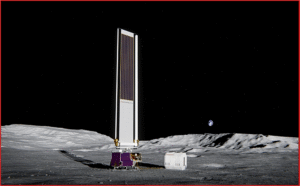
Astrobotic is creating a scalable power infrastructure service, called LunaGrid, designed to supply sustained lunar surface power for a wide range of lunar missions and customers. A key component of LunaGrid is the Astrobotic VSAT, a solar-powered system that is deployable, self-leveling, and capable of sun tracking for optimal energy capture. Astrobotic is developing a 10 kW VSAT system, along with the Extra-Large Vertical Solar Array Technology (VSAT-XL), which would generate 50 kW of power to support the growing power requirements of planned lunar missions.
The joint feasibility study will explore how the Honda regenerative fuel cell (RFC) system can be integrated with Astrobotic’s Vertical Solar Array Technology (VSAT) and LunaGrid service to provide continuous power, even during prolonged periods of darkness on the Moon. The study will integrate the Honda RFC and Astrobotic VSAT Systems and will focus on three key objectives:
- Conducting detailed illumination studies to assess power generation and storage requirements at different sites where the LunaGrid system will be deployed.
- Evaluating the scalability of the Honda RFC system for LunaGrid’s use.
- Assessing hardware and software integration with the Honda RFC and Astrobotic VSAT to define RFC system requirements that ensure reliable operation in future deployments.
“A key advantage of the Honda regenerative fuel cell system is its ability to provide continuous power during the lunar night. By integrating the Honda RFC with the Astrobotic VSAT, the combined system could significantly extend power availability beyond the lunar night, which would enable expanded mission capabilities, support a sustained human presence on the Moon, advance lunar surface infrastructure development and power future commercial industries,” Honda said. [see Footnotes below]
During the study, Honda and Astrobotic will also simulate one-year solar illumination profiles at various lunar South Pole sites using both the Astrobotic 10 kW and 50 kW VSAT systems. These simulated illumination profiles will determine how much sunlight the VSAT solar panels will receive on the lunar surface to power the water electrolysis during the day, enabling the RFC system to convert the stored hydrogen into electricity throughout the night. Based on the modeled solar energy production, Honda will size its regenerative fuel cell system to meet the energy storage needs of various lunar mission scenarios. [see Footnotes below]
“Astrobotic’s LunaGrid is being developed to deliver reliable, continuous power for lunar surface missions, revolutionizing the economics of exploration. By enabling survival through the harsh lunar night and extending mission durations from days to years, LunaGrid will significantly boost mission performance and data return per dollar invested. Our collaboration with Honda is a major move in this vision, as their scalable energy storage technology will enhance both LunaGrid and our Vertical Solar Array Technology (VSAT), expanding our overall power generation and storage capabilities,” claimed Bobby Rolley, Astrobotic’s Lunar Power Systems Architect.
Inevitable Footnotes
- A lunar day is how long it takes for the Moon to go from one sunrise to the next at the same spot. It lasts ~29.5 Earth days.
- A lunar night is the long period of darkness on the Moon after the Sun has set. It lasts ~14 Earth days.

About Ken Zino
Ken Zino, editor and publisher of AutoInformed, is a versatile auto industry participant with global experience spanning decades in print and broadcast journalism, as well as social media. He has automobile testing, marketing, public relations and communications experience. He is past president of The International Motor Press Assn, the Detroit Press Club, founding member and first President of the Automotive Press Assn. He is a member of APA, IMPA and the Midwest Automotive Press Assn.
He also brings an historical perspective while citing their contemporary relevance of the work of legendary auto writers such as Ken Purdy, Jim Dunne or Jerry Flint, or writers such as Red Smith, Mark Twain, Thomas Jefferson – all to bring perspective to a chaotic automotive universe.
Above all, decades after he first drove a car, Zino still revels in the sound of the exhaust as the throttle is blipped during a downshift and the driver’s rush that occurs when the entry, apex and exit points of a turn are smoothly and swiftly crossed. It’s the beginning of a perfect lap.
AutoInformed has an editorial philosophy that loves transportation machines of all kinds while promoting critical thinking about the future use of cars and trucks.
Zino builds AutoInformed from his background in automotive journalism starting at Hearst Publishing in New York City on Motor and MotorTech Magazines and car testing where he reviewed hundreds of vehicles in his decade-long stint as the Detroit Bureau Chief of Road & Track magazine. Zino has also worked in Europe, and Asia – now the largest automotive market in the world with China at its center.







Honda, Astrobotic Start Study of Lunar Power
Click for more.
American Honda Motor Company and Astrobotic Technology today announced a joint-development agreement aimed at developing a scalable and integrated power supply for sustained lunar surface missions.
“The collaboration between Honda and Astrobotic marks a pivotal step toward creating scalable power solutions for long-term lunar surface missions. Powered by core Honda technologies, our regenerative fuel cell system is designed to provide efficient energy storage and regeneration to support sustained human life on the Moon, as well as advance zero-emission applications on Earth,” claimed Derek Adelman, chief engineer, Space Development Division, American Honda Motor Company.
Astrobotic is creating a scalable power infrastructure service, called LunaGrid, designed to supply sustained lunar surface power for a wide range of lunar missions and customers. A key component of LunaGrid is the Astrobotic VSAT, a solar-powered system that is deployable, self-leveling, and capable of sun tracking for optimal energy capture. Astrobotic is developing a 10 kW VSAT system, along with the Extra-Large Vertical Solar Array Technology (VSAT-XL), which would generate 50 kW of power to support the growing power requirements of planned lunar missions.
The joint feasibility study will explore how the Honda regenerative fuel cell (RFC) system can be integrated with Astrobotic’s Vertical Solar Array Technology (VSAT) and LunaGrid service to provide continuous power, even during prolonged periods of darkness on the Moon. The study will integrate the Honda RFC and Astrobotic VSAT Systems and will focus on three key objectives:
“A key advantage of the Honda regenerative fuel cell system is its ability to provide continuous power during the lunar night. By integrating the Honda RFC with the Astrobotic VSAT, the combined system could significantly extend power availability beyond the lunar night, which would enable expanded mission capabilities, support a sustained human presence on the Moon, advance lunar surface infrastructure development and power future commercial industries,” Honda said. [see Footnotes below]
During the study, Honda and Astrobotic will also simulate one-year solar illumination profiles at various lunar South Pole sites using both the Astrobotic 10 kW and 50 kW VSAT systems. These simulated illumination profiles will determine how much sunlight the VSAT solar panels will receive on the lunar surface to power the water electrolysis during the day, enabling the RFC system to convert the stored hydrogen into electricity throughout the night. Based on the modeled solar energy production, Honda will size its regenerative fuel cell system to meet the energy storage needs of various lunar mission scenarios. [see Footnotes below]
“Astrobotic’s LunaGrid is being developed to deliver reliable, continuous power for lunar surface missions, revolutionizing the economics of exploration. By enabling survival through the harsh lunar night and extending mission durations from days to years, LunaGrid will significantly boost mission performance and data return per dollar invested. Our collaboration with Honda is a major move in this vision, as their scalable energy storage technology will enhance both LunaGrid and our Vertical Solar Array Technology (VSAT), expanding our overall power generation and storage capabilities,” claimed Bobby Rolley, Astrobotic’s Lunar Power Systems Architect.
Inevitable Footnotes
About Ken Zino
Ken Zino, editor and publisher of AutoInformed, is a versatile auto industry participant with global experience spanning decades in print and broadcast journalism, as well as social media. He has automobile testing, marketing, public relations and communications experience. He is past president of The International Motor Press Assn, the Detroit Press Club, founding member and first President of the Automotive Press Assn. He is a member of APA, IMPA and the Midwest Automotive Press Assn. He also brings an historical perspective while citing their contemporary relevance of the work of legendary auto writers such as Ken Purdy, Jim Dunne or Jerry Flint, or writers such as Red Smith, Mark Twain, Thomas Jefferson – all to bring perspective to a chaotic automotive universe. Above all, decades after he first drove a car, Zino still revels in the sound of the exhaust as the throttle is blipped during a downshift and the driver’s rush that occurs when the entry, apex and exit points of a turn are smoothly and swiftly crossed. It’s the beginning of a perfect lap. AutoInformed has an editorial philosophy that loves transportation machines of all kinds while promoting critical thinking about the future use of cars and trucks. Zino builds AutoInformed from his background in automotive journalism starting at Hearst Publishing in New York City on Motor and MotorTech Magazines and car testing where he reviewed hundreds of vehicles in his decade-long stint as the Detroit Bureau Chief of Road & Track magazine. Zino has also worked in Europe, and Asia – now the largest automotive market in the world with China at its center.