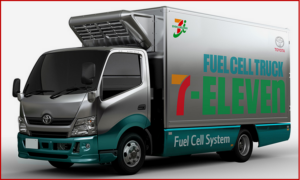
A previous foray. Click for more.
Isuzu Motors (OTC: ISUZY, 7202T) and Toyota Motor (NYSE: TM, 7203T) said today that they have agreed to collaborate on the development toward the mass production of a next-generation light-duty fuel cell (FC) electric truck.*
“The vehicle is based on Isuzu’s ELF EV BEV (footnote 3 below) light-duty truck and combines Toyota’s new fuel cell system (3rd-generation FC system footnote 2). Both companies will jointly develop the system to ensure its compatibility, and aiming to start production in FY2027. Both companies will further advance technologies capable of supporting the high-utilization operating conditions unique to commercial vehicles, based on its multi-pathway approach to powertrains, while helping build a hydrogen society and carbon neutral logistics sector,” the Japanese companies said in a release.
Light-duty trucks are regularly used for deliveries to supermarkets, convenience stores, and other services that support everyday life. In many cases, these vehicles are equipped with refrigeration or frozen storage capabilities and make multiple deliveries per day, requiring long operating hours while driven long distances. Under such operating conditions, quick energy replenishment is essential to maintaining operational efficiency.
“For such high-utilization applications, fuel cell electric vehicles (FCEVs), which use hydrogen as a high-energy-density fuel, represent an effective option. Compared to BEVs (footnote 1), which face the challenge of long charging times, FCEVs can significantly reduce refueling time. Furthermore, because they offer a long driving range per refueling, they are well-suited for harsh operating environments. Furthermore, like BEVs, FCEVs produce little vibration or noise and emit no CO2 while in use, thereby contributing to reduced environmental impact,” the companies noted.
The new vehicle will be based on the ELF EV, launched in 2023 and designed using I-MACS, Isuzu’s product development platform (3). It adopts Toyota’s next-generation fuel cell stack, enhancing vehicle durability and extending its service life.
“One of the challenges to the widespread adoption of FCEVs is the high vehicle price point. Isuzu is working to reduce costs by optimizing the vehicle body structure and reviewing manufacturing processes. Toyota is undertaking similar efforts through innovations in fuel cell design and manufacturing processes,” the companies said.
“In addition, by leveraging the technologies, expertise, and insights gained through the joint development of the next-generation fuel cell route bus (ERGA FCV), as well as the results of the FC light-duty truck social implementation project conducted by Commercial Japan Partnership Technologies Corporation, the two companies will advance the sophistication of control technologies and system improvements to enhance fuel cell durability, achieving the high levels of reliability and practicality required of commercial vehicles.”
*AutoInformed on
Inevitable Isuzu and Toyota Footnotes
- Battery Electric Vehicle
- Fuel Cell Electric Vehicle
- Abbreviation for Isuzu Modular Architecture and Component Standard. A development approach that enables the flexible combination of components and devices to meet diverse needs, applied in anticipation of future advancement in technologies and the expansion of vehicle types in the future.

About Ken Zino
Ken Zino, editor and publisher of AutoInformed, is a versatile auto industry participant with global experience spanning decades in print and broadcast journalism, as well as social media. He has automobile testing, marketing, public relations and communications experience. He is past president of The International Motor Press Assn, the Detroit Press Club, founding member and first President of the Automotive Press Assn. He is a member of APA, IMPA and the Midwest Automotive Press Assn.
He also brings an historical perspective while citing their contemporary relevance of the work of legendary auto writers such as Ken Purdy, Jim Dunne or Jerry Flint, or writers such as Red Smith, Mark Twain, Thomas Jefferson – all to bring perspective to a chaotic automotive universe.
Above all, decades after he first drove a car, Zino still revels in the sound of the exhaust as the throttle is blipped during a downshift and the driver’s rush that occurs when the entry, apex and exit points of a turn are smoothly and swiftly crossed. It’s the beginning of a perfect lap.
AutoInformed has an editorial philosophy that loves transportation machines of all kinds while promoting critical thinking about the future use of cars and trucks.
Zino builds AutoInformed from his background in automotive journalism starting at Hearst Publishing in New York City on Motor and MotorTech Magazines and car testing where he reviewed hundreds of vehicles in his decade-long stint as the Detroit Bureau Chief of Road & Track magazine. Zino has also worked in Europe, and Asia – now the largest automotive market in the world with China at its center.







Light-Duty Fuel Cell Trucks – Isuzu, Toyota Collaboration!
A previous foray. Click for more.
Isuzu Motors (OTC: ISUZY, 7202T) and Toyota Motor (NYSE: TM, 7203T) said today that they have agreed to collaborate on the development toward the mass production of a next-generation light-duty fuel cell (FC) electric truck.*
“The vehicle is based on Isuzu’s ELF EV BEV (footnote 3 below) light-duty truck and combines Toyota’s new fuel cell system (3rd-generation FC system footnote 2). Both companies will jointly develop the system to ensure its compatibility, and aiming to start production in FY2027. Both companies will further advance technologies capable of supporting the high-utilization operating conditions unique to commercial vehicles, based on its multi-pathway approach to powertrains, while helping build a hydrogen society and carbon neutral logistics sector,” the Japanese companies said in a release.
Light-duty trucks are regularly used for deliveries to supermarkets, convenience stores, and other services that support everyday life. In many cases, these vehicles are equipped with refrigeration or frozen storage capabilities and make multiple deliveries per day, requiring long operating hours while driven long distances. Under such operating conditions, quick energy replenishment is essential to maintaining operational efficiency.
“For such high-utilization applications, fuel cell electric vehicles (FCEVs), which use hydrogen as a high-energy-density fuel, represent an effective option. Compared to BEVs (footnote 1), which face the challenge of long charging times, FCEVs can significantly reduce refueling time. Furthermore, because they offer a long driving range per refueling, they are well-suited for harsh operating environments. Furthermore, like BEVs, FCEVs produce little vibration or noise and emit no CO2 while in use, thereby contributing to reduced environmental impact,” the companies noted.
The new vehicle will be based on the ELF EV, launched in 2023 and designed using I-MACS, Isuzu’s product development platform (3). It adopts Toyota’s next-generation fuel cell stack, enhancing vehicle durability and extending its service life.
“One of the challenges to the widespread adoption of FCEVs is the high vehicle price point. Isuzu is working to reduce costs by optimizing the vehicle body structure and reviewing manufacturing processes. Toyota is undertaking similar efforts through innovations in fuel cell design and manufacturing processes,” the companies said.
“In addition, by leveraging the technologies, expertise, and insights gained through the joint development of the next-generation fuel cell route bus (ERGA FCV), as well as the results of the FC light-duty truck social implementation project conducted by Commercial Japan Partnership Technologies Corporation, the two companies will advance the sophistication of control technologies and system improvements to enhance fuel cell durability, achieving the high levels of reliability and practicality required of commercial vehicles.”
*AutoInformed on
Inevitable Isuzu and Toyota Footnotes
About Ken Zino
Ken Zino, editor and publisher of AutoInformed, is a versatile auto industry participant with global experience spanning decades in print and broadcast journalism, as well as social media. He has automobile testing, marketing, public relations and communications experience. He is past president of The International Motor Press Assn, the Detroit Press Club, founding member and first President of the Automotive Press Assn. He is a member of APA, IMPA and the Midwest Automotive Press Assn. He also brings an historical perspective while citing their contemporary relevance of the work of legendary auto writers such as Ken Purdy, Jim Dunne or Jerry Flint, or writers such as Red Smith, Mark Twain, Thomas Jefferson – all to bring perspective to a chaotic automotive universe. Above all, decades after he first drove a car, Zino still revels in the sound of the exhaust as the throttle is blipped during a downshift and the driver’s rush that occurs when the entry, apex and exit points of a turn are smoothly and swiftly crossed. It’s the beginning of a perfect lap. AutoInformed has an editorial philosophy that loves transportation machines of all kinds while promoting critical thinking about the future use of cars and trucks. Zino builds AutoInformed from his background in automotive journalism starting at Hearst Publishing in New York City on Motor and MotorTech Magazines and car testing where he reviewed hundreds of vehicles in his decade-long stint as the Detroit Bureau Chief of Road & Track magazine. Zino has also worked in Europe, and Asia – now the largest automotive market in the world with China at its center.