Money making at the expense of U.S. jobs and the decline of the U.S. as the result of “globalization” will be key issues in the 2012 election.
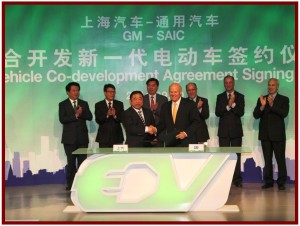
SAIC Motor Corp., Ltd. (SAIC) Chairman Hu Maoyuan and General Motors Co. (GM) Chairman and CEO Dan Akerson signed an agreement today in Shanghai for the co-development of a new electric vehicle architecture in China. Further details of the vehicles to be designed, developed and sold in China under the Shanghai GM and SAIC brands were not disclosed.
SAIC and GM will also use the new architecture to build electric vehicles around the globe for their own profits. Product details and timing will be announced at a later date. The electric vehicle architecture will be the first to be co-developed by the two companies, and as such is an important step by the Chinese to bring their auto industry competence up to world class levels. GM is the market leader in China, which is also GM’s single biggest market globally for auto sales.
The GM deal is the outgrowth of the latest Chinese industrial policy established roughly a year ago that required all western automakers to transfer the latest electric vehicle and other advanced technologies before the Communist party would approve further expansion of western companies in China.
“The policy is not written, but the pressure is real,” said auto analyst Mike Dunne in an interview with AutoInformed. “All the western automakers have the same story – GM, Volkswagen, Ford – all have now reluctantly agreed to do so as a condition of further market expansion,” according to Dunne, author of American Wheels Chinese Roads, who has spent his career in Asia and is fluent in Chinese, among other languages.
During a subsequent media conference call from Shanghai conducted by Steve Girsky, the GM Vice Chairman said that costs would be shared equally between the Chinese and GM. Girsky also expressed surprise (feigned or otherwise) at close media questioning about the transfer of GM’s intellectual property to China, one-third owned by U.S. taxpayers who saved GM from bankruptcy in 2009, as well as an ongoing controversy surrounding the importation of the Chevrolet Volt hybrid.
“We have done ten JVs with SAIC for almost 15 years,” Girsky said. He added – more than once during the call – that, “We (GM) make a lot of money here because we work with our partner to satisfy customers.”
The JVs involve vehicle and powertrain manufacturing, sales and aftermarket sales, automotive engineering and design, automotive finance and telematics, as well as the sale of used vehicles. The companies’ manufacturing joint ventures, Shanghai GM and SAIC-GM-Wuling, are market leaders in China. In addition, SAIC and GM operate a joint venture in India and SAIC is an investor in GM Korea Company. In Girsky’s view this is just another business deal.
“This is not the first time we are bringing intellectual property into China,” Girsky said. “We have seen no leakage of IP from SAIC,” he said when queried about SAIC’s other partner Volkswagen, which wants to use China to become the world’s largest automaker by 2018.
One of the customers Girsky didn’t specifically name is the Communist Party run government, which dictates the terms of business in China, including the requirement of joint ventures with Chinese manufacturers and cities to gain access to the world’s largest automarket.
Girsky did emphasize that neither SAIC nor the central government had asked GM to share the technology of the Chevrolet Volt hybrid, which will be imported into China later this year in small numbers. That could be because China does not see the hybrid Volt as the latest in automotive technology since it is a variation on the Prius developed more than a decade ago in Japan, and although it has a battery, it still uses a gasoline engine for most of its range.
Due to a combination of tariffs and incentives for locally-produced Chinese vehicles – at the core of China’s job creating industrial policy – the Michigan built Volt (more than $40,000 in the U.S. without government incentives) will be at about a $19,000 per hybrid disadvantage, not good news for UAW employees who build the Volt in Hamtramck.
SAIC and GM’s engineering and design joint venture in Shanghai – the Pan Asia Technical Automotive Center or PATAC – will serve as the home for the new architecture. Joint teams from the parent companies will also cooperate on the development of key components and vehicle structures.The majority of the jobs will be in China.
In a statement GM said that the agreement “will leverage SAIC’s market knowledge and local expertise along with GM’s expertise in electric vehicle development and global know-how. It will ensure local input in the development of electric vehicle technology and the delivery of products developed in China.”
“The co-development of this new electric vehicle architecture demonstrates the broad range of benefits made possible by the strong partnership between SAIC and GM,” said Tim Lee, president of GM International Operations in the statement. Lee was on the media call, but did not speak, as Girsky did all the talking in his less than polished, New York slangy manner.
“You guys are working me today,” Girsky said, who came across as a straight Wall Street money guy. To be fair GM is only one of many U.S. based corporations to use the mantra of free trade to move millions of manufacturing jobs offshore. He also admitted – perhaps with a touch of humor – he was having “trouble deciphering the media’s interpretation of GM’s interpretation” of the deal.
However, the globalization strategy is increasingly under attack as U.S. unemployment is projected by the hapless “no jobs” Obama Administration to remain above 9% for years to come as deficits soar. Even once staunch “free market” defenders, such as GE’s chairman Jeffry Immelt and head of Obama’s jobs council are having doubts as they observe the longer term negative results, which increasingly include GE’s dancing to a Chinese called tune.
Money making at the expense of U.S. jobs and the decline of the U.S. as the direct result of “globalization” will be key issues in the upcoming 2012 election. Economist Michael Spence, a Nobel Prize winner, in an article in Foreign Affairs said that of 27 million U.S. jobs created between 1990 and 2008, 98% were in the non-tradable sectors of the U.S. economy – notably in government and the health care industry.
Today’s agreement in China is a follow-up to a memorandum of understanding on strategic cooperation signed by SAIC and GM on 3 November 2010. At the time, the two automakers said they would reinforce their collaboration in certain core areas of their business, including the development of new energy vehicles and the creation of a stronger and more integrated role for PATAC to work on future vehicles and powertrains
See also:
- UAW Reaches Agreement with GM. Members Vote This Week
- GM Board Meets in China. New Investment Coming Tomorrow?
- Chinese Government Approves Two VW Joint Venture Plants
- Great Leap Forward! GM China Announces Five Year Plan to Double Sales by Introducing 60 New and Upgraded Models
- New-Vehicle Consideration Rates Shift to European Models in China, away from Japanese. Chevrolet and Buick Gaining
- Milestones: 20 Years of FAW-Volkswagen in China
- Johnson Controls to Build $100 Million Battery Plant in China