Click for more CALTY.
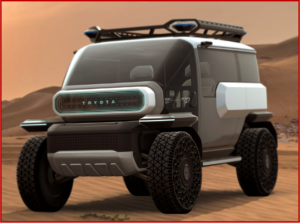
CALTY Design Research, the American base of Toyota’s global design network (NYSE:TM), marked five decades of creation today by revealing the Toyota Baby Lunar Cruiser. The BLC concept has so-called adaptive technology and heritage design cues from the original FJ40 Land Cruiser, CALTY said in a Newport Beach, CA.
“California was a youthful, vibrant epicenter of fresh ideas, a cool car culture, and the glamorous movie industry that inspired CALTY to create innovative designs and establish new trends,” said Kevin Hunter, president of CALTY Design Research.
The Toyota Baby Lunar Cruiser has in-wheel electric motors and is controlled by dual joysticks. Toyota notes that the BLC’s compact footprint and airless tires give it unparalleled maneuverability. It also has protruding glass canopy and a panoramic, augmented reality dashboard display.
Claimed heritage cues include a “TOYOTA” script grille up front, complete with a full array of cameras and lidar/radar sensors, and a split tailgate configuration in back. BLC draws inspiration from the real Lunar Cruiser being developed by the Japanese Aerospace Exploration Agency (JAXA) and Toyota.
Established in 1973 in El Segundo, California, CALTY was the idea of Dr. Shoichiro Toyoda and Eiji Toyoda. The new studio was deliberately kept quiet, allowing it to develop a unique identity and in theory provide fresh, creative inspiration to Toyota’s global design headquarters in Japan.
When CALTY decided to expand and relocate, it moved down the coast to Newport Beach in 1978, which was also the home of Road&Track magazine, another California original, and where I once was an editor. That same year, CALTY’s first production car design, the second-generation Celica, became a global success.
During the 1990s, CALTY had a major role in designing Toyota’s production vehicles for the North American market. Notable designs include the 1995 Tacoma, the 1997 Prius and the 2000 Avalon.
It also worked on designs that didn’t make production, notably the fourth generation Supra, or A80 as it was known internally. CALTY’s intent was to take the Supra in the direction of a “pure sports car,” rather than continue with the previous models’ Grand Touring character. They gave it a long hood and a linear bulge so the engine bay could accommodate a large inline-6 engine. The fourth generation Supra was introduced in 1993.
With the growth of production car development in North America, CALTY established a design studio in Ann Arbor, MI in 2004 which revolutionized local production design efforts, resulting in the creation of North American-specific models such as the Tundra, Tacoma, Avalon and Sienna.
“As we continue our journey from the automotive era into the mobility era, there is one thing I feel I can say for sure,” says Simon Humphries, Toyota Motor Corporation Chief Branding Officer and Head of Design. “CALTY will be there at the forefront.”
CALTY today is made up of a group of exterior and interior designers, CMF (Color, Material, Finish) designers, clay modelers, digital sculptors, visualization specialists, paint specialists, CAD/CAM specialists, a research/planning group, a PR/Multimedia team and administrative group.
As the automotive industry shifts toward an electrified future CALTY will continue with vehicles such as the 2021 Lexus Electrified Sport concept. “CALTY’s most recent production designs, the highly anticipated 2024 Land Cruiser and the 2024 Tacoma, showcase their commitment to moving forward and embracing new technology while still remaining authentic to the brand’s heritage DNA,” said CALTY.
AutoInformed on

About Ken Zino
Ken Zino, editor and publisher of AutoInformed, is a versatile auto industry participant with global experience spanning decades in print and broadcast journalism, as well as social media. He has automobile testing, marketing, public relations and communications experience. He is past president of The International Motor Press Assn, the Detroit Press Club, founding member and first President of the Automotive Press Assn. He is a member of APA, IMPA and the Midwest Automotive Press Assn.
He also brings an historical perspective while citing their contemporary relevance of the work of legendary auto writers such as Ken Purdy, Jim Dunne or Jerry Flint, or writers such as Red Smith, Mark Twain, Thomas Jefferson – all to bring perspective to a chaotic automotive universe.
Above all, decades after he first drove a car, Zino still revels in the sound of the exhaust as the throttle is blipped during a downshift and the driver’s rush that occurs when the entry, apex and exit points of a turn are smoothly and swiftly crossed. It’s the beginning of a perfect lap.
AutoInformed has an editorial philosophy that loves transportation machines of all kinds while promoting critical thinking about the future use of cars and trucks.
Zino builds AutoInformed from his background in automotive journalism starting at Hearst Publishing in New York City on Motor and MotorTech Magazines and car testing where he reviewed hundreds of vehicles in his decade-long stint as the Detroit Bureau Chief of Road & Track magazine. Zino has also worked in Europe, and Asia – now the largest automotive market in the world with China at its center.







CALTY Design Reveals Toyota Baby Lunar Cruiser
Click for more CALTY.
CALTY Design Research, the American base of Toyota’s global design network (NYSE:TM), marked five decades of creation today by revealing the Toyota Baby Lunar Cruiser. The BLC concept has so-called adaptive technology and heritage design cues from the original FJ40 Land Cruiser, CALTY said in a Newport Beach, CA.
“California was a youthful, vibrant epicenter of fresh ideas, a cool car culture, and the glamorous movie industry that inspired CALTY to create innovative designs and establish new trends,” said Kevin Hunter, president of CALTY Design Research.
The Toyota Baby Lunar Cruiser has in-wheel electric motors and is controlled by dual joysticks. Toyota notes that the BLC’s compact footprint and airless tires give it unparalleled maneuverability. It also has protruding glass canopy and a panoramic, augmented reality dashboard display.
Claimed heritage cues include a “TOYOTA” script grille up front, complete with a full array of cameras and lidar/radar sensors, and a split tailgate configuration in back. BLC draws inspiration from the real Lunar Cruiser being developed by the Japanese Aerospace Exploration Agency (JAXA) and Toyota.
Established in 1973 in El Segundo, California, CALTY was the idea of Dr. Shoichiro Toyoda and Eiji Toyoda. The new studio was deliberately kept quiet, allowing it to develop a unique identity and in theory provide fresh, creative inspiration to Toyota’s global design headquarters in Japan.
When CALTY decided to expand and relocate, it moved down the coast to Newport Beach in 1978, which was also the home of Road&Track magazine, another California original, and where I once was an editor. That same year, CALTY’s first production car design, the second-generation Celica, became a global success.
During the 1990s, CALTY had a major role in designing Toyota’s production vehicles for the North American market. Notable designs include the 1995 Tacoma, the 1997 Prius and the 2000 Avalon.
It also worked on designs that didn’t make production, notably the fourth generation Supra, or A80 as it was known internally. CALTY’s intent was to take the Supra in the direction of a “pure sports car,” rather than continue with the previous models’ Grand Touring character. They gave it a long hood and a linear bulge so the engine bay could accommodate a large inline-6 engine. The fourth generation Supra was introduced in 1993.
With the growth of production car development in North America, CALTY established a design studio in Ann Arbor, MI in 2004 which revolutionized local production design efforts, resulting in the creation of North American-specific models such as the Tundra, Tacoma, Avalon and Sienna.
“As we continue our journey from the automotive era into the mobility era, there is one thing I feel I can say for sure,” says Simon Humphries, Toyota Motor Corporation Chief Branding Officer and Head of Design. “CALTY will be there at the forefront.”
CALTY today is made up of a group of exterior and interior designers, CMF (Color, Material, Finish) designers, clay modelers, digital sculptors, visualization specialists, paint specialists, CAD/CAM specialists, a research/planning group, a PR/Multimedia team and administrative group.
As the automotive industry shifts toward an electrified future CALTY will continue with vehicles such as the 2021 Lexus Electrified Sport concept. “CALTY’s most recent production designs, the highly anticipated 2024 Land Cruiser and the 2024 Tacoma, showcase their commitment to moving forward and embracing new technology while still remaining authentic to the brand’s heritage DNA,” said CALTY.
AutoInformed on
About Ken Zino
Ken Zino, editor and publisher of AutoInformed, is a versatile auto industry participant with global experience spanning decades in print and broadcast journalism, as well as social media. He has automobile testing, marketing, public relations and communications experience. He is past president of The International Motor Press Assn, the Detroit Press Club, founding member and first President of the Automotive Press Assn. He is a member of APA, IMPA and the Midwest Automotive Press Assn. He also brings an historical perspective while citing their contemporary relevance of the work of legendary auto writers such as Ken Purdy, Jim Dunne or Jerry Flint, or writers such as Red Smith, Mark Twain, Thomas Jefferson – all to bring perspective to a chaotic automotive universe. Above all, decades after he first drove a car, Zino still revels in the sound of the exhaust as the throttle is blipped during a downshift and the driver’s rush that occurs when the entry, apex and exit points of a turn are smoothly and swiftly crossed. It’s the beginning of a perfect lap. AutoInformed has an editorial philosophy that loves transportation machines of all kinds while promoting critical thinking about the future use of cars and trucks. Zino builds AutoInformed from his background in automotive journalism starting at Hearst Publishing in New York City on Motor and MotorTech Magazines and car testing where he reviewed hundreds of vehicles in his decade-long stint as the Detroit Bureau Chief of Road & Track magazine. Zino has also worked in Europe, and Asia – now the largest automotive market in the world with China at its center.