Click for more IIHS data.
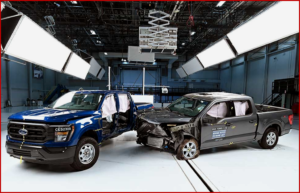
The Ram 1500 crew cab, Ford F-150 crew cab and Toyota Tundra crew cab, all 2023 models, earn good ratings in the Insurance Institute for Highway Safety’s updated side crash test, while the 2023 Chevrolet Silverado 1500 crew cab is rated acceptable, IIHS said today. However, in the updated moderate overlap front crash test, which now emphasizes back seat safety, only the Tundra manages a marginal rating. The F-150, Ram 1500 and Silverado are rated poor. (AutoInformed: IIHS Toughens Musts for Top Safety Pick Ratings)
“Like most other vehicle classes, large pickups don’t perform as well in the new moderate overlap evaluation as they do in the updated side test, which is now a requirement for our Top Safety Pick awards,” said IIHS President David Harkey.
IIHS launched the updated moderate overlap front test last year after research showed that in newer vehicles the risk of a fatal injury is now higher for belted occupants in the second row than for those in front. This is because the front seat has become safer with improved airbags and advanced seat belts that are rarely available in back. However, the back seat remains the safest place for children, who can be injured by an inflating front airbag, and the rating does not apply to children secured properly in child safety seats.
In the updated test, a second dummy is placed in the second row behind the driver. The driver dummy is the size of an average adult man. The rear dummy is the size of a small woman or 12-year-old child. IIHS researchers also developed new measurements focusing on the injuries most frequently seen in back seat passengers.
For a vehicle to earn a good rating, there can’t be an excessive risk of injury to the head, neck, chest or thigh, as recorded by the second-row dummy. The dummy should remain correctly positioned during the crash without “submarining,” which is sliding forward beneath the lap belt because this increases the risk of abdominal injuries. The head should also remain a safe distance from the front seatback and the rest of the vehicle interior, and the shoulder belt should remain on the shoulder, where it is most effective. A pressure sensor on the rear dummy’s torso is used to check the shoulder belt position during the crash.
As in the original overlap test, the structure of the occupant compartment must maintain adequate survival space for the driver, and measurements taken from the driver dummy shouldn’t show an excessive risk of injuries. All four pickups provided good protection in the front seat. But the restraint systems in the rear were inadequate.
“Submarining was a problem for all four pickups, and belt forces were too high in all but the Tundra,” Harkey said.
Measurements taken from the rear dummy show that chest injuries and head or neck injuries would be likely in the F-150 and Ram 1500. The risk of those injuries was somewhat lower but still excessive in the Silverado. For the Tundra, the risk of chest injuries was also too high due to poor belt positioning, but the risk of head or neck injuries was only slightly elevated.
The updated side test was introduced to address higher-speed crashes that are still causing fatalities, even in vehicles that excelled in the original evaluation. Like its predecessor, the updated test uses two dummies, a driver and a rear passenger. However, it uses a heavier barrier traveling at a higher speed to simulate the striking vehicle. The updated test replaced the original in the criteria for the TOP SAFETY PICK awards in 2023.
In this test, the good-rated F-150, Ram 1500 and Tundra provided solid protection in front and back, though the occupant compartment of the F-150 was compromised slightly by the impact. There was an elevated risk of chest injury to the rear passenger in the acceptable-rated Silverado.

About Ken Zino
Ken Zino, editor and publisher of AutoInformed, is a versatile auto industry participant with global experience spanning decades in print and broadcast journalism, as well as social media. He has automobile testing, marketing, public relations and communications experience. He is past president of The International Motor Press Assn, the Detroit Press Club, founding member and first President of the Automotive Press Assn. He is a member of APA, IMPA and the Midwest Automotive Press Assn.
He also brings an historical perspective while citing their contemporary relevance of the work of legendary auto writers such as Ken Purdy, Jim Dunne or Jerry Flint, or writers such as Red Smith, Mark Twain, Thomas Jefferson – all to bring perspective to a chaotic automotive universe.
Above all, decades after he first drove a car, Zino still revels in the sound of the exhaust as the throttle is blipped during a downshift and the driver’s rush that occurs when the entry, apex and exit points of a turn are smoothly and swiftly crossed. It’s the beginning of a perfect lap.
AutoInformed has an editorial philosophy that loves transportation machines of all kinds while promoting critical thinking about the future use of cars and trucks.
Zino builds AutoInformed from his background in automotive journalism starting at Hearst Publishing in New York City on Motor and MotorTech Magazines and car testing where he reviewed hundreds of vehicles in his decade-long stint as the Detroit Bureau Chief of Road & Track magazine. Zino has also worked in Europe, and Asia – now the largest automotive market in the world with China at its center.







Large Pickups Good in Side Impacts. Back Seat Safety Lacking
Click for more IIHS data.
The Ram 1500 crew cab, Ford F-150 crew cab and Toyota Tundra crew cab, all 2023 models, earn good ratings in the Insurance Institute for Highway Safety’s updated side crash test, while the 2023 Chevrolet Silverado 1500 crew cab is rated acceptable, IIHS said today. However, in the updated moderate overlap front crash test, which now emphasizes back seat safety, only the Tundra manages a marginal rating. The F-150, Ram 1500 and Silverado are rated poor. (AutoInformed: IIHS Toughens Musts for Top Safety Pick Ratings)
“Like most other vehicle classes, large pickups don’t perform as well in the new moderate overlap evaluation as they do in the updated side test, which is now a requirement for our Top Safety Pick awards,” said IIHS President David Harkey.
IIHS launched the updated moderate overlap front test last year after research showed that in newer vehicles the risk of a fatal injury is now higher for belted occupants in the second row than for those in front. This is because the front seat has become safer with improved airbags and advanced seat belts that are rarely available in back. However, the back seat remains the safest place for children, who can be injured by an inflating front airbag, and the rating does not apply to children secured properly in child safety seats.
In the updated test, a second dummy is placed in the second row behind the driver. The driver dummy is the size of an average adult man. The rear dummy is the size of a small woman or 12-year-old child. IIHS researchers also developed new measurements focusing on the injuries most frequently seen in back seat passengers.
For a vehicle to earn a good rating, there can’t be an excessive risk of injury to the head, neck, chest or thigh, as recorded by the second-row dummy. The dummy should remain correctly positioned during the crash without “submarining,” which is sliding forward beneath the lap belt because this increases the risk of abdominal injuries. The head should also remain a safe distance from the front seatback and the rest of the vehicle interior, and the shoulder belt should remain on the shoulder, where it is most effective. A pressure sensor on the rear dummy’s torso is used to check the shoulder belt position during the crash.
As in the original overlap test, the structure of the occupant compartment must maintain adequate survival space for the driver, and measurements taken from the driver dummy shouldn’t show an excessive risk of injuries. All four pickups provided good protection in the front seat. But the restraint systems in the rear were inadequate.
“Submarining was a problem for all four pickups, and belt forces were too high in all but the Tundra,” Harkey said.
Measurements taken from the rear dummy show that chest injuries and head or neck injuries would be likely in the F-150 and Ram 1500. The risk of those injuries was somewhat lower but still excessive in the Silverado. For the Tundra, the risk of chest injuries was also too high due to poor belt positioning, but the risk of head or neck injuries was only slightly elevated.
The updated side test was introduced to address higher-speed crashes that are still causing fatalities, even in vehicles that excelled in the original evaluation. Like its predecessor, the updated test uses two dummies, a driver and a rear passenger. However, it uses a heavier barrier traveling at a higher speed to simulate the striking vehicle. The updated test replaced the original in the criteria for the TOP SAFETY PICK awards in 2023.
In this test, the good-rated F-150, Ram 1500 and Tundra provided solid protection in front and back, though the occupant compartment of the F-150 was compromised slightly by the impact. There was an elevated risk of chest injury to the rear passenger in the acceptable-rated Silverado.
About Ken Zino
Ken Zino, editor and publisher of AutoInformed, is a versatile auto industry participant with global experience spanning decades in print and broadcast journalism, as well as social media. He has automobile testing, marketing, public relations and communications experience. He is past president of The International Motor Press Assn, the Detroit Press Club, founding member and first President of the Automotive Press Assn. He is a member of APA, IMPA and the Midwest Automotive Press Assn. He also brings an historical perspective while citing their contemporary relevance of the work of legendary auto writers such as Ken Purdy, Jim Dunne or Jerry Flint, or writers such as Red Smith, Mark Twain, Thomas Jefferson – all to bring perspective to a chaotic automotive universe. Above all, decades after he first drove a car, Zino still revels in the sound of the exhaust as the throttle is blipped during a downshift and the driver’s rush that occurs when the entry, apex and exit points of a turn are smoothly and swiftly crossed. It’s the beginning of a perfect lap. AutoInformed has an editorial philosophy that loves transportation machines of all kinds while promoting critical thinking about the future use of cars and trucks. Zino builds AutoInformed from his background in automotive journalism starting at Hearst Publishing in New York City on Motor and MotorTech Magazines and car testing where he reviewed hundreds of vehicles in his decade-long stint as the Detroit Bureau Chief of Road & Track magazine. Zino has also worked in Europe, and Asia – now the largest automotive market in the world with China at its center.