Click to enlarge.
Mainstream brand vehicles clearly now deliver many of the technologies, amenities and sensory details that once separated premium offerings from the rest of the market. It also allowed for premium pricing, which in some cases was often stratospheric. However, vehicle buyers are increasingly coming down to earth.*
“The result is a measurable migration. Premium owners are not necessarily leaving the new-vehicle market when trading in. Instead, many are simply choosing a different class of vehicle. Affordability is shaping what they buy rather than whether they buy. Younger, value-conscious, and some rural and suburban buyers are shifting away from premium vehicles toward well-equipped mainstream models, a trend driven by the appeal of strong features at non-premium prices,” said the estimable J.D. Power this week in its latest Automotive OEM Intelligence Report.**
“This Automotive OEM Intelligence Report analyzes detailed data behind this spectacle to explain which premium owners are likely to defect, what are their destination segments and why the traditional premium proposition is losing its accustomed edge,” said Power.
This coincides with the Manheim Used Vehicle Value Index: July 2026 Trends report from Cox Automotive this week: “The bigger picture is still affordability. Compact cars remain the strongest performer year over year, and the softness we’d confined to SUVs and pickups has spread into midsize cars too. Off-lease maturities kept building. These are a healthy source for dealers’ late-model inventory, but also adding to the depreciation pressure we’re watching into the fall,” said Jonathan Gregory, Senior Director, Cox.
The Power Points, so to speak…
“Premium vehicles, excluding direct-to-consumer brands, accounted for 13.3% of new-vehicle sales for the first half of 2026, down from 13.8% during the same period last year, the lowest premium vehicle market share since 2020.
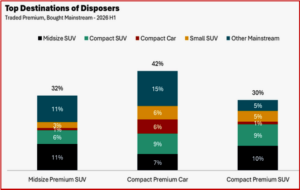
- “The clearest evidence of the shift appears in the SUV segments. During the first half of 2026, 32% of consumers trading a mid-size premium SUV purchased a non-luxury brand. This is a significant trend to watch because midsized premium SUVs are currently the top selling premium market segment. Mainstream mid-size SUVs were the leading destination, accounting for 11% of those transactions, while 6% moved into compact SUVs.
Similar pattern Among Compact Premium SUV Owners
“Thirty percent moved to mainstream brands, including 10% who selected a mid-size SUV and 9% who purchased a compact SUV.
- “The shift was even more pronounced among compact premium car disposers: 42% chose a mainstream vehicle, with buyers spreading across compact SUVs, mid-size SUVs, compact cars, small SUVs and other mainstream segments,” said Power.
The Chinese are Concerning and Coming?
“The destination segment matters. Premium customers are not abandoning utility, comfort or technology. Quite the contrary, they are finding those qualities in mainstream crossovers that have become increasingly sophisticated, without requiring the price premium associated with a luxury badge.
- “Also, contrary to conventional wisdom, pickup trucks have not seen a notable trend in defection among premium segment customers. The percentage of consumers who traded any premium segment for large pickup light duty remained flat at 2.6%, the same rate it has been since 2024, although defectors to mid-size pickup have increased by half a percentage point to 1.8%,” said Power.
J.D. Power Concludes that Premium Brands Need a New Reason for Being
“Premium brands are being squeezed from several directions. First, they must compete with mainstream products that increasingly match them in technology, design, convenience and perceived quality. And they must serve an array of buyers who want gasoline vehicles, hybrids or EVs, rather than having the luxury of concentrating on a single powertrain. Premium brands also face more global challenges than mainstream brands. These include a faster transition to EVs in many significant markets, as well as greater exposure to tariffs on non-U.S.-assembled vehicles, which has disproportionally tilted the premium vehicle mix toward higher-priced EVs. As a whole, premium brands are facing challenges from many fronts that make it difficult to compete as effectively in the U.S. market.
“The traditional premium formula must expand beyond richer materials, more equipment and perceived brand prestige. The product needs to be demonstrably better, but so do the shopping, delivery, service and ownership experiences. A premium dealership must give consumers a reason to visit, and the brand must explain why its vehicle is worth the additional money when the less expensive alternative offers comparable screens, safety technology, and comfort features.
“The over-arching message is clear: the affordability issue is not eliminating demand; it is redirecting it. Mainstream brands are gaining because their vehicles now satisfy practical, technological and emotional expectations that were once closely associated with luxury products,” said Power.
*AutoInformed on
**The Automotive OEM Intelligence Report is based on insights gathered from JD Power intelligence, proprietary market data, findings from the JD Power 2026 APEAL Study and PIN+ Demographics utilizing TransUnion’s TruAudience Consumer Insights. It was authored by Tyson Jominy, senior vice president of OEM customer success, and Srini Rajagopalan, vice president of OEM customer success at JD Power.
*** JD Power defines generational groups as:
- Pre-Boomers (born before 1946).
- Boomers (1946-1964).
- Gen X (1965-1976).
- Gen Y (1977-1994) Millennials (1982-1994) are subset of Gen Y.
- Gen Z (1995-2008).

About Ken Zino
Ken Zino, editor and publisher of AutoInformed, is a versatile auto industry participant with global experience spanning decades in print and broadcast journalism, as well as social media. He has automobile testing, marketing, public relations and communications experience. He is past president of The International Motor Press Assn, the Detroit Press Club, founding member and first President of the Automotive Press Assn. He is a member of APA, IMPA and the Midwest Automotive Press Assn.
He also brings an historical perspective while citing their contemporary relevance of the work of legendary auto writers such as Ken Purdy, Jim Dunne or Jerry Flint, or writers such as Red Smith, Mark Twain, Thomas Jefferson – all to bring perspective to a chaotic automotive universe.
Above all, decades after he first drove a car, Zino still revels in the sound of the exhaust as the throttle is blipped during a downshift and the driver’s rush that occurs when the entry, apex and exit points of a turn are smoothly and swiftly crossed. It’s the beginning of a perfect lap.
AutoInformed has an editorial philosophy that loves transportation machines of all kinds while promoting critical thinking about the future use of cars and trucks.
Zino builds AutoInformed from his background in automotive journalism starting at Hearst Publishing in New York City on Motor and MotorTech Magazines and car testing where he reviewed hundreds of vehicles in his decade-long stint as the Detroit Bureau Chief of Road & Track magazine. Zino has also worked in Europe, and Asia – now the largest automotive market in the world with China at its center.







Premium Vehicle Buyers Defecting to Mainstream Brands!
Click to enlarge.
Mainstream brand vehicles clearly now deliver many of the technologies, amenities and sensory details that once separated premium offerings from the rest of the market. It also allowed for premium pricing, which in some cases was often stratospheric. However, vehicle buyers are increasingly coming down to earth.*
“The result is a measurable migration. Premium owners are not necessarily leaving the new-vehicle market when trading in. Instead, many are simply choosing a different class of vehicle. Affordability is shaping what they buy rather than whether they buy. Younger, value-conscious, and some rural and suburban buyers are shifting away from premium vehicles toward well-equipped mainstream models, a trend driven by the appeal of strong features at non-premium prices,” said the estimable J.D. Power this week in its latest Automotive OEM Intelligence Report.**
“This Automotive OEM Intelligence Report analyzes detailed data behind this spectacle to explain which premium owners are likely to defect, what are their destination segments and why the traditional premium proposition is losing its accustomed edge,” said Power.
This coincides with the Manheim Used Vehicle Value Index: July 2026 Trends report from Cox Automotive this week: “The bigger picture is still affordability. Compact cars remain the strongest performer year over year, and the softness we’d confined to SUVs and pickups has spread into midsize cars too. Off-lease maturities kept building. These are a healthy source for dealers’ late-model inventory, but also adding to the depreciation pressure we’re watching into the fall,” said Jonathan Gregory, Senior Director, Cox.
The Power Points, so to speak…
“Premium vehicles, excluding direct-to-consumer brands, accounted for 13.3% of new-vehicle sales for the first half of 2026, down from 13.8% during the same period last year, the lowest premium vehicle market share since 2020.
Similar pattern Among Compact Premium SUV Owners
“Thirty percent moved to mainstream brands, including 10% who selected a mid-size SUV and 9% who purchased a compact SUV.
The Chinese are Concerning and Coming?
“The destination segment matters. Premium customers are not abandoning utility, comfort or technology. Quite the contrary, they are finding those qualities in mainstream crossovers that have become increasingly sophisticated, without requiring the price premium associated with a luxury badge.
J.D. Power Concludes that Premium Brands Need a New Reason for Being
“Premium brands are being squeezed from several directions. First, they must compete with mainstream products that increasingly match them in technology, design, convenience and perceived quality. And they must serve an array of buyers who want gasoline vehicles, hybrids or EVs, rather than having the luxury of concentrating on a single powertrain. Premium brands also face more global challenges than mainstream brands. These include a faster transition to EVs in many significant markets, as well as greater exposure to tariffs on non-U.S.-assembled vehicles, which has disproportionally tilted the premium vehicle mix toward higher-priced EVs. As a whole, premium brands are facing challenges from many fronts that make it difficult to compete as effectively in the U.S. market.
“The traditional premium formula must expand beyond richer materials, more equipment and perceived brand prestige. The product needs to be demonstrably better, but so do the shopping, delivery, service and ownership experiences. A premium dealership must give consumers a reason to visit, and the brand must explain why its vehicle is worth the additional money when the less expensive alternative offers comparable screens, safety technology, and comfort features.
“The over-arching message is clear: the affordability issue is not eliminating demand; it is redirecting it. Mainstream brands are gaining because their vehicles now satisfy practical, technological and emotional expectations that were once closely associated with luxury products,” said Power.
*AutoInformed on
**The Automotive OEM Intelligence Report is based on insights gathered from JD Power intelligence, proprietary market data, findings from the JD Power 2026 APEAL Study and PIN+ Demographics utilizing TransUnion’s TruAudience Consumer Insights. It was authored by Tyson Jominy, senior vice president of OEM customer success, and Srini Rajagopalan, vice president of OEM customer success at JD Power.
*** JD Power defines generational groups as:
About Ken Zino
Ken Zino, editor and publisher of AutoInformed, is a versatile auto industry participant with global experience spanning decades in print and broadcast journalism, as well as social media. He has automobile testing, marketing, public relations and communications experience. He is past president of The International Motor Press Assn, the Detroit Press Club, founding member and first President of the Automotive Press Assn. He is a member of APA, IMPA and the Midwest Automotive Press Assn. He also brings an historical perspective while citing their contemporary relevance of the work of legendary auto writers such as Ken Purdy, Jim Dunne or Jerry Flint, or writers such as Red Smith, Mark Twain, Thomas Jefferson – all to bring perspective to a chaotic automotive universe. Above all, decades after he first drove a car, Zino still revels in the sound of the exhaust as the throttle is blipped during a downshift and the driver’s rush that occurs when the entry, apex and exit points of a turn are smoothly and swiftly crossed. It’s the beginning of a perfect lap. AutoInformed has an editorial philosophy that loves transportation machines of all kinds while promoting critical thinking about the future use of cars and trucks. Zino builds AutoInformed from his background in automotive journalism starting at Hearst Publishing in New York City on Motor and MotorTech Magazines and car testing where he reviewed hundreds of vehicles in his decade-long stint as the Detroit Bureau Chief of Road & Track magazine. Zino has also worked in Europe, and Asia – now the largest automotive market in the world with China at its center.