Cutting the total cost of ownership could boost the transition to zero-emission truck fleets. A new study released by the respected McKinsey & Company consultancy observes that the total cost of ownership (TCO) for ZEVs remains significantly higher than that of internal combustion engine (ICE) vehicles. The TCO gap ranges between 30% and 50% compared to ICE vehicles running on dirtier diesel fuel.
“Trucking is a significant source of emissions. Given that transportation is the second-largest source of greenhouse gas emissions in the United States, with medium- and heavy-duty trucks accounting for about a quarter of these, transitioning fleets to zero-emission vehicles (ZEVs) has emerged as an urgent priority. [footnote 1] McKinsey’s recent survey of more than 200 US trucking fleets found that while two-thirds are committed to decarbonization and over half are piloting ZEVs, fewer than 10% see a viable path to scaling the use of ZEVs. [2] Adoption currently sits at a few thousand units per year, and even with decarbonization targets, there is uncertainty around scalable and timely zero-emission truck adoption,” McKinsey said.
McKinsey posits that there are three areas for potential action.
“Closing the TCO gap could be essential to unlocking ZEV adoption at scale. Even with the significant structural challenges, there are many opportunities for fleet operators, OEMs, and ecosystem partners to act now, collectively, and pave the path to a zero-emissions future at TCO parity.
Three Areas For Potential Action
- Truck OEMs could take steps to incrementally reduce product costs and deliver their offerings in the US market at scale – which, in turn, could unlock opportunities to compete effectively with their global counterparts.
- Fleet operators can consider evolving their ZEV adoption approach from plug-and-play to operations tailored toward optimizing the unique capabilities ZEV assets can deliver compared to ICE vehicles.
- Service providers, beyond OEMs and fleet operators, play an important role in reinforcing an ecosystem that supports zero-emission truck adoption at scale. This may include supplying the required charging or fuel infrastructure along freight corridors and developing innovative financing offerings.
Click to enlarge.
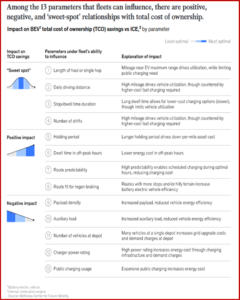
“Achieving TCO parity is a pivotal enabler for the ZEV transition, but most fleets struggle to achieve it today. TCO parity exists for light vehicles like vans, but for heavy-duty trucking, TCO is 50% higher in many cases. [7] The hurdles to TCO parity differ across truck archetypes and use cases.
“For example, local distributors run routes that, on the surface, seem perfect for electrification-low daily mileage, predictable routes, light payloads, and vehicles that return to the same depot each night. However, these operators don’t turn the vehicles frequently enough to amortize the higher zero-emission truck costs. To recoup the up-front ZEV costs and approach TCO parity, local distributors may need to increase utilization and raise daily mileage.
“Conversely, long-haul full truckload (FTL) networks have multishift operations with high utilization at over 500 miles per day. Yet, their schedules are less predictable, and the time available to charge is limited. FTL fleets’ high payload density also requires large batteries or hydrogen tanks supported by infrastructure built out across freight corridors. Reliance on public fast-charging stations, often during peak electricity rate periods, adds unpredictability and erases much of the variable cost advantages of battery electric vehicle (BEV) trucks compared to ICE trucks. Beyond lower up-front vehicle costs, a path to parity may require FTL fleets to tailor schedules to allow for charging in off-peak times and to form partnerships to develop electrified freight corridors and reduce on-route charging costs.
Truck OEMs: Step change cost reductions for at-scale economics
“For fleet operators aiming for TCO parity, the up-front vehicle price tag is a recurring obstacle. [8] In the United States today, BEV trucks can cost between 50% and 250% more than ICE alternatives. [9] While there could be opportunities for savings outside of the asset – fuel and maintenance, for example – these are less predictable. Trucking fleet owners are having to reckon with higher up-front asset costs against the uncertain anticipation of lower operational costs and residual value of ZEV assets in the future,” said Dilip Bhattacharjee and Moritz Rittstieg with Cross Pagano and Saral Chauhan.
(Dilip Bhattacharjee and Moritz Rittstieg are partners in McKinsey’s Chicago office, where Cross Pagano is a consultant; and Saral Chauhan is a consultant in the Detroit office. The authors wish to thank Disha Mendhekar, Neeraj Gole, and Nick Inchaustegui for their contributions to this article, Courtesy of and Copyright McKinsey & Company all rights reserved – AutoCrat)
The Inevitable, but Exhaustive McKinsey Footnotes
- “Sources of greenhouse gas emissions,” United States Environmental Protection Agency (EPA), accessed January 16, 2025; “Fast facts on transportation greenhouse gas emissions,” EPA, accessed June 18, 2024.
- McKinsey Fleet Decarbonization Survey (n = 264 respondents), distributed in August 2022 across fleet operators in Germany, the United Kingdom, and the United States.
- “The bumpy road to zero-emission trucks,” McKinsey, September 13, 2024.
- 4 McKinsey’s Fleet Decarbonization Optimizer Tool (2024), based on real-world EV fleet plans and deployments.
- The bumpy road to zero-emission trucks,” McKinsey, September 13, 2024.
- For more on the transition, see “Preparing the world for zero-emission trucks,” McKinsey, November 17, 2022.
- “Charged logistics: The cost of electric vehicle conversion for U.S. commercial fleets,” Ryder, May 2024.

About Ken Zino
Ken Zino, editor and publisher of AutoInformed, is a versatile auto industry participant with global experience spanning decades in print and broadcast journalism, as well as social media. He has automobile testing, marketing, public relations and communications experience. He is past president of The International Motor Press Assn, the Detroit Press Club, founding member and first President of the Automotive Press Assn. He is a member of APA, IMPA and the Midwest Automotive Press Assn.
He also brings an historical perspective while citing their contemporary relevance of the work of legendary auto writers such as Ken Purdy, Jim Dunne or Jerry Flint, or writers such as Red Smith, Mark Twain, Thomas Jefferson – all to bring perspective to a chaotic automotive universe.
Above all, decades after he first drove a car, Zino still revels in the sound of the exhaust as the throttle is blipped during a downshift and the driver’s rush that occurs when the entry, apex and exit points of a turn are smoothly and swiftly crossed. It’s the beginning of a perfect lap.
AutoInformed has an editorial philosophy that loves transportation machines of all kinds while promoting critical thinking about the future use of cars and trucks.
Zino builds AutoInformed from his background in automotive journalism starting at Hearst Publishing in New York City on Motor and MotorTech Magazines and car testing where he reviewed hundreds of vehicles in his decade-long stint as the Detroit Bureau Chief of Road & Track magazine. Zino has also worked in Europe, and Asia – now the largest automotive market in the world with China at its center.







ZEV Truck Adoption Stalled by Costs
Cutting the total cost of ownership could boost the transition to zero-emission truck fleets. A new study released by the respected McKinsey & Company consultancy observes that the total cost of ownership (TCO) for ZEVs remains significantly higher than that of internal combustion engine (ICE) vehicles. The TCO gap ranges between 30% and 50% compared to ICE vehicles running on dirtier diesel fuel.
“Trucking is a significant source of emissions. Given that transportation is the second-largest source of greenhouse gas emissions in the United States, with medium- and heavy-duty trucks accounting for about a quarter of these, transitioning fleets to zero-emission vehicles (ZEVs) has emerged as an urgent priority. [footnote 1] McKinsey’s recent survey of more than 200 US trucking fleets found that while two-thirds are committed to decarbonization and over half are piloting ZEVs, fewer than 10% see a viable path to scaling the use of ZEVs. [2] Adoption currently sits at a few thousand units per year, and even with decarbonization targets, there is uncertainty around scalable and timely zero-emission truck adoption,” McKinsey said.
McKinsey posits that there are three areas for potential action.
“Closing the TCO gap could be essential to unlocking ZEV adoption at scale. Even with the significant structural challenges, there are many opportunities for fleet operators, OEMs, and ecosystem partners to act now, collectively, and pave the path to a zero-emissions future at TCO parity.
Three Areas For Potential Action
Click to enlarge.
“Achieving TCO parity is a pivotal enabler for the ZEV transition, but most fleets struggle to achieve it today. TCO parity exists for light vehicles like vans, but for heavy-duty trucking, TCO is 50% higher in many cases. [7] The hurdles to TCO parity differ across truck archetypes and use cases.
“For example, local distributors run routes that, on the surface, seem perfect for electrification-low daily mileage, predictable routes, light payloads, and vehicles that return to the same depot each night. However, these operators don’t turn the vehicles frequently enough to amortize the higher zero-emission truck costs. To recoup the up-front ZEV costs and approach TCO parity, local distributors may need to increase utilization and raise daily mileage.
“Conversely, long-haul full truckload (FTL) networks have multishift operations with high utilization at over 500 miles per day. Yet, their schedules are less predictable, and the time available to charge is limited. FTL fleets’ high payload density also requires large batteries or hydrogen tanks supported by infrastructure built out across freight corridors. Reliance on public fast-charging stations, often during peak electricity rate periods, adds unpredictability and erases much of the variable cost advantages of battery electric vehicle (BEV) trucks compared to ICE trucks. Beyond lower up-front vehicle costs, a path to parity may require FTL fleets to tailor schedules to allow for charging in off-peak times and to form partnerships to develop electrified freight corridors and reduce on-route charging costs.
Truck OEMs: Step change cost reductions for at-scale economics
“For fleet operators aiming for TCO parity, the up-front vehicle price tag is a recurring obstacle. [8] In the United States today, BEV trucks can cost between 50% and 250% more than ICE alternatives. [9] While there could be opportunities for savings outside of the asset – fuel and maintenance, for example – these are less predictable. Trucking fleet owners are having to reckon with higher up-front asset costs against the uncertain anticipation of lower operational costs and residual value of ZEV assets in the future,” said Dilip Bhattacharjee and Moritz Rittstieg with Cross Pagano and Saral Chauhan.
(Dilip Bhattacharjee and Moritz Rittstieg are partners in McKinsey’s Chicago office, where Cross Pagano is a consultant; and Saral Chauhan is a consultant in the Detroit office. The authors wish to thank Disha Mendhekar, Neeraj Gole, and Nick Inchaustegui for their contributions to this article, Courtesy of and Copyright McKinsey & Company all rights reserved – AutoCrat)
The Inevitable, but Exhaustive McKinsey Footnotes
About Ken Zino
Ken Zino, editor and publisher of AutoInformed, is a versatile auto industry participant with global experience spanning decades in print and broadcast journalism, as well as social media. He has automobile testing, marketing, public relations and communications experience. He is past president of The International Motor Press Assn, the Detroit Press Club, founding member and first President of the Automotive Press Assn. He is a member of APA, IMPA and the Midwest Automotive Press Assn. He also brings an historical perspective while citing their contemporary relevance of the work of legendary auto writers such as Ken Purdy, Jim Dunne or Jerry Flint, or writers such as Red Smith, Mark Twain, Thomas Jefferson – all to bring perspective to a chaotic automotive universe. Above all, decades after he first drove a car, Zino still revels in the sound of the exhaust as the throttle is blipped during a downshift and the driver’s rush that occurs when the entry, apex and exit points of a turn are smoothly and swiftly crossed. It’s the beginning of a perfect lap. AutoInformed has an editorial philosophy that loves transportation machines of all kinds while promoting critical thinking about the future use of cars and trucks. Zino builds AutoInformed from his background in automotive journalism starting at Hearst Publishing in New York City on Motor and MotorTech Magazines and car testing where he reviewed hundreds of vehicles in his decade-long stint as the Detroit Bureau Chief of Road & Track magazine. Zino has also worked in Europe, and Asia – now the largest automotive market in the world with China at its center.