Click to enlarge.
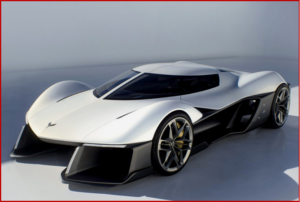
The algorithmic-driven world of electronic media is taking over traditional automotive marketing communications. In the latest example, General Motors (NYSE:GM) used the opening of a new UK advanced design studio to show a concept of what a future concept of the next generation C9 Corvette might look like.* The publicity ploy involves multiple studios that will see additional Corvette concepts revealed throughout 2025. Concepts of what could ultimately be a concept of what could be a production hypercar. In short, concepts, almost ad infinitum.
“Our advanced design team’s mandate extends well beyond creating production vehicles,” said Michael Simcoe, senior VP of global design. “While they collaborate within our global design network on production and concept vehicle programs, these teams are primarily tasked with imagining what mobility could look like five, 10, and even 20 years into the future and driving innovation for GM.”
Click for more.
The UK design studio is part of GM’s global design network. It is supposed to provide insights into European customer and cultural trends while introducing new talent and fresh perspectives into GM. GM’s global design studios exist in Detroit, Los Angeles, Shanghai, and Seoul.
The UK studio is led by Julian Thomson, an experienced automotive designer with Jaguar and Lotus designs, among others, in his background. The 24,584-square-foot Royal Leamington Spa studio, employs more than 30 designers and creative team members, is outfitted for both digital and physical clay model development.
“As part of the Corvette creative study, we asked multiple studios to develop hypercar concepts, which we’ll see more of later this year,” Simcoe said. “It was important that they all pay homage to Corvette’s historic DNA, but each studio brought their own unique creative interpretation to the project. That is exactly what our advanced design studio network is intended to do – push the envelope, challenge convention and imagine what could be.”
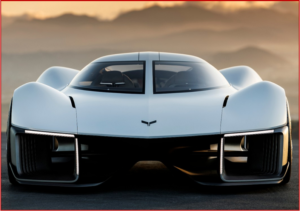
The UK team’s concept uses Corvette’s design heritage (don’t all concepts do this? – AutoCrat) into a futuristic aesthetic focused here on clean forms and muscular shapes. The design is said to draw inspiration from the aviation industry in the sculptural and functional elements.
“One of the most unusual and significant aspects of our concept’s design is a feature known as Apex Vision,” said Thomson. “A nod to Corvette’s centerline focus, and inspired by the iconic ‘split window’ 1963 Chevrolet Corvette Sting Ray, this feature emphasizes a singular vertical central spine that is also a structural element, also providing a panoramic view of the road and surroundings.”
C9 Concept Technical Details
Body structure:
- Additive manufacturing body structure
- For low mass, manufacturing efficiency, part count reduction and driving agility
- Halo roof structure with wind shield center spar
Body panels:
- Additive manufactured structure exposed for light weight authenticity
- Part integration, panel count reduction
Closures:
- Full wrap around side glass to deliver Apex Vision
- Powered wing door design
Aero-Duality:
- On-road efficiency and on-track performance in harmony
- Fan assistance and active ducting to redirect air over and through the vehicle
- On-road: flowing forms, functional intakes and vented surfaces
- On road: air directed through vehicles to fill its wake, increasing efficiency and range
- On track: like an aircraft wing, aero surfaces reconfigure, dorsal fins deploy and spoiler venting creates aero vectoring to enhance cornering performance
- Sculpted underbody, lowered ride height and fan assistance delivers ground effect
Chassis
- Racecar inspired, package efficient, pushrod suspension set-up.
Interface
- Windshield center spar augmented display.
Dimensions
- 1033mm tall / 2178mm width / 4669mm length.
- 22inch front wheel / 23inch rear wheel.
- 127mm seat height – race car inspired.
AutoInformed on

About Ken Zino
Ken Zino, editor and publisher of AutoInformed, is a versatile auto industry participant with global experience spanning decades in print and broadcast journalism, as well as social media. He has automobile testing, marketing, public relations and communications experience. He is past president of The International Motor Press Assn, the Detroit Press Club, founding member and first President of the Automotive Press Assn. He is a member of APA, IMPA and the Midwest Automotive Press Assn.
He also brings an historical perspective while citing their contemporary relevance of the work of legendary auto writers such as Ken Purdy, Jim Dunne or Jerry Flint, or writers such as Red Smith, Mark Twain, Thomas Jefferson – all to bring perspective to a chaotic automotive universe.
Above all, decades after he first drove a car, Zino still revels in the sound of the exhaust as the throttle is blipped during a downshift and the driver’s rush that occurs when the entry, apex and exit points of a turn are smoothly and swiftly crossed. It’s the beginning of a perfect lap.
AutoInformed has an editorial philosophy that loves transportation machines of all kinds while promoting critical thinking about the future use of cars and trucks.
Zino builds AutoInformed from his background in automotive journalism starting at Hearst Publishing in New York City on Motor and MotorTech Magazines and car testing where he reviewed hundreds of vehicles in his decade-long stint as the Detroit Bureau Chief of Road & Track magazine. Zino has also worked in Europe, and Asia – now the largest automotive market in the world with China at its center.








Concepts of What Could be a C9 Corvette Concept?
Click to enlarge.
The algorithmic-driven world of electronic media is taking over traditional automotive marketing communications. In the latest example, General Motors (NYSE:GM) used the opening of a new UK advanced design studio to show a concept of what a future concept of the next generation C9 Corvette might look like.* The publicity ploy involves multiple studios that will see additional Corvette concepts revealed throughout 2025. Concepts of what could ultimately be a concept of what could be a production hypercar. In short, concepts, almost ad infinitum.
“Our advanced design team’s mandate extends well beyond creating production vehicles,” said Michael Simcoe, senior VP of global design. “While they collaborate within our global design network on production and concept vehicle programs, these teams are primarily tasked with imagining what mobility could look like five, 10, and even 20 years into the future and driving innovation for GM.”
Click for more.
The UK design studio is part of GM’s global design network. It is supposed to provide insights into European customer and cultural trends while introducing new talent and fresh perspectives into GM. GM’s global design studios exist in Detroit, Los Angeles, Shanghai, and Seoul.
The UK studio is led by Julian Thomson, an experienced automotive designer with Jaguar and Lotus designs, among others, in his background. The 24,584-square-foot Royal Leamington Spa studio, employs more than 30 designers and creative team members, is outfitted for both digital and physical clay model development.
“As part of the Corvette creative study, we asked multiple studios to develop hypercar concepts, which we’ll see more of later this year,” Simcoe said. “It was important that they all pay homage to Corvette’s historic DNA, but each studio brought their own unique creative interpretation to the project. That is exactly what our advanced design studio network is intended to do – push the envelope, challenge convention and imagine what could be.”
The UK team’s concept uses Corvette’s design heritage (don’t all concepts do this? – AutoCrat) into a futuristic aesthetic focused here on clean forms and muscular shapes. The design is said to draw inspiration from the aviation industry in the sculptural and functional elements.
“One of the most unusual and significant aspects of our concept’s design is a feature known as Apex Vision,” said Thomson. “A nod to Corvette’s centerline focus, and inspired by the iconic ‘split window’ 1963 Chevrolet Corvette Sting Ray, this feature emphasizes a singular vertical central spine that is also a structural element, also providing a panoramic view of the road and surroundings.”
C9 Concept Technical Details
Body structure:
Body panels:
Closures:
Aero-Duality:
Chassis
Interface
Dimensions
AutoInformed on
About Ken Zino
Ken Zino, editor and publisher of AutoInformed, is a versatile auto industry participant with global experience spanning decades in print and broadcast journalism, as well as social media. He has automobile testing, marketing, public relations and communications experience. He is past president of The International Motor Press Assn, the Detroit Press Club, founding member and first President of the Automotive Press Assn. He is a member of APA, IMPA and the Midwest Automotive Press Assn. He also brings an historical perspective while citing their contemporary relevance of the work of legendary auto writers such as Ken Purdy, Jim Dunne or Jerry Flint, or writers such as Red Smith, Mark Twain, Thomas Jefferson – all to bring perspective to a chaotic automotive universe. Above all, decades after he first drove a car, Zino still revels in the sound of the exhaust as the throttle is blipped during a downshift and the driver’s rush that occurs when the entry, apex and exit points of a turn are smoothly and swiftly crossed. It’s the beginning of a perfect lap. AutoInformed has an editorial philosophy that loves transportation machines of all kinds while promoting critical thinking about the future use of cars and trucks. Zino builds AutoInformed from his background in automotive journalism starting at Hearst Publishing in New York City on Motor and MotorTech Magazines and car testing where he reviewed hundreds of vehicles in his decade-long stint as the Detroit Bureau Chief of Road & Track magazine. Zino has also worked in Europe, and Asia – now the largest automotive market in the world with China at its center.