Click to enlarge.
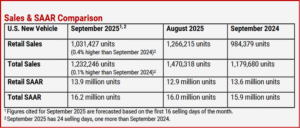
Total U.S. new-vehicle sales for September 2025, including retail and non-retail transactions, are projected to reach 1,232,200, a 0.1% increase year over year, according to a joint forecast from J.D. Power and GlobalData released today. September 2025 has 24 selling days, one more than September 2024. Comparing the same sales volume without adjusting for the number of selling days translates to an increase of 4.5% from 2024.*
“In aggregate, September sales results point to another month of strong demand for new vehicles. However, as has been the case for the past few months, assessing the health of the industry requires a closer look at the underlying market dynamics,” said Thomas King, president of the data and analytics division at J.D. Power.
September U.S. Sales Forecast at a Glance
- Fleet sales are expected to total 200,819 units in September, down 1.5% from September 2024. Fleet volume is expected to account for 16.3% of total light-vehicle sales, down 0.3 percentage points from a year ago.
- Internal combustion engine (ICE) vehicles are projected to account for 71.7% of new-vehicle retail sales, a decrease of 4.9 percentage points from a year ago. Plug-in hybrid vehicles (PHEV) are on pace to make up 2.6% of sales, up 0.5 percentage points from September 2024, while electric vehicles (EV) are expected to account for 12.2% of sales, up 2.6 percentage points, and hybrid electric vehicles (HEV) are expected to account for 12.4% of new-vehicle retail sales, up 0.7 percentage points.
- U.S. final assembly vehicles are expected to make up 55.0% of sales in September, up 4.1 percentage points from a year ago.
- Trucks/SUVs are on pace to account for 82.1% of new-vehicle retail sales, up 1.6 percentage points from September 2024.
- Retail inventory levels are currently at 2.21 million units, a 17.5% increase from September 2024.
- The industry’s inventory days of supply is 60 days in September, up from 54 days a year ago.
- The average new-vehicle retail transaction price in September is expected to reach $45,795,up $1,310 from September 2024. Transaction price as a percentage of MSRP fell to 89.2%, down 0.5 percentage points from a year ago.
- Retail buyers are on pace to spend $45.0 billion on new vehicles, up $3.5 billion from September 2024.
- Average incentive spending per unit in September is expected to reach $3,116, down $3 from September 2024. Incentive spending as a percentage of the average MSRP is expected to decrease to 6.1%, down 0.2 percentage points from September 2024.
- Average incentive spending per unit on trucks/SUVs in September is expected to be $3,244, down $54 from a year ago, while the average spending on cars is expected to be $2,492, up $167 from a year ago.
- Leasing is expected to account for 23.9% of sales this month, up 0.6 percentage points from a year ago.
- The average time a new vehicle remains in the dealer’s possession before sale is expected to be 50 days in September, up from 49 days a year ago.
- 8% of vehicles sold in less than 10 days in September, down 1.5 percentage points from a year ago.
- Average monthly finance payments are on pace to be $756, up $21 from September 2024. The average interest rate for new-vehicle loans is expected to be 6.51%, down 0.25 percentage points from a year ago.
- So far in September, average used-vehicle retail prices are $29,668, up $739 from a year ago. Trade-in equity is trending towards $8,430, which is up $534 from a year ago.
- 9% of trade-ins are expected to carry negative equity this month—an increase of 1.5 percentage points from September 2024.
- Finance loans with terms greater than or equal to 84 months are expected to reach 11.0% of finance sales this month, up 1.5 percentage points from September 2024.
The U.S. Retail Sales Forecast
New-vehicle retail sales for September 2025 are projected to reach 1,031,400, a 0.4% increase from September 2024. Comparing the same sales volume without adjusting for the number of selling days translates to an increase of 4.8% from 2024.
“The biggest driver of September’s strong sales pace is temporarily inflated demand for electric vehicles. The federal EV tax credit expires at the end of the month, which is causing many shoppers to accelerate their purchase. EV share of retail sales is expected to reach a record of 12.2% this month—up 2.6 percentage points from a year ago. On a volume basis, this equates to a 27.5% increase in EV sales—selling day adjusted—from a year ago. Conversely, demand for non-EVs is muted, with non-EV sales down 2.5% this month from a year ago. The second key driver is affordability. Although again, the EV dynamic means aggregate results need careful evaluation. In totality, average vehicle prices continue to rise, discounts remain low and monthly finance payments are at record highs—all of which affects the overall sales pace,” said King.
“The average new-vehicle retail transaction price in September is expected to reach $45,795, up $1,310 or 2.9% from September 2024. The average manufacturer incentive per vehicle is on track to reach $3116, an increase of just $24 from August, and a decrease of $3 from a year ago. Expressed as a percentage of MSRP, incentive spending is at 6.1%, a decrease of 0.2 percentage points from a year ago. Average monthly finance payments are on track to reach $756, an increase of $21 from September 2024, and the highest on record for the month of September. In response, more buyers are opting for extended 84-month loan terms, which are expected to account for 11.0% of finance sales this month—the second-highest level on record for September.
“The decline in manufacturer incentive spending to just 6.1% of MSRP is notable, but more notable are the limited discounts offered on non-EVs. Incentives as a percentage of MSRP for non-EVs fell to just 4.8% of MSRP in September, down 0.8 percentage points from a year ago. Collectively, these pricing dynamics are helping manufacturers preserve profitability amidst tariff related cost pressure, but at the expense of higher sales volumes. Nevertheless, there are some positives for new-vehicle demand, most notably lower interest rates, stronger used-vehicle prices and improved loan availability,” said King.
“The average used-vehicle price is trending towards $29,668, up $739 from a year ago. This reflects the combination of reduced supply of recent model year used vehicles—due to lower new-vehicle production during the pandemic—fewer lease maturities and manufacturers moderating discounts. The rise in used-vehicle prices is good news for new-vehicle buyers, with average trade-in equity in September up $534 year over year to $8,430. That increase is partially offset by higher loan balances that exist on vehicles being traded in. The number of new-vehicle buyers with negative equity on their trade-in is expected to reach 25.9%—an increase of 1.5 percentage points from September 2024.
“Access to new-vehicle loans for buyers with weaker credit also appears to be improving. The percentage of buyers with sub 650 FICO scores is trending towards 14.0%, up 3.1 percentage points from last year and the highest level for September since 2016 at 14.9%.
“The stable sales pace, combined with elevated average transaction prices mean consumers are on track to spend nearly $45.0 billion on new vehicles this month—8.5% higher than a year ago and the second highest on record for the month of September.
“Total retailer profit per unit—which includes vehicle gross plus finance and insurance income—is expected to be $2240, up $12 from September 2024 and up $79 from August 2025. Total aggregate retailer profit from new-vehicle sales for this month is projected to be $2.2 billion, up 6.0% from September 2024.
“Looking to October, the EV dynamic will continue to heavily influence results, but the effect on sales will shift from positive to negative. A very significant decline in EV sales is expected for October, reflecting both the effect of the federal EV tax credit expiring and the start of payback from all the EV purchases that were accelerated into the summer. The net effect will be heavily influenced by the extent to which manufacturers attempt to offset the loss of the federal EV tax credit, if at all.
“October sales will also be affected by manufacturers’ pricing and incentive decisions on non-EVs. The current low level of non-EV discounting provides plenty of potential for manufacturers to escalate incentives to bolster demand. However, tariff-related cost pressure remains significant, meaning the current pricing and incentive environment is likely to persist for much of Q4,” said King.
Electrification Outlook
“As the final month of the federal EV incentive draws to a close, EVs are on pace to exceed 12% in the United States for the first time ever,” said Tyson Jominy, senior vice president of data & analytics at J.D. Power. “ While this would mark another record, the absence of a significant end-of-incentive surge underscores the underlying softness in consumer demand for the technology.
“Inventory remains the key story-line as the quarter winds down. Barring a significant final sales week, more than 163,000 EVs remain on dealer lots, with approximately 100,000 of those from legacy automakers. The looming question is, ‘What happens to this inventory in Q4?’ With federal support expiring, manufacturers may be compelled to absorb some or all the lost value to maintain momentum.
“In the context of the recently released J.D. Power 2025 U.S. Automotive Brand Loyalty StudySM, there is a bright spot: EVs from franchised automakers are showing 55% nameplate loyalty, outperforming the industry average by 6 percentage points. This suggests that while the broader market may be hesitant, brand equity is still resonating with EV buyers.
“Plug-in hybrids, also affected by the tax credit changes, are seeing less disruption. Their 2.6% retail share is 0.5 points below the all-time high set in December 2024, indicating a more stable demand curve.
“Meanwhile, hybrids continue to gain traction. Retail share stands at 13.8%, up 2.1 percentage points from September 2024 and holding near record highs. This growth underscores the segment’s resilience, even as consumers adjust to the phase-out of the federal incentive for electric vehicles and plug-in hybrids,” said Jominy.
Global Sales Outlook
“August global light-vehicle sales increased 4.1% year over year to 7.2 million units, with most key markets showing year over year growth. The selling rate for August was recorded at 94.5 million units, down slightly from an upwardly revised 94.7 million units in July,” said David Oakley, manager, Americas vehicle sales forecasts at GlobalData.**
“China was the main driver of global sales growth in August, with volumes increasing by 12.4% year over year. China was the only major market to deliver double-digit percentage growth, as a government-backed trade-in scheme, combined with a price war between manufacturers, boosted the market. The U.S. and Europe both achieved year-over-year gains, but at relatively modest levels. On the other hand, Japan saw a second consecutive month of year-over-year sales declines, hindered by robust year-ago sales, as the market was at that time recovering from production disruptions earlier in 2024.
“September sales are expected to increase 4.2% year over year. China is once again expected to deliver growth, given that there are indications that the government will continue its support for the trade-in scheme, even as it looks to rein in manufacturers and push them towards more sustainable pricing. Europe is also forecast to see some year-over-year gains, centered on the United Kingdom and Germany, although these increases are largely due to weak year-ago sales and favorable calendar effects, rather than any particular strength in those markets.
“Several recent developments point to a more positive outlook for the global auto market in the remainder of 2025. Though trade tensions remain, the situation has stabilized to some extent, compared with a constantly changing picture earlier in the year. Meanwhile, the ongoing government stimulus in China warrants a more optimistic forecast in the world’s largest light-vehicle market. We now see total 2025 global sales at 91.2 million units, up by 2.7% year over year,” said David Oakley.
*AutoInformed on
**GlobalData
GlobalData says that “4000 of the world’s largest companies, including over 70% of FTSE 100 and 60% of Fortune 100 companies, make more timely and better business decisions thanks to GlobalData’s unique data, expert analysis, and innovative solutions, all in one platform. GlobalData’s mission is to help our clients decode the future to be more successful and innovative across a range of industries, including the healthcare, consumer, retail, financial, technology and professional services sectors.” J.D. Power is also part of GlobalData. Inquiries at: customersuccess.automotive@globaldata.com








September 2025 U.S. Vehicle Sales Forecast Flat. Global Sales Better
Click to enlarge.
Total U.S. new-vehicle sales for September 2025, including retail and non-retail transactions, are projected to reach 1,232,200, a 0.1% increase year over year, according to a joint forecast from J.D. Power and GlobalData released today. September 2025 has 24 selling days, one more than September 2024. Comparing the same sales volume without adjusting for the number of selling days translates to an increase of 4.5% from 2024.*
“In aggregate, September sales results point to another month of strong demand for new vehicles. However, as has been the case for the past few months, assessing the health of the industry requires a closer look at the underlying market dynamics,” said Thomas King, president of the data and analytics division at J.D. Power.
September U.S. Sales Forecast at a Glance
The U.S. Retail Sales Forecast
New-vehicle retail sales for September 2025 are projected to reach 1,031,400, a 0.4% increase from September 2024. Comparing the same sales volume without adjusting for the number of selling days translates to an increase of 4.8% from 2024.
“The biggest driver of September’s strong sales pace is temporarily inflated demand for electric vehicles. The federal EV tax credit expires at the end of the month, which is causing many shoppers to accelerate their purchase. EV share of retail sales is expected to reach a record of 12.2% this month—up 2.6 percentage points from a year ago. On a volume basis, this equates to a 27.5% increase in EV sales—selling day adjusted—from a year ago. Conversely, demand for non-EVs is muted, with non-EV sales down 2.5% this month from a year ago. The second key driver is affordability. Although again, the EV dynamic means aggregate results need careful evaluation. In totality, average vehicle prices continue to rise, discounts remain low and monthly finance payments are at record highs—all of which affects the overall sales pace,” said King.
“The average new-vehicle retail transaction price in September is expected to reach $45,795, up $1,310 or 2.9% from September 2024. The average manufacturer incentive per vehicle is on track to reach $3116, an increase of just $24 from August, and a decrease of $3 from a year ago. Expressed as a percentage of MSRP, incentive spending is at 6.1%, a decrease of 0.2 percentage points from a year ago. Average monthly finance payments are on track to reach $756, an increase of $21 from September 2024, and the highest on record for the month of September. In response, more buyers are opting for extended 84-month loan terms, which are expected to account for 11.0% of finance sales this month—the second-highest level on record for September.
“The decline in manufacturer incentive spending to just 6.1% of MSRP is notable, but more notable are the limited discounts offered on non-EVs. Incentives as a percentage of MSRP for non-EVs fell to just 4.8% of MSRP in September, down 0.8 percentage points from a year ago. Collectively, these pricing dynamics are helping manufacturers preserve profitability amidst tariff related cost pressure, but at the expense of higher sales volumes. Nevertheless, there are some positives for new-vehicle demand, most notably lower interest rates, stronger used-vehicle prices and improved loan availability,” said King.
“The average used-vehicle price is trending towards $29,668, up $739 from a year ago. This reflects the combination of reduced supply of recent model year used vehicles—due to lower new-vehicle production during the pandemic—fewer lease maturities and manufacturers moderating discounts. The rise in used-vehicle prices is good news for new-vehicle buyers, with average trade-in equity in September up $534 year over year to $8,430. That increase is partially offset by higher loan balances that exist on vehicles being traded in. The number of new-vehicle buyers with negative equity on their trade-in is expected to reach 25.9%—an increase of 1.5 percentage points from September 2024.
“Access to new-vehicle loans for buyers with weaker credit also appears to be improving. The percentage of buyers with sub 650 FICO scores is trending towards 14.0%, up 3.1 percentage points from last year and the highest level for September since 2016 at 14.9%.
“The stable sales pace, combined with elevated average transaction prices mean consumers are on track to spend nearly $45.0 billion on new vehicles this month—8.5% higher than a year ago and the second highest on record for the month of September.
“Total retailer profit per unit—which includes vehicle gross plus finance and insurance income—is expected to be $2240, up $12 from September 2024 and up $79 from August 2025. Total aggregate retailer profit from new-vehicle sales for this month is projected to be $2.2 billion, up 6.0% from September 2024.
“Looking to October, the EV dynamic will continue to heavily influence results, but the effect on sales will shift from positive to negative. A very significant decline in EV sales is expected for October, reflecting both the effect of the federal EV tax credit expiring and the start of payback from all the EV purchases that were accelerated into the summer. The net effect will be heavily influenced by the extent to which manufacturers attempt to offset the loss of the federal EV tax credit, if at all.
“October sales will also be affected by manufacturers’ pricing and incentive decisions on non-EVs. The current low level of non-EV discounting provides plenty of potential for manufacturers to escalate incentives to bolster demand. However, tariff-related cost pressure remains significant, meaning the current pricing and incentive environment is likely to persist for much of Q4,” said King.
Electrification Outlook
“As the final month of the federal EV incentive draws to a close, EVs are on pace to exceed 12% in the United States for the first time ever,” said Tyson Jominy, senior vice president of data & analytics at J.D. Power. “ While this would mark another record, the absence of a significant end-of-incentive surge underscores the underlying softness in consumer demand for the technology.
“Inventory remains the key story-line as the quarter winds down. Barring a significant final sales week, more than 163,000 EVs remain on dealer lots, with approximately 100,000 of those from legacy automakers. The looming question is, ‘What happens to this inventory in Q4?’ With federal support expiring, manufacturers may be compelled to absorb some or all the lost value to maintain momentum.
“In the context of the recently released J.D. Power 2025 U.S. Automotive Brand Loyalty StudySM, there is a bright spot: EVs from franchised automakers are showing 55% nameplate loyalty, outperforming the industry average by 6 percentage points. This suggests that while the broader market may be hesitant, brand equity is still resonating with EV buyers.
“Plug-in hybrids, also affected by the tax credit changes, are seeing less disruption. Their 2.6% retail share is 0.5 points below the all-time high set in December 2024, indicating a more stable demand curve.
“Meanwhile, hybrids continue to gain traction. Retail share stands at 13.8%, up 2.1 percentage points from September 2024 and holding near record highs. This growth underscores the segment’s resilience, even as consumers adjust to the phase-out of the federal incentive for electric vehicles and plug-in hybrids,” said Jominy.
Global Sales Outlook
“August global light-vehicle sales increased 4.1% year over year to 7.2 million units, with most key markets showing year over year growth. The selling rate for August was recorded at 94.5 million units, down slightly from an upwardly revised 94.7 million units in July,” said David Oakley, manager, Americas vehicle sales forecasts at GlobalData.**
“China was the main driver of global sales growth in August, with volumes increasing by 12.4% year over year. China was the only major market to deliver double-digit percentage growth, as a government-backed trade-in scheme, combined with a price war between manufacturers, boosted the market. The U.S. and Europe both achieved year-over-year gains, but at relatively modest levels. On the other hand, Japan saw a second consecutive month of year-over-year sales declines, hindered by robust year-ago sales, as the market was at that time recovering from production disruptions earlier in 2024.
“September sales are expected to increase 4.2% year over year. China is once again expected to deliver growth, given that there are indications that the government will continue its support for the trade-in scheme, even as it looks to rein in manufacturers and push them towards more sustainable pricing. Europe is also forecast to see some year-over-year gains, centered on the United Kingdom and Germany, although these increases are largely due to weak year-ago sales and favorable calendar effects, rather than any particular strength in those markets.
“Several recent developments point to a more positive outlook for the global auto market in the remainder of 2025. Though trade tensions remain, the situation has stabilized to some extent, compared with a constantly changing picture earlier in the year. Meanwhile, the ongoing government stimulus in China warrants a more optimistic forecast in the world’s largest light-vehicle market. We now see total 2025 global sales at 91.2 million units, up by 2.7% year over year,” said David Oakley.
*AutoInformed on
**GlobalData
GlobalData says that “4000 of the world’s largest companies, including over 70% of FTSE 100 and 60% of Fortune 100 companies, make more timely and better business decisions thanks to GlobalData’s unique data, expert analysis, and innovative solutions, all in one platform. GlobalData’s mission is to help our clients decode the future to be more successful and innovative across a range of industries, including the healthcare, consumer, retail, financial, technology and professional services sectors.” J.D. Power is also part of GlobalData. Inquiries at: customersuccess.automotive@globaldata.com
About Ken Zino
Ken Zino, editor and publisher of AutoInformed, is a versatile auto industry participant with global experience spanning decades in print and broadcast journalism, as well as social media. He has automobile testing, marketing, public relations and communications experience. He is past president of The International Motor Press Assn, the Detroit Press Club, founding member and first President of the Automotive Press Assn. He is a member of APA, IMPA and the Midwest Automotive Press Assn. He also brings an historical perspective while citing their contemporary relevance of the work of legendary auto writers such as Ken Purdy, Jim Dunne or Jerry Flint, or writers such as Red Smith, Mark Twain, Thomas Jefferson – all to bring perspective to a chaotic automotive universe. Above all, decades after he first drove a car, Zino still revels in the sound of the exhaust as the throttle is blipped during a downshift and the driver’s rush that occurs when the entry, apex and exit points of a turn are smoothly and swiftly crossed. It’s the beginning of a perfect lap. AutoInformed has an editorial philosophy that loves transportation machines of all kinds while promoting critical thinking about the future use of cars and trucks. Zino builds AutoInformed from his background in automotive journalism starting at Hearst Publishing in New York City on Motor and MotorTech Magazines and car testing where he reviewed hundreds of vehicles in his decade-long stint as the Detroit Bureau Chief of Road & Track magazine. Zino has also worked in Europe, and Asia – now the largest automotive market in the world with China at its center.