Click for more.
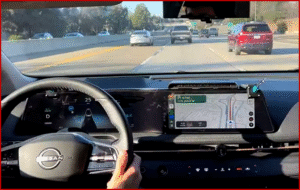
Nissan (7201.T) said today that a trial with UC Berkeley and Contra Costa Transportation Authority showed how connected vehicles can help reduce congestion. Nissan’s Cooperative Congestion Management (CCM) trial resulted in 85% fewer hard-braking events and 70% less time stopped in traffic during 600 miles of testing. It’s the latest example of how connected vehicles can yield safety benefits, although there are still huge, unanswered questions about privacy rights and the lack of regulations with the impending monitoring by State and the Federal government entities. (Read AutoInformed.com on: State Privacy Laws Failing to Protect Your Data and IIHS Safety Award to Use Risky Driver Behavior Tech)*
“Our goal is to eliminate the waste of stop-and-go traffic,” said Zvi Guter, senior manager of mobility research, who is leading the CCM project at Nissan’s Silicon Valley lab.
Cooperative Congestion Management
In typical traffic patterns, drivers often follow too closely. This prevents them from seeing slowing traffic ahead, leading to hard braking when approaching the slower traffic. This creates stop-and-go waves, which are less efficient than traveling at a steady pace. “Stop-and-go traffic is often due to the imperfection of human driving behavior,” Guter said.
CCM’s goal is to predict and guide collective behavior, which would reduce the inefficiencies of human driving and create a steadier, more efficient traffic environment. The CCM trial uses data from one “probe” vehicle to help others keep an appropriate distance and speed. The “probe” vehicle is ahead and supplies congestion data to a second set of vehicles 30 to 60 seconds behind. The second set of vehicles then adjusts their speeds in advance of the jam, creating a smooth buffer for trailing cars.
It relies on ProPILOT Assist, Nissan’s semi-autonomous driver assistance technology available on most U.S. models. This reduces the need for hard braking and allows traffic to flow more consistently instead of entering a stop-and-go pattern. During 600 miles of testing on Interstate 680 in the San Francisco Bay Area, vehicles with CCM software logged 85% fewer hard-braking incidents and 70% less time stopped in traffic. It also reduced the incidence of vehicles following too closely and risking rear-end accidents.
Backed by an Automated Driving Systems grant from the U.S. Department of Transportation, CCTA oversaw project design, coordination and data collection to evaluate how Nissan’s technologies can improve traffic flow, enhance safety and reduce congestion on one of Contra Costa County’s most congested corridors. “Our testing indicates CCM doesn’t just make commuting more comfortable and efficient, but safer, too,” Guter said.
“Nissan’s advanced tech and high-quality hardware made integrating the CCM software much easier,” said Jerry Chou, a senior researcher at Nissan’s Silicon Valley office.
Technical and Social Challenges
“One of the biggest challenges was demonstrating the effectiveness of the system in traffic with just a handful of controlled vehicles,” Chou said. “The success of the trial, even with a small number of controlled vehicles, demonstrates how the system can begin to influence collective traffic behavior and provides a glimpse of potential future benefits.”
For more than three years, the Nissan team developed the project with research lead Jonathan Lee from Professor Alexandre Bayen’s lab at UC Berkeley. Another substantial challenge they faced was adjusting for human behavior. For example, when one of the test vehicles begins gently slowing down ahead of a traffic jam, its driver might try to override the system and “fill the gap” between it and upcoming traffic.
“In order to make this more acceptable to the human driver, we’re trying to enhance the vehicle interface to let the driver know why we’re slowing down,” said Joy Carpio, a researcher at Nissan’s Silicon Valley office.
The team said educating people about CCM and helping them understand how it can help them save time and money is critical. “It requires cooperation. If drivers don’t accept the solution, it will be difficult to implement,” Carpio said.
The Future?
When will communicating cars start to impact traffic everywhere? While the team cannot yet say when the technology will be implemented at scale, the fact that it’s already showing results in real-world testing is promising. “The hope is that by using more common technology like 4G LTE to communicate, CCM can easily scale up to accommodate more users,” Guter said.
AutoInformed on

About Ken Zino
Ken Zino, editor and publisher of AutoInformed, is a versatile auto industry participant with global experience spanning decades in print and broadcast journalism, as well as social media. He has automobile testing, marketing, public relations and communications experience. He is past president of The International Motor Press Assn, the Detroit Press Club, founding member and first President of the Automotive Press Assn. He is a member of APA, IMPA and the Midwest Automotive Press Assn.
He also brings an historical perspective while citing their contemporary relevance of the work of legendary auto writers such as Ken Purdy, Jim Dunne or Jerry Flint, or writers such as Red Smith, Mark Twain, Thomas Jefferson – all to bring perspective to a chaotic automotive universe.
Above all, decades after he first drove a car, Zino still revels in the sound of the exhaust as the throttle is blipped during a downshift and the driver’s rush that occurs when the entry, apex and exit points of a turn are smoothly and swiftly crossed. It’s the beginning of a perfect lap.
AutoInformed has an editorial philosophy that loves transportation machines of all kinds while promoting critical thinking about the future use of cars and trucks.
Zino builds AutoInformed from his background in automotive journalism starting at Hearst Publishing in New York City on Motor and MotorTech Magazines and car testing where he reviewed hundreds of vehicles in his decade-long stint as the Detroit Bureau Chief of Road & Track magazine. Zino has also worked in Europe, and Asia – now the largest automotive market in the world with China at its center.







Nissan Testing Cooperative Congestion Management
Click for more.
Nissan (7201.T) said today that a trial with UC Berkeley and Contra Costa Transportation Authority showed how connected vehicles can help reduce congestion. Nissan’s Cooperative Congestion Management (CCM) trial resulted in 85% fewer hard-braking events and 70% less time stopped in traffic during 600 miles of testing. It’s the latest example of how connected vehicles can yield safety benefits, although there are still huge, unanswered questions about privacy rights and the lack of regulations with the impending monitoring by State and the Federal government entities. (Read AutoInformed.com on: State Privacy Laws Failing to Protect Your Data and IIHS Safety Award to Use Risky Driver Behavior Tech)*
“Our goal is to eliminate the waste of stop-and-go traffic,” said Zvi Guter, senior manager of mobility research, who is leading the CCM project at Nissan’s Silicon Valley lab.
Cooperative Congestion Management
In typical traffic patterns, drivers often follow too closely. This prevents them from seeing slowing traffic ahead, leading to hard braking when approaching the slower traffic. This creates stop-and-go waves, which are less efficient than traveling at a steady pace. “Stop-and-go traffic is often due to the imperfection of human driving behavior,” Guter said.
CCM’s goal is to predict and guide collective behavior, which would reduce the inefficiencies of human driving and create a steadier, more efficient traffic environment. The CCM trial uses data from one “probe” vehicle to help others keep an appropriate distance and speed. The “probe” vehicle is ahead and supplies congestion data to a second set of vehicles 30 to 60 seconds behind. The second set of vehicles then adjusts their speeds in advance of the jam, creating a smooth buffer for trailing cars.
It relies on ProPILOT Assist, Nissan’s semi-autonomous driver assistance technology available on most U.S. models. This reduces the need for hard braking and allows traffic to flow more consistently instead of entering a stop-and-go pattern. During 600 miles of testing on Interstate 680 in the San Francisco Bay Area, vehicles with CCM software logged 85% fewer hard-braking incidents and 70% less time stopped in traffic. It also reduced the incidence of vehicles following too closely and risking rear-end accidents.
Backed by an Automated Driving Systems grant from the U.S. Department of Transportation, CCTA oversaw project design, coordination and data collection to evaluate how Nissan’s technologies can improve traffic flow, enhance safety and reduce congestion on one of Contra Costa County’s most congested corridors. “Our testing indicates CCM doesn’t just make commuting more comfortable and efficient, but safer, too,” Guter said.
“Nissan’s advanced tech and high-quality hardware made integrating the CCM software much easier,” said Jerry Chou, a senior researcher at Nissan’s Silicon Valley office.
Technical and Social Challenges
“One of the biggest challenges was demonstrating the effectiveness of the system in traffic with just a handful of controlled vehicles,” Chou said. “The success of the trial, even with a small number of controlled vehicles, demonstrates how the system can begin to influence collective traffic behavior and provides a glimpse of potential future benefits.”
For more than three years, the Nissan team developed the project with research lead Jonathan Lee from Professor Alexandre Bayen’s lab at UC Berkeley. Another substantial challenge they faced was adjusting for human behavior. For example, when one of the test vehicles begins gently slowing down ahead of a traffic jam, its driver might try to override the system and “fill the gap” between it and upcoming traffic.
“In order to make this more acceptable to the human driver, we’re trying to enhance the vehicle interface to let the driver know why we’re slowing down,” said Joy Carpio, a researcher at Nissan’s Silicon Valley office.
The team said educating people about CCM and helping them understand how it can help them save time and money is critical. “It requires cooperation. If drivers don’t accept the solution, it will be difficult to implement,” Carpio said.
The Future?
When will communicating cars start to impact traffic everywhere? While the team cannot yet say when the technology will be implemented at scale, the fact that it’s already showing results in real-world testing is promising. “The hope is that by using more common technology like 4G LTE to communicate, CCM can easily scale up to accommodate more users,” Guter said.
AutoInformed on
About Ken Zino
Ken Zino, editor and publisher of AutoInformed, is a versatile auto industry participant with global experience spanning decades in print and broadcast journalism, as well as social media. He has automobile testing, marketing, public relations and communications experience. He is past president of The International Motor Press Assn, the Detroit Press Club, founding member and first President of the Automotive Press Assn. He is a member of APA, IMPA and the Midwest Automotive Press Assn. He also brings an historical perspective while citing their contemporary relevance of the work of legendary auto writers such as Ken Purdy, Jim Dunne or Jerry Flint, or writers such as Red Smith, Mark Twain, Thomas Jefferson – all to bring perspective to a chaotic automotive universe. Above all, decades after he first drove a car, Zino still revels in the sound of the exhaust as the throttle is blipped during a downshift and the driver’s rush that occurs when the entry, apex and exit points of a turn are smoothly and swiftly crossed. It’s the beginning of a perfect lap. AutoInformed has an editorial philosophy that loves transportation machines of all kinds while promoting critical thinking about the future use of cars and trucks. Zino builds AutoInformed from his background in automotive journalism starting at Hearst Publishing in New York City on Motor and MotorTech Magazines and car testing where he reviewed hundreds of vehicles in his decade-long stint as the Detroit Bureau Chief of Road & Track magazine. Zino has also worked in Europe, and Asia – now the largest automotive market in the world with China at its center.