Click for more sub-atomic behavior.
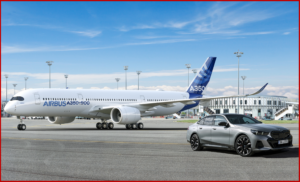
Airbus and BMW Group launched today the so-called “The Quantum Mobility Quest” to address challenges in the data-driven aviation and automotive industries that remain insurmountable for classic computers. This could be a first-of-its-kind attempt to develop applications to harness quantum technologies for real-world industrial applications. The companies said it has the potential to forge more efficient, sustainable and safer solutions for the future of transportation. This nascent technology could play a key role in simulating various industrial and operational processes, opening up opportunities to shape future mobility products and services.
“This is the perfect time to shine a spotlight on quantum technology* and its potential impact on our society. Partnering with an industry leader like BMW Group enables us to mature the technology as we need to bridge the gap between scientific exploration and its potential applications. We’re seeking the best-in-class students, PhDs, academics, researchers, start-ups, companies, or professionals in the field, worldwide to join our challenge to create a massive paradigm shift in the way aircraft are built and flown.” said Isabell Gradert, Vice President Central Research and Technology at Airbus.
Challenge candidates are invited to select one or more problem statements: improved aerodynamics design with quantum solvers, future automated mobility with quantum machine learning, more sustainable supply chain with quantum optimization, and enhanced corrosion inhibition with quantum simulation. Moreover, candidates can put forward their own quantum technologies with the potential to develop native apps yet to be explored in the transportation sector.
The challenge is hosted by The Quantum Insider (TQI) and divided into two parts, a four-month phase where participants will develop a theoretical framework for one of the given statements, and a second phase during which selected finalists will implement and benchmark their solutions. Amazon Web Services (AWS) provides candidates with an opportunity to run their algorithms on their Amazon Braket (Sic) quantum computing service.
A jury composed of world-leading quantum experts will team up with experts from Airbus, BMW Group, and AWS to evaluate submitted proposals and award one winning-team with a €30,000 prize in each of the five challenges, by the end of 2024. Registration opens today, and submissions will be accepted from mid-January through April 30, 2024 here: www.thequantuminsider.com/quantum-challenge.
“Following the success of previous editions of Quantum Computing Challenges by BMW Group and Airbus, we are gearing up for a new wave of innovation, exploring the technology capabilities for sustainability and operational excellence.” said Dr. Peter Lehnert, Vice-President, Research Technologies at BMW Group. “The BMW Group is clearly aiming at positioning itself at the crossroads of quantum technology, the global ecosystem, and cutting-edge solutions. By doing so, we strongly believe in major advances when it comes to sustainable materials for batteries and fuel cells, to generate unique and efficient designs, or to enhance the overall user experience in the BMW Group Products.”
*According to IBM – itself a large player in Quantum Computing: “When scientists and engineers encounter difficult problems, they turn to supercomputers. These are very large classical computers, often with thousands of classical CPU and GPU cores capable of running very large calculations and advanced artificial intelligence. However, even supercomputers are binary code-based machines reliant on 20th-century transistor technology. They struggle to solve certain kinds of problems.
“If a supercomputer gets stumped, that’s probably because the big classical machine was asked to solve a problem with a high degree of complexity. When classical computers fail, it’s often due to complexity.
“Complex problems are problems with lots of variables interacting in complicated ways. Modeling the behavior of individual atoms in a molecule is a complex problem, because of all the different electrons interacting with one another. Identifying subtle patterns of fraud in financial transactions or new physics in a supercollider are also complex problems. There are some complex problems that we do not know how to solve with classical computers at any scale,” says IBM.

About Ken Zino
Ken Zino, editor and publisher of AutoInformed, is a versatile auto industry participant with global experience spanning decades in print and broadcast journalism, as well as social media. He has automobile testing, marketing, public relations and communications experience. He is past president of The International Motor Press Assn, the Detroit Press Club, founding member and first President of the Automotive Press Assn. He is a member of APA, IMPA and the Midwest Automotive Press Assn.
He also brings an historical perspective while citing their contemporary relevance of the work of legendary auto writers such as Ken Purdy, Jim Dunne or Jerry Flint, or writers such as Red Smith, Mark Twain, Thomas Jefferson – all to bring perspective to a chaotic automotive universe.
Above all, decades after he first drove a car, Zino still revels in the sound of the exhaust as the throttle is blipped during a downshift and the driver’s rush that occurs when the entry, apex and exit points of a turn are smoothly and swiftly crossed. It’s the beginning of a perfect lap.
AutoInformed has an editorial philosophy that loves transportation machines of all kinds while promoting critical thinking about the future use of cars and trucks.
Zino builds AutoInformed from his background in automotive journalism starting at Hearst Publishing in New York City on Motor and MotorTech Magazines and car testing where he reviewed hundreds of vehicles in his decade-long stint as the Detroit Bureau Chief of Road & Track magazine. Zino has also worked in Europe, and Asia – now the largest automotive market in the world with China at its center.








The Quantum Mobility Quest from Airbus and BMW Group
Click for more sub-atomic behavior.
Airbus and BMW Group launched today the so-called “The Quantum Mobility Quest” to address challenges in the data-driven aviation and automotive industries that remain insurmountable for classic computers. This could be a first-of-its-kind attempt to develop applications to harness quantum technologies for real-world industrial applications. The companies said it has the potential to forge more efficient, sustainable and safer solutions for the future of transportation. This nascent technology could play a key role in simulating various industrial and operational processes, opening up opportunities to shape future mobility products and services.
“This is the perfect time to shine a spotlight on quantum technology* and its potential impact on our society. Partnering with an industry leader like BMW Group enables us to mature the technology as we need to bridge the gap between scientific exploration and its potential applications. We’re seeking the best-in-class students, PhDs, academics, researchers, start-ups, companies, or professionals in the field, worldwide to join our challenge to create a massive paradigm shift in the way aircraft are built and flown.” said Isabell Gradert, Vice President Central Research and Technology at Airbus.
Challenge candidates are invited to select one or more problem statements: improved aerodynamics design with quantum solvers, future automated mobility with quantum machine learning, more sustainable supply chain with quantum optimization, and enhanced corrosion inhibition with quantum simulation. Moreover, candidates can put forward their own quantum technologies with the potential to develop native apps yet to be explored in the transportation sector.
The challenge is hosted by The Quantum Insider (TQI) and divided into two parts, a four-month phase where participants will develop a theoretical framework for one of the given statements, and a second phase during which selected finalists will implement and benchmark their solutions. Amazon Web Services (AWS) provides candidates with an opportunity to run their algorithms on their Amazon Braket (Sic) quantum computing service.
A jury composed of world-leading quantum experts will team up with experts from Airbus, BMW Group, and AWS to evaluate submitted proposals and award one winning-team with a €30,000 prize in each of the five challenges, by the end of 2024. Registration opens today, and submissions will be accepted from mid-January through April 30, 2024 here: www.thequantuminsider.com/quantum-challenge.
“Following the success of previous editions of Quantum Computing Challenges by BMW Group and Airbus, we are gearing up for a new wave of innovation, exploring the technology capabilities for sustainability and operational excellence.” said Dr. Peter Lehnert, Vice-President, Research Technologies at BMW Group. “The BMW Group is clearly aiming at positioning itself at the crossroads of quantum technology, the global ecosystem, and cutting-edge solutions. By doing so, we strongly believe in major advances when it comes to sustainable materials for batteries and fuel cells, to generate unique and efficient designs, or to enhance the overall user experience in the BMW Group Products.”
*According to IBM – itself a large player in Quantum Computing: “When scientists and engineers encounter difficult problems, they turn to supercomputers. These are very large classical computers, often with thousands of classical CPU and GPU cores capable of running very large calculations and advanced artificial intelligence. However, even supercomputers are binary code-based machines reliant on 20th-century transistor technology. They struggle to solve certain kinds of problems.
“If a supercomputer gets stumped, that’s probably because the big classical machine was asked to solve a problem with a high degree of complexity. When classical computers fail, it’s often due to complexity.
“Complex problems are problems with lots of variables interacting in complicated ways. Modeling the behavior of individual atoms in a molecule is a complex problem, because of all the different electrons interacting with one another. Identifying subtle patterns of fraud in financial transactions or new physics in a supercollider are also complex problems. There are some complex problems that we do not know how to solve with classical computers at any scale,” says IBM.
About Ken Zino
Ken Zino, editor and publisher of AutoInformed, is a versatile auto industry participant with global experience spanning decades in print and broadcast journalism, as well as social media. He has automobile testing, marketing, public relations and communications experience. He is past president of The International Motor Press Assn, the Detroit Press Club, founding member and first President of the Automotive Press Assn. He is a member of APA, IMPA and the Midwest Automotive Press Assn. He also brings an historical perspective while citing their contemporary relevance of the work of legendary auto writers such as Ken Purdy, Jim Dunne or Jerry Flint, or writers such as Red Smith, Mark Twain, Thomas Jefferson – all to bring perspective to a chaotic automotive universe. Above all, decades after he first drove a car, Zino still revels in the sound of the exhaust as the throttle is blipped during a downshift and the driver’s rush that occurs when the entry, apex and exit points of a turn are smoothly and swiftly crossed. It’s the beginning of a perfect lap. AutoInformed has an editorial philosophy that loves transportation machines of all kinds while promoting critical thinking about the future use of cars and trucks. Zino builds AutoInformed from his background in automotive journalism starting at Hearst Publishing in New York City on Motor and MotorTech Magazines and car testing where he reviewed hundreds of vehicles in his decade-long stint as the Detroit Bureau Chief of Road & Track magazine. Zino has also worked in Europe, and Asia – now the largest automotive market in the world with China at its center.