Click for more.
In the face of Trump chaos and continued uncertainty surrounding National Electric Vehicle Infrastructure (NEVI) funding, the electric vehicle (EV) public charging industry is showing strong signs of resilience and progress, according to the J.D. Power 2025 U.S. Electric Vehicle Experience (EVX) Public Charging StudySM released today. Non-charging visits at public EV chargers [when the driver visited a charger but was unable to charge their vehicle] are at their lowest level in four years. (Read AutoInformed.com on: EV Satisfaction Improves But Trump Chaos Looms)
“In the absence of NEVI funding, the industry is experiencing a concerted effort among various stakeholders in the EV ecosystem – particularly from automakers and charging networks – to improve the public charging experience for customers,” said Brent Gruber, executive director of the EV practice at J.D. Power. “With or without the federal funding, NEVI guidelines have made their mark by establishing a playbook for industry success. While overall satisfaction scores decline this year, our data show clear improvement in the reliability and success of public charging – a promising sign of progress for the industry. As part of its analysis, J.D. Power also monitors public charging performance across the country by measuring failed charging attempts and availability, as well as providing critical data on where the customer experience is improving and where challenges remain.”
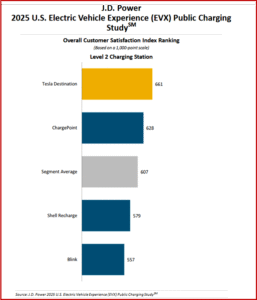
“In the 2025 study, satisfaction with DC (direct current) fast chargers is 654 (on a 1000-point scale), a 10-point decrease from the same period a year ago, with notable declines in factors related to payment and cost. Satisfaction with public Level 2 charging has declined to 607, a 7-point decrease year-over-year. The study also reveals a notable improvement in charging reliability, despite lower overall satisfaction, with only 14% of all EV owners saying they visited a charger without successfully charging their vehicle, a significant decrease of 5 percentage points from 2024,” according to Power.
Key 2025 Study Results
- EV owners aren’t thrilled with cost of charging: Satisfaction with cost of charging among users of both Level 2 and DC fast chargers declines this year to 459 (-16 points) and 430 (-16), respectively. For users of DC fast chargers, the cost of charging – one of 10 factors on which the study is based – is the least satisfying aspect overall. “Part of the decrease is due to non-Tesla owners using Tesla Superchargers, which deliver a far less satisfying user experience relative to the costs incurred, in comparison to those of Tesla owners,” Gruber said. “Additionally, in previous years, many DC fast charging networks kept prices low as they developed their market presence, while manufacturers regularly offered free charging incentives with vehicle purchases. However, as the infrastructure market evolves and electricity rates rise, charging prices have increased significantly in some cases, directly affecting the overall EV ownership experience.”
- OEM-branded DC fast charging networks show strong early performance: Tesla’s Supercharger network continues to lead the DC fast charger (DCFC) segment in customer satisfaction with a score of 709, despite a 22-point decline from last year. However, non-Tesla automaker-operated networks, including the Mercedes-Benz Charging Network, Rivian Adventure Network and Ford Charge, collectively earn a satisfaction score of 709, on par with Tesla. These networks were not eligible for rank consideration in this year’s study due to their limited footprint, but early performance suggests manufacturers are successfully applying lessons from Tesla’s brand-level ecosystem. In comparison, third-party DCFC providers, which have the added challenge of targeting a broader audience, average a score of 591.
- Non-charge visits and availability vary by location: To understand better the EV charging experience, J.D. Power monitors non-charge visits and availability at public stations nationwide. The findings reveal that the Pacific region has the highest rate of non-charge visits (21%), with 12% of customers also reporting waiting times for an available charger. In contrast, the East South-Central region has the lowest incidence of both issues, just 7% for non-charge visits and 5% for waiting times. Among major cities, EV owners in Seattle (25%) and Los Angeles (24%) report high rates of unsuccessful charging attempts, while a greater share of drivers in San Francisco (18%) and Denver (14%) experience wait times to access chargers. By far, the most common reason for non-charge visits is the charger being out of service or not working properly, which affects 60% of failed charging visits.
- First-time EV owners are more satisfied than veteran EV owners: Across both public charging segments, satisfaction is higher among first-time EV owners compared with their more experienced counterparts. Overall satisfaction is 610 among first-time EV owners using Level 2 chargers and 592 among veteran EV owners. The satisfaction gap between newbies (654) and veterans (648) is smaller among DC fast charger users, however. A possible explanation for this trend is that veteran EV owners have higher expectations for technological advancements that aren’t quite being met by current vehicle and charger offerings.
Study Rankings
- Tesla Destination ranks highest among Level 2 charging stations for a second consecutive year, with a score of 661. ChargePoint (628) ranks second.
- Tesla Supercharger ranks highest among DC fast chargers for a fifth consecutive year, with a score of 709. Red E (668) ranks second.
- The U.S. Electric Vehicle Experience (EVX) Public Charging Study, now in its fifth year, measures EV owner satisfaction with two types of public charge-point operators: Level 2 charging stations and DC fast charger stations. Satisfaction is measured across 10 factors: ease of charging; speed of charging; physical condition of charging station; availability of chargers; convenience of this location; things to do while charging; how safe you feel at this location; ease of finding this location; cost of charging; and ease of payment.
- The study is a collaboration with PlugShare, an EV driver app maker and research firm. Power claims [with justification – AutoCrat] this study sets the standard for bench-marking satisfaction with the critical attributes that affect the total or overall EV ownership experience. The 2025 study included 7428 owners of battery electric vehicles (BEVs) and plug-in hybrid electric vehicles (PHEVs). The study was fielded from January through June 2025.
“While the expansion of DC fast chargers remains important, the data strongly indicate that increasing speed alone is not the solution to public charging challenges,” Gruber said. “Improving reliability, ease of use and addressing cost concerns are among a multitude of factors at play that must be prioritized to enhance the overall public EV charging experience. Faster does not always mean better.”

About Ken Zino
Ken Zino, editor and publisher of AutoInformed, is a versatile auto industry participant with global experience spanning decades in print and broadcast journalism, as well as social media. He has automobile testing, marketing, public relations and communications experience. He is past president of The International Motor Press Assn, the Detroit Press Club, founding member and first President of the Automotive Press Assn. He is a member of APA, IMPA and the Midwest Automotive Press Assn.
He also brings an historical perspective while citing their contemporary relevance of the work of legendary auto writers such as Ken Purdy, Jim Dunne or Jerry Flint, or writers such as Red Smith, Mark Twain, Thomas Jefferson – all to bring perspective to a chaotic automotive universe.
Above all, decades after he first drove a car, Zino still revels in the sound of the exhaust as the throttle is blipped during a downshift and the driver’s rush that occurs when the entry, apex and exit points of a turn are smoothly and swiftly crossed. It’s the beginning of a perfect lap.
AutoInformed has an editorial philosophy that loves transportation machines of all kinds while promoting critical thinking about the future use of cars and trucks.
Zino builds AutoInformed from his background in automotive journalism starting at Hearst Publishing in New York City on Motor and MotorTech Magazines and car testing where he reviewed hundreds of vehicles in his decade-long stint as the Detroit Bureau Chief of Road & Track magazine. Zino has also worked in Europe, and Asia – now the largest automotive market in the world with China at its center.







EV Infrastructure Better J.D. Power Says
Click for more.
In the face of Trump chaos and continued uncertainty surrounding National Electric Vehicle Infrastructure (NEVI) funding, the electric vehicle (EV) public charging industry is showing strong signs of resilience and progress, according to the J.D. Power 2025 U.S. Electric Vehicle Experience (EVX) Public Charging StudySM released today. Non-charging visits at public EV chargers [when the driver visited a charger but was unable to charge their vehicle] are at their lowest level in four years. (Read AutoInformed.com on: EV Satisfaction Improves But Trump Chaos Looms)
“In the absence of NEVI funding, the industry is experiencing a concerted effort among various stakeholders in the EV ecosystem – particularly from automakers and charging networks – to improve the public charging experience for customers,” said Brent Gruber, executive director of the EV practice at J.D. Power. “With or without the federal funding, NEVI guidelines have made their mark by establishing a playbook for industry success. While overall satisfaction scores decline this year, our data show clear improvement in the reliability and success of public charging – a promising sign of progress for the industry. As part of its analysis, J.D. Power also monitors public charging performance across the country by measuring failed charging attempts and availability, as well as providing critical data on where the customer experience is improving and where challenges remain.”
“In the 2025 study, satisfaction with DC (direct current) fast chargers is 654 (on a 1000-point scale), a 10-point decrease from the same period a year ago, with notable declines in factors related to payment and cost. Satisfaction with public Level 2 charging has declined to 607, a 7-point decrease year-over-year. The study also reveals a notable improvement in charging reliability, despite lower overall satisfaction, with only 14% of all EV owners saying they visited a charger without successfully charging their vehicle, a significant decrease of 5 percentage points from 2024,” according to Power.
Key 2025 Study Results
Study Rankings
“While the expansion of DC fast chargers remains important, the data strongly indicate that increasing speed alone is not the solution to public charging challenges,” Gruber said. “Improving reliability, ease of use and addressing cost concerns are among a multitude of factors at play that must be prioritized to enhance the overall public EV charging experience. Faster does not always mean better.”
About Ken Zino
Ken Zino, editor and publisher of AutoInformed, is a versatile auto industry participant with global experience spanning decades in print and broadcast journalism, as well as social media. He has automobile testing, marketing, public relations and communications experience. He is past president of The International Motor Press Assn, the Detroit Press Club, founding member and first President of the Automotive Press Assn. He is a member of APA, IMPA and the Midwest Automotive Press Assn. He also brings an historical perspective while citing their contemporary relevance of the work of legendary auto writers such as Ken Purdy, Jim Dunne or Jerry Flint, or writers such as Red Smith, Mark Twain, Thomas Jefferson – all to bring perspective to a chaotic automotive universe. Above all, decades after he first drove a car, Zino still revels in the sound of the exhaust as the throttle is blipped during a downshift and the driver’s rush that occurs when the entry, apex and exit points of a turn are smoothly and swiftly crossed. It’s the beginning of a perfect lap. AutoInformed has an editorial philosophy that loves transportation machines of all kinds while promoting critical thinking about the future use of cars and trucks. Zino builds AutoInformed from his background in automotive journalism starting at Hearst Publishing in New York City on Motor and MotorTech Magazines and car testing where he reviewed hundreds of vehicles in his decade-long stint as the Detroit Bureau Chief of Road & Track magazine. Zino has also worked in Europe, and Asia – now the largest automotive market in the world with China at its center.