Click for more.
Honda (7267.T)* today announced plans to test its high-differential pressure water electrolysis system at the International Space Station (ISS) in collaboration with space and technology companies Sierra Space and Tec-Masters.
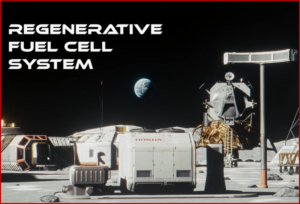
“The project is part of Honda’s vision for a regenerative fuel cell system that could provide advanced energy storage capable of supporting human life on the lunar surface,” Honda said.*
New U.S. Honda Space Development Division
In late 2024, Honda established the Space Development Division at American Honda to promote technology development in the U.S. and increase collaboration with the U.S. space industry. The U.S. and Japan teams work closely to leverage Honda core technologies and apply them to the expansion of human activities and development on the Lunar surface. These space development initiatives demonstrate the commitment by Honda to fostering a sustainable future through pioneering technology and collaboration.
*AutoInformed on
**Regenerative Fuel Cell System for Outer Space
Honda is using decades of hydrogen fuel cell technology expertise to develop a regenerative fuel cell system, known as a circulative renewable energy system, that will continuously produce oxygen, hydrogen, and electricity. “Honda envisions the circulative renewable energy system to be part of the infrastructure for humanity’s sustained habitation on the Moon – utilizing the available resources of sunlight and water. By enhancing the performance of the circulative renewable energy system, improvements can be made to long-life regenerative fuel cells that can be used as a scalable, clean, and renewable energy source both in space and on Earth,” Honda said.
During the Lunar Day, the system will use electricity generated by the sun to power the process. Honda’s high-differential pressure water electrolysis system will then produce hydrogen and oxygen from water.
During the Lunar Night, when the Moon is not receiving sunlight, some of the oxygen will be used for astronauts to breathe. The Honda fuel cell system will use the remaining oxygen, along with the hydrogen produced during the Lunar Day, to generate electricity.
After the fuel cells generate electricity, the only byproduct is water, which is recycled back into the water electrolysis system to create a closed-loop energy cycle. This process is similar to how a home solar system operates on Earth, where daytime solar electricity is harnessed, and excess energy is stored in home energy batteries to provide power throughout the night.
International Space Station Testing
Honda said it has developed an advanced water electrolysis system designed to support long-term operations on the Moon by prioritizing efficiency and reliability. The system’s lightweight and compact design addresses the critical need to reduce transportation costs in lunar development. Additionally, since it doesn’t use mechanical compression, maintenance needs are reduced, enhancing reliability for extended missions. By enabling high-pressure gas storage in smaller containers, the system also reduces the need to transport and manage large numbers of tanks.
“Honda will test the core part of its high-differential pressure water electrolysis system to verify the efficiency and reliability of the system in the microgravity environment of the ISS. For the ISS testing, Honda is collaborating with Sierra Space, a leading commercial space company at the forefront of innovation and the commercialization of space, and Tec-Masters, a leading provider of innovative scientific and technological solutions. Sierra Space will be the primary space mission integrator, working with NASA to transport materials on Sierra Space’s Dream Chaser® spaceplane, the world’s only commercial spaceplane. Tec-Masters will be the ISS technology expert,” Honda said.

About Ken Zino
Ken Zino, editor and publisher of AutoInformed, is a versatile auto industry participant with global experience spanning decades in print and broadcast journalism, as well as social media. He has automobile testing, marketing, public relations and communications experience. He is past president of The International Motor Press Assn, the Detroit Press Club, founding member and first President of the Automotive Press Assn. He is a member of APA, IMPA and the Midwest Automotive Press Assn.
He also brings an historical perspective while citing their contemporary relevance of the work of legendary auto writers such as Ken Purdy, Jim Dunne or Jerry Flint, or writers such as Red Smith, Mark Twain, Thomas Jefferson – all to bring perspective to a chaotic automotive universe.
Above all, decades after he first drove a car, Zino still revels in the sound of the exhaust as the throttle is blipped during a downshift and the driver’s rush that occurs when the entry, apex and exit points of a turn are smoothly and swiftly crossed. It’s the beginning of a perfect lap.
AutoInformed has an editorial philosophy that loves transportation machines of all kinds while promoting critical thinking about the future use of cars and trucks.
Zino builds AutoInformed from his background in automotive journalism starting at Hearst Publishing in New York City on Motor and MotorTech Magazines and car testing where he reviewed hundreds of vehicles in his decade-long stint as the Detroit Bureau Chief of Road & Track magazine. Zino has also worked in Europe, and Asia – now the largest automotive market in the world with China at its center.







Honda R&D to Test Life-Support Systems in Space
Click for more.
Honda (7267.T)* today announced plans to test its high-differential pressure water electrolysis system at the International Space Station (ISS) in collaboration with space and technology companies Sierra Space and Tec-Masters.
“The project is part of Honda’s vision for a regenerative fuel cell system that could provide advanced energy storage capable of supporting human life on the lunar surface,” Honda said.*
New U.S. Honda Space Development Division
In late 2024, Honda established the Space Development Division at American Honda to promote technology development in the U.S. and increase collaboration with the U.S. space industry. The U.S. and Japan teams work closely to leverage Honda core technologies and apply them to the expansion of human activities and development on the Lunar surface. These space development initiatives demonstrate the commitment by Honda to fostering a sustainable future through pioneering technology and collaboration.
*AutoInformed on
**Regenerative Fuel Cell System for Outer Space
Honda is using decades of hydrogen fuel cell technology expertise to develop a regenerative fuel cell system, known as a circulative renewable energy system, that will continuously produce oxygen, hydrogen, and electricity. “Honda envisions the circulative renewable energy system to be part of the infrastructure for humanity’s sustained habitation on the Moon – utilizing the available resources of sunlight and water. By enhancing the performance of the circulative renewable energy system, improvements can be made to long-life regenerative fuel cells that can be used as a scalable, clean, and renewable energy source both in space and on Earth,” Honda said.
During the Lunar Day, the system will use electricity generated by the sun to power the process. Honda’s high-differential pressure water electrolysis system will then produce hydrogen and oxygen from water.
During the Lunar Night, when the Moon is not receiving sunlight, some of the oxygen will be used for astronauts to breathe. The Honda fuel cell system will use the remaining oxygen, along with the hydrogen produced during the Lunar Day, to generate electricity.
After the fuel cells generate electricity, the only byproduct is water, which is recycled back into the water electrolysis system to create a closed-loop energy cycle. This process is similar to how a home solar system operates on Earth, where daytime solar electricity is harnessed, and excess energy is stored in home energy batteries to provide power throughout the night.
International Space Station Testing
Honda said it has developed an advanced water electrolysis system designed to support long-term operations on the Moon by prioritizing efficiency and reliability. The system’s lightweight and compact design addresses the critical need to reduce transportation costs in lunar development. Additionally, since it doesn’t use mechanical compression, maintenance needs are reduced, enhancing reliability for extended missions. By enabling high-pressure gas storage in smaller containers, the system also reduces the need to transport and manage large numbers of tanks.
“Honda will test the core part of its high-differential pressure water electrolysis system to verify the efficiency and reliability of the system in the microgravity environment of the ISS. For the ISS testing, Honda is collaborating with Sierra Space, a leading commercial space company at the forefront of innovation and the commercialization of space, and Tec-Masters, a leading provider of innovative scientific and technological solutions. Sierra Space will be the primary space mission integrator, working with NASA to transport materials on Sierra Space’s Dream Chaser® spaceplane, the world’s only commercial spaceplane. Tec-Masters will be the ISS technology expert,” Honda said.
About Ken Zino
Ken Zino, editor and publisher of AutoInformed, is a versatile auto industry participant with global experience spanning decades in print and broadcast journalism, as well as social media. He has automobile testing, marketing, public relations and communications experience. He is past president of The International Motor Press Assn, the Detroit Press Club, founding member and first President of the Automotive Press Assn. He is a member of APA, IMPA and the Midwest Automotive Press Assn. He also brings an historical perspective while citing their contemporary relevance of the work of legendary auto writers such as Ken Purdy, Jim Dunne or Jerry Flint, or writers such as Red Smith, Mark Twain, Thomas Jefferson – all to bring perspective to a chaotic automotive universe. Above all, decades after he first drove a car, Zino still revels in the sound of the exhaust as the throttle is blipped during a downshift and the driver’s rush that occurs when the entry, apex and exit points of a turn are smoothly and swiftly crossed. It’s the beginning of a perfect lap. AutoInformed has an editorial philosophy that loves transportation machines of all kinds while promoting critical thinking about the future use of cars and trucks. Zino builds AutoInformed from his background in automotive journalism starting at Hearst Publishing in New York City on Motor and MotorTech Magazines and car testing where he reviewed hundreds of vehicles in his decade-long stint as the Detroit Bureau Chief of Road & Track magazine. Zino has also worked in Europe, and Asia – now the largest automotive market in the world with China at its center.