Click to enlarge.
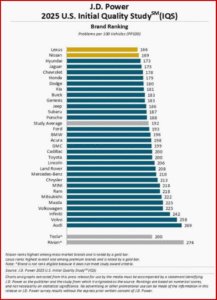
The number of problems cited by owners in the first 90 days of ownership has improved slightly, according to the J.D. Power 2025 U.S. Initial Quality Study (IQS)SM released today. Overall, problems per 100 vehicles (PP100) have improved to 192 PP100 from 194 PP100 a year ago. Premium brands have improved to 27 PP100 to 203 PP100 from 230 PP100 in 2024, while problems among mass market brands have increased to 187 PP100 from 181 PP100 in 2024. A lower score reflects higher vehicle quality.* Lexus is the highest-ranking brand overall in initial quality with a score of 166 PP100. Among premium brands, Jaguar (175 PP100) ranks second and Genesis (183 PP100) ranks third. Among mass market brands, Nissan ranks highest with a score of 169 PP100. Hyundai (173 PP100) ranks second and Chevrolet (178 PP100) ranks third.
“While customers do find the larger touchscreens visually appealing, their functionality within the vehicle is an increasing source of frustration,” said Frank Hanley, senior director of auto benchmarking at J.D. Power. Customers are having to tap and swipe through multiple screens to access key vehicle functions like climate settings and built-in garage door openers. Owners find these things to be overly complicated and too distracting to use while driving. By retaining dedicated physical controls for some of these interactions, automakers can alleviate pain points and simplify the overall customer experience.”
Selected Findings of the 2025 Study**
- Premium vehicles have more defects than mass market counterparts: While design-related issues are equal between mass market and premium vehicles, defect/malfunction-related issues are more prevalent on premium vehicles. Exterior is the largest area of discrepancy, with premium vehicles averaging 4.2 more problems than mass market vehicles, mostly driven by those from non-traditional automakers.
- Plug-in hybrid electric vehicles (PHEVs) have most problems: For the first time, PHEVs, on average, have more problems than their battery electric vehicle (BEV) counterparts (237 PP100 vs. 212 PP100, respectively). Gasoline (184 PP100) and hybrid (196 PP100) vehicles have fewer problems than PHEVs and BEVs. The improvement in BEVs is “driven by a 62 PP100 improvement for Tesla.”
- Problematic launches and late model-year changeovers: New-model launches account for the highest number of problems (203 PP100) since the study was redesigned in 2020, compared with 190 PP100 for carryover models. Of the 18 new models launched this year, only two have fewer problems than their respective segment average.
“Typically, problems for new launches are balanced with some being successful and others having issues,” Hanley said. “This year, however, new launches are notably more problematic.”
- Shifting consumer preferences increase cupholder frustration: While it seemed like manufacturers had cupholders figured out, given that owners are now bringing more reusable containers into their vehicles, manufacturers are struggling to keep up with being able to accommodate all the different shapes and sizes that are increasingly available. Consequently, owners are again citing more problems in this area, with the expectation that their vehicle should be able to hold different sizes of containers.
- The parent corporation receiving the most model-level awards is General Motors Company (five awards), followed by Ford Motor Company (four awards) and Honda Motor Company (three awards). Among brands, Ford receives the most segment awards (four), followed by Chevrolet (three).
- General Motors Company models that rank highest in their respective segment are Buick Encore GX, Cadillac XT5, Chevrolet Blazer, Chevrolet Silverado and Chevrolet Tahoe.
- Ford Motor Company models that rank highest in their respective segment are Ford Escape, Ford F-150, Ford Mustang and Ford Super Duty.
- Honda Motor Company models that rank highest in their respective segment are Acura Integra, Acura RDX and Honda Odyssey.
- Volkswagen AG has the highest-ranking model overall, the Porsche 911, with 116 PP100.
Plant Quality Awards
- BMW AG’s Graz (Magna Steyr-BMW), Austria, plant, which manufactures the BMW Z4, receives the Platinum Plant Quality Award. (Plant quality awards are based solely on defects and malfunctions and exclude design-related problems and repair incidents.)
- Gold Plant Quality Awards for North/South America, in a tie, go to Toyota Motor Corporation’s Cambridge South plant in Ontario, Canada, which produces the Lexus RX, and Toyota Motor Corporation’s Georgetown 3, Kentucky, plant, which produces the Lexus ES.
- The Gold Plant Quality Award for Asia Pacific goes to Toyota Motor Corporation’s Tahara Lexus, Japan, plant, which produces the Lexus IS, Lexus LS and Lexus NX.
*AutoInformed on
**The J.D. Power U.S. Initial Quality Study, now in its 39th year, is based this year on responses from 92,694 purchasers and lessees of new 2025 model-year vehicles who were surveyed after 90 days of ownership. The study additionally incorporates repair visit data based on hundreds of thousands of real-world events reported to franchised new-vehicle dealers. The methodology unites state-of-the-art vehicle repair data with traditional J.D. Power Voice of the Customer (VOC) data while fielding continuously year-round. This enhanced IQS data allows automakers the ability to quickly identify potential issues before they become bigger problems in the quality landscape.
The study is based on a battery of 227 VOC questions plus relevant repair data, all of which is organized into 10 vehicle categories: infotainment; features, controls and displays; exterior; driving assistance; interior; powertrain; seats; driving experience; climate; and unspecified (unique to repair). The study is designed to provide manufacturers with information to facilitate the identification of problems and to drive product improvement. The study was fielded from June 2024 through May 2025.

About Ken Zino
Ken Zino, editor and publisher of AutoInformed, is a versatile auto industry participant with global experience spanning decades in print and broadcast journalism, as well as social media. He has automobile testing, marketing, public relations and communications experience. He is past president of The International Motor Press Assn, the Detroit Press Club, founding member and first President of the Automotive Press Assn. He is a member of APA, IMPA and the Midwest Automotive Press Assn.
He also brings an historical perspective while citing their contemporary relevance of the work of legendary auto writers such as Ken Purdy, Jim Dunne or Jerry Flint, or writers such as Red Smith, Mark Twain, Thomas Jefferson – all to bring perspective to a chaotic automotive universe.
Above all, decades after he first drove a car, Zino still revels in the sound of the exhaust as the throttle is blipped during a downshift and the driver’s rush that occurs when the entry, apex and exit points of a turn are smoothly and swiftly crossed. It’s the beginning of a perfect lap.
AutoInformed has an editorial philosophy that loves transportation machines of all kinds while promoting critical thinking about the future use of cars and trucks.
Zino builds AutoInformed from his background in automotive journalism starting at Hearst Publishing in New York City on Motor and MotorTech Magazines and car testing where he reviewed hundreds of vehicles in his decade-long stint as the Detroit Bureau Chief of Road & Track magazine. Zino has also worked in Europe, and Asia – now the largest automotive market in the world with China at its center.








J.D. Power 2025 U.S. Initial Quality Study Released
Click to enlarge.
The number of problems cited by owners in the first 90 days of ownership has improved slightly, according to the J.D. Power 2025 U.S. Initial Quality Study (IQS)SM released today. Overall, problems per 100 vehicles (PP100) have improved to 192 PP100 from 194 PP100 a year ago. Premium brands have improved to 27 PP100 to 203 PP100 from 230 PP100 in 2024, while problems among mass market brands have increased to 187 PP100 from 181 PP100 in 2024. A lower score reflects higher vehicle quality.* Lexus is the highest-ranking brand overall in initial quality with a score of 166 PP100. Among premium brands, Jaguar (175 PP100) ranks second and Genesis (183 PP100) ranks third. Among mass market brands, Nissan ranks highest with a score of 169 PP100. Hyundai (173 PP100) ranks second and Chevrolet (178 PP100) ranks third.
“While customers do find the larger touchscreens visually appealing, their functionality within the vehicle is an increasing source of frustration,” said Frank Hanley, senior director of auto benchmarking at J.D. Power. Customers are having to tap and swipe through multiple screens to access key vehicle functions like climate settings and built-in garage door openers. Owners find these things to be overly complicated and too distracting to use while driving. By retaining dedicated physical controls for some of these interactions, automakers can alleviate pain points and simplify the overall customer experience.”
Selected Findings of the 2025 Study**
“Typically, problems for new launches are balanced with some being successful and others having issues,” Hanley said. “This year, however, new launches are notably more problematic.”
Plant Quality Awards
*AutoInformed on
**The J.D. Power U.S. Initial Quality Study, now in its 39th year, is based this year on responses from 92,694 purchasers and lessees of new 2025 model-year vehicles who were surveyed after 90 days of ownership. The study additionally incorporates repair visit data based on hundreds of thousands of real-world events reported to franchised new-vehicle dealers. The methodology unites state-of-the-art vehicle repair data with traditional J.D. Power Voice of the Customer (VOC) data while fielding continuously year-round. This enhanced IQS data allows automakers the ability to quickly identify potential issues before they become bigger problems in the quality landscape.
The study is based on a battery of 227 VOC questions plus relevant repair data, all of which is organized into 10 vehicle categories: infotainment; features, controls and displays; exterior; driving assistance; interior; powertrain; seats; driving experience; climate; and unspecified (unique to repair). The study is designed to provide manufacturers with information to facilitate the identification of problems and to drive product improvement. The study was fielded from June 2024 through May 2025.
About Ken Zino
Ken Zino, editor and publisher of AutoInformed, is a versatile auto industry participant with global experience spanning decades in print and broadcast journalism, as well as social media. He has automobile testing, marketing, public relations and communications experience. He is past president of The International Motor Press Assn, the Detroit Press Club, founding member and first President of the Automotive Press Assn. He is a member of APA, IMPA and the Midwest Automotive Press Assn. He also brings an historical perspective while citing their contemporary relevance of the work of legendary auto writers such as Ken Purdy, Jim Dunne or Jerry Flint, or writers such as Red Smith, Mark Twain, Thomas Jefferson – all to bring perspective to a chaotic automotive universe. Above all, decades after he first drove a car, Zino still revels in the sound of the exhaust as the throttle is blipped during a downshift and the driver’s rush that occurs when the entry, apex and exit points of a turn are smoothly and swiftly crossed. It’s the beginning of a perfect lap. AutoInformed has an editorial philosophy that loves transportation machines of all kinds while promoting critical thinking about the future use of cars and trucks. Zino builds AutoInformed from his background in automotive journalism starting at Hearst Publishing in New York City on Motor and MotorTech Magazines and car testing where he reviewed hundreds of vehicles in his decade-long stint as the Detroit Bureau Chief of Road & Track magazine. Zino has also worked in Europe, and Asia – now the largest automotive market in the world with China at its center.