Click for more.
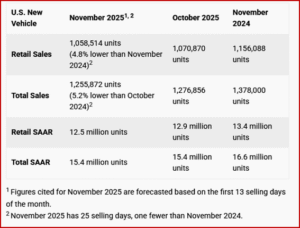
Total new-vehicle sales for November 2025, including retail and non-retail transactions, are estimated to reach 1,255,900, a 5.2% decrease year over year, according to a joint forecast from J.D. Power and GlobalData released today. The seasonally adjusted annualized rate (SAAR) for total new-vehicle sales is expected to be 15.4 million units, down 1.2 million units from November 2024. Global November sales are expected to decrease 3.9% from November 2024. The global selling rate is expected to reach 92.7 million units in November, down from a rate of 95.8 million units in November 2024.
“November’s results reflect another notable—yet anticipated—decline in the [U.S.] new-vehicle sales pace, driven largely by the pull-ahead of electric vehicle (EV) purchases prior to the expiration of federal EV tax credits on Sept. 30. That expiration prompted many shoppers to accelerate buying decisions, resulting in a surge in EV sales that temporarily inflated the overall industry sales pace. Now, two months after the credit expired, the industry continues to feel the effect of those accelerated purchases. In November, EVs are expected to account for just 6.0% of new-vehicle retail sales, consistent with October but well below the 12.9% recorded in September,” said Thomas King, president of OEM solutions at J.D. Power.
“Automakers are recalibrating pricing strategies following the expiration of EV tax credits, tariff dynamics and evolving fuel economy requirements, along with the transition to the new model year. These factors create some distortions in typical seasonal discount patterns. Discounts on EVs are expected to average $11,869 in November, up $260 from November 2024 but down $928 from October 2025. Discounts on non-EVs are projected at $2,960, an increase of $161 from a year ago,” said King. [November 2025 has 25 selling days, one fewer than November 2024 – AutoCrat]
The Critical Devil in the Details
- Fleet sales are expected to total 197,358 units in November, down 7.5% from November 2024. Fleet volume is expected to account for 15.7% of total light-vehicle sales, down 0.4 percentage points from a year ago.
- Internal combustion engine (ICE) vehicles are projected to account for 77.5% of new-vehicle retail sales, an increase of 2.3 percentage points from a year ago. Plug-in hybrid vehicles (PHEV) are on pace to make up 1.1% of sales, down 1.4 percentage points from November 2024, while electric vehicles (EV) are expected to account for 6.0% of sales, down 3.6 percentage points, and hybrid electric vehicles (HEV) are expected to account for 14.5% of new-vehicle retail sales, up 1.7 percentage points.
- U.S. final assembly vehicles are expected to make up 55.7% of sales in November, up 4.1 percentage points from a year ago.
- Trucks/SUVs are on pace to account for 82.6% of new-vehicle retail sales, up 1.0 percentage point from November 2024.
- Retail inventory levels are currently at 2.29 million units, an 11.7% increase from November 2024.
- The industry’s inventory days of supply is 64 days in November, up 5 days from a year ago.
- The average new-vehicle retail transaction price in November is expected to reach $46,029,up $722 from November 2024. Transaction price as a percentage of MSRP rose to 89.4%, up 0.2 percentage points from a year ago.
- Retail buyers are on pace to spend $46.8 billion on new vehicles, down $3.2 billion from November 2024.
- Average incentive spending per unit in November is expected to reach $3,211, down $125 from November 2024. Incentive spending as a percentage of the average MSRP is expected to decrease to 6.2%, down 0.3 percentage points from November 2024.
- Average incentive spending per unit on trucks/SUVs in November is expected to be $3,388, down $79 from a year ago, while the average spending on cars is expected to be $2,362, down $365 from a year ago.
- Leasing is expected to account for 20.5% of sales this month, down 2.7 percentage points from a year ago.
- The average time a new vehicle remains in the dealer’s possession before sale is expected to be 52 days in November, which is flat from a year ago.
- 8% of vehicles sold in less than 10 days in November, down 4.4 percentage points from a year ago.
- Average monthly finance payments are on pace to be $760, up $19 from November 2024. The average interest rate for new-vehicle loans is expected to be 6.05%, down 0.27 percentage points from a year ago.
- So far in November, average used-vehicle retail prices are $29,696, up $725 from a year ago. Trade-in equity is trending towards $7,822, which is down $111 from a year ago.
- 9% of trade-ins are expected to carry negative equity this month—an increase of 3.3 percentage points from November 2024.
- Finance loans with terms greater than or equal to 84 months are expected to reach 11.1% of finance sales this month, up 2.1 percentage points from November 2024.
“The declining percentage of vehicles leased compared to a year ago is adding secondary pressure to lower incentive spending. Leasing is expected to decline 2.7 percentage points from November 2024, reaching 20.5% of sales. EV manufacturers have heavily relied on leasing to allow consumers to benefit from the EV tax credit, but EV leasing has declined 12.0 percentage points from November 2024, trending at 54%. A lower percentage of EV leases combined with a lower percentage of EV sales is driving incentive spending down from a year ago,” said King.
“Affordability pressures remain, with monthly finance payments reaching a record for the month of November at $760. In response, more consumers are turning to extended 84-month loan terms, which are expected to account for 11.1% of financed sales this month—nearing the highest level on record for the month of November set in 2022. The average new-vehicle retail transaction price in November is expected to reach $46,029, up $722 or 1.6% from November 2024.
“The average used-vehicle price is trending toward $29,696, up $725 from a year ago. This reflects the combination of reduced supply of recent model-year used vehicles due to lower new-vehicle production during the pandemic, fewer lease maturities and manufacturers moderating discounts. The rise in used-vehicle prices is good news for new-vehicle buyers with a trade-in, although average trade-in equity in November is down a modest $111 year over year to $7,822. The number of new-vehicle buyers with negative equity on their trade-in is expected to reach 26.9%—an increase of 3.3 percentage points from November 2024. Although negative equity is rising, it remains below the peak November level of 32.9% recorded in 2019.
“Elevated transaction prices in November are not enough to offset the lower sales pace, with consumers on track to spend nearly $46.8 billion on new vehicles this month—6.4% lower than a year ago. Total retailer profit per unit—which includes vehicle gross plus finance and insurance income—is expected to be $2,161, up $6 from November 2024 and down $54 from October 2025. The improvement in retailer profit per unit is primarily a function of lower EV sales, which typically generate lower retailer profits than non-EVs. Total aggregate retailer profit from new-vehicle sales for this month is projected to be $2.2 billion, down 7.7% from last year.
“Subprime mix had been on a steady upward trajectory this year, topping out at 9.8% in October, the highest of any month since March 2020. Subprime mix fell slightly from October to 8.9% in November, still 2.8 percentage points higher than November 2024.
“The industry enters the holiday sales season facing a mix of affordability challenges, evolving incentive strategies and lingering effects from the EV pull-ahead earlier this year. While interest rates have eased and used-vehicle values remain strong—providing some support for trade-in equity—the number of leases set to expire in December is projected to be more than 15% lower than the same period a year ago and 50% lower than in 2023, thus limiting the typical year-end boost. Automakers are expected to maintain disciplined pricing and restrained incentives, particularly in non-EV segments, as they balance profitability with the need to stimulate demand. How aggressively manufacturers choose to adjust discounting and promotional activity during December will be critical in shaping the close of 2025,” said King.
Global Sales Outlook
“October global light-vehicle sales are estimated to have increased 3.1% year over year to 8.2 million units, despite some mixed results across major regions. The selling rate for October was estimated at 95.9 million units, up from a downwardly revised 92.3 million units in September,” said David Oakley, manager, Americas vehicle sales forecasts at GlobalData.
“China, India and Europe contributed the most to year-over-year sales gains in October. Although government subsidies and tax incentives in China are being wound down, there was still sufficient demand to deliver year-over-year growth in October, with new energy vehicles accounting for more than half of all sales. Tax reductions and holiday sales events spurred strong sales in India. In Europe, sales in Turkey increased sharply as consumers sought to invest in vehicles to guard against inflation.
“November sales are expected to decrease 3.9% from November 2024. In part, this is a reflection of a relatively strong month in November 2024. However, tariff effects and economic uncertainty are expected to play a part in subduing demand in Europe and North America, while China could see a slight slowdown as subsidies ease. The global selling rate is expected to reach 92.7 million units in November, down from a rate of 95.8 million units in November 2024.
“Overall, global trade appears to have stabilized slightly over the past month, with some progress made on resolving the Nexperia chip crisis. Despite some uncertainty remaining over the health of the global economy, we see total 2025 sales at 91.4 million units, up by around 200,000 from our forecast a month ago and representing growth of 3.0% year over year,” said Oakley.

About Ken Zino
Ken Zino, editor and publisher of AutoInformed, is a versatile auto industry participant with global experience spanning decades in print and broadcast journalism, as well as social media. He has automobile testing, marketing, public relations and communications experience. He is past president of The International Motor Press Assn, the Detroit Press Club, founding member and first President of the Automotive Press Assn. He is a member of APA, IMPA and the Midwest Automotive Press Assn.
He also brings an historical perspective while citing their contemporary relevance of the work of legendary auto writers such as Ken Purdy, Jim Dunne or Jerry Flint, or writers such as Red Smith, Mark Twain, Thomas Jefferson – all to bring perspective to a chaotic automotive universe.
Above all, decades after he first drove a car, Zino still revels in the sound of the exhaust as the throttle is blipped during a downshift and the driver’s rush that occurs when the entry, apex and exit points of a turn are smoothly and swiftly crossed. It’s the beginning of a perfect lap.
AutoInformed has an editorial philosophy that loves transportation machines of all kinds while promoting critical thinking about the future use of cars and trucks.
Zino builds AutoInformed from his background in automotive journalism starting at Hearst Publishing in New York City on Motor and MotorTech Magazines and car testing where he reviewed hundreds of vehicles in his decade-long stint as the Detroit Bureau Chief of Road & Track magazine. Zino has also worked in Europe, and Asia – now the largest automotive market in the world with China at its center.








November U.S. and Global New Vehicle Sales Forecast Down
Click for more.
Total new-vehicle sales for November 2025, including retail and non-retail transactions, are estimated to reach 1,255,900, a 5.2% decrease year over year, according to a joint forecast from J.D. Power and GlobalData released today. The seasonally adjusted annualized rate (SAAR) for total new-vehicle sales is expected to be 15.4 million units, down 1.2 million units from November 2024. Global November sales are expected to decrease 3.9% from November 2024. The global selling rate is expected to reach 92.7 million units in November, down from a rate of 95.8 million units in November 2024.
“November’s results reflect another notable—yet anticipated—decline in the [U.S.] new-vehicle sales pace, driven largely by the pull-ahead of electric vehicle (EV) purchases prior to the expiration of federal EV tax credits on Sept. 30. That expiration prompted many shoppers to accelerate buying decisions, resulting in a surge in EV sales that temporarily inflated the overall industry sales pace. Now, two months after the credit expired, the industry continues to feel the effect of those accelerated purchases. In November, EVs are expected to account for just 6.0% of new-vehicle retail sales, consistent with October but well below the 12.9% recorded in September,” said Thomas King, president of OEM solutions at J.D. Power.
“Automakers are recalibrating pricing strategies following the expiration of EV tax credits, tariff dynamics and evolving fuel economy requirements, along with the transition to the new model year. These factors create some distortions in typical seasonal discount patterns. Discounts on EVs are expected to average $11,869 in November, up $260 from November 2024 but down $928 from October 2025. Discounts on non-EVs are projected at $2,960, an increase of $161 from a year ago,” said King. [November 2025 has 25 selling days, one fewer than November 2024 – AutoCrat]
The Critical Devil in the Details
“The declining percentage of vehicles leased compared to a year ago is adding secondary pressure to lower incentive spending. Leasing is expected to decline 2.7 percentage points from November 2024, reaching 20.5% of sales. EV manufacturers have heavily relied on leasing to allow consumers to benefit from the EV tax credit, but EV leasing has declined 12.0 percentage points from November 2024, trending at 54%. A lower percentage of EV leases combined with a lower percentage of EV sales is driving incentive spending down from a year ago,” said King.
“Affordability pressures remain, with monthly finance payments reaching a record for the month of November at $760. In response, more consumers are turning to extended 84-month loan terms, which are expected to account for 11.1% of financed sales this month—nearing the highest level on record for the month of November set in 2022. The average new-vehicle retail transaction price in November is expected to reach $46,029, up $722 or 1.6% from November 2024.
“The average used-vehicle price is trending toward $29,696, up $725 from a year ago. This reflects the combination of reduced supply of recent model-year used vehicles due to lower new-vehicle production during the pandemic, fewer lease maturities and manufacturers moderating discounts. The rise in used-vehicle prices is good news for new-vehicle buyers with a trade-in, although average trade-in equity in November is down a modest $111 year over year to $7,822. The number of new-vehicle buyers with negative equity on their trade-in is expected to reach 26.9%—an increase of 3.3 percentage points from November 2024. Although negative equity is rising, it remains below the peak November level of 32.9% recorded in 2019.
“Elevated transaction prices in November are not enough to offset the lower sales pace, with consumers on track to spend nearly $46.8 billion on new vehicles this month—6.4% lower than a year ago. Total retailer profit per unit—which includes vehicle gross plus finance and insurance income—is expected to be $2,161, up $6 from November 2024 and down $54 from October 2025. The improvement in retailer profit per unit is primarily a function of lower EV sales, which typically generate lower retailer profits than non-EVs. Total aggregate retailer profit from new-vehicle sales for this month is projected to be $2.2 billion, down 7.7% from last year.
“Subprime mix had been on a steady upward trajectory this year, topping out at 9.8% in October, the highest of any month since March 2020. Subprime mix fell slightly from October to 8.9% in November, still 2.8 percentage points higher than November 2024.
“The industry enters the holiday sales season facing a mix of affordability challenges, evolving incentive strategies and lingering effects from the EV pull-ahead earlier this year. While interest rates have eased and used-vehicle values remain strong—providing some support for trade-in equity—the number of leases set to expire in December is projected to be more than 15% lower than the same period a year ago and 50% lower than in 2023, thus limiting the typical year-end boost. Automakers are expected to maintain disciplined pricing and restrained incentives, particularly in non-EV segments, as they balance profitability with the need to stimulate demand. How aggressively manufacturers choose to adjust discounting and promotional activity during December will be critical in shaping the close of 2025,” said King.
Global Sales Outlook
“October global light-vehicle sales are estimated to have increased 3.1% year over year to 8.2 million units, despite some mixed results across major regions. The selling rate for October was estimated at 95.9 million units, up from a downwardly revised 92.3 million units in September,” said David Oakley, manager, Americas vehicle sales forecasts at GlobalData.
“China, India and Europe contributed the most to year-over-year sales gains in October. Although government subsidies and tax incentives in China are being wound down, there was still sufficient demand to deliver year-over-year growth in October, with new energy vehicles accounting for more than half of all sales. Tax reductions and holiday sales events spurred strong sales in India. In Europe, sales in Turkey increased sharply as consumers sought to invest in vehicles to guard against inflation.
“November sales are expected to decrease 3.9% from November 2024. In part, this is a reflection of a relatively strong month in November 2024. However, tariff effects and economic uncertainty are expected to play a part in subduing demand in Europe and North America, while China could see a slight slowdown as subsidies ease. The global selling rate is expected to reach 92.7 million units in November, down from a rate of 95.8 million units in November 2024.
“Overall, global trade appears to have stabilized slightly over the past month, with some progress made on resolving the Nexperia chip crisis. Despite some uncertainty remaining over the health of the global economy, we see total 2025 sales at 91.4 million units, up by around 200,000 from our forecast a month ago and representing growth of 3.0% year over year,” said Oakley.
About Ken Zino
Ken Zino, editor and publisher of AutoInformed, is a versatile auto industry participant with global experience spanning decades in print and broadcast journalism, as well as social media. He has automobile testing, marketing, public relations and communications experience. He is past president of The International Motor Press Assn, the Detroit Press Club, founding member and first President of the Automotive Press Assn. He is a member of APA, IMPA and the Midwest Automotive Press Assn. He also brings an historical perspective while citing their contemporary relevance of the work of legendary auto writers such as Ken Purdy, Jim Dunne or Jerry Flint, or writers such as Red Smith, Mark Twain, Thomas Jefferson – all to bring perspective to a chaotic automotive universe. Above all, decades after he first drove a car, Zino still revels in the sound of the exhaust as the throttle is blipped during a downshift and the driver’s rush that occurs when the entry, apex and exit points of a turn are smoothly and swiftly crossed. It’s the beginning of a perfect lap. AutoInformed has an editorial philosophy that loves transportation machines of all kinds while promoting critical thinking about the future use of cars and trucks. Zino builds AutoInformed from his background in automotive journalism starting at Hearst Publishing in New York City on Motor and MotorTech Magazines and car testing where he reviewed hundreds of vehicles in his decade-long stint as the Detroit Bureau Chief of Road & Track magazine. Zino has also worked in Europe, and Asia – now the largest automotive market in the world with China at its center.