Click for more.
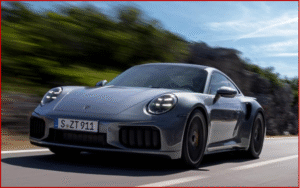
Porsche (P911.DE) showed the new 911 Turbo S series at the IAA Mobility motor show in Munich. The twin-turbo powertrain with so-called T-Hybrid technology makes the new 911 Turbo S the most powerful production 911 thus far. The sports car, available as a coupé and cabriolet, claims more intelligent aerodynamics, an optimized chassis and more exclusive equipment. Prices, inevitably high, are thus far are unknown. They will be influenced negatively by the ongoing Trump Tariff economic chaos.*
“The 911 Turbo S is the most complete and versatile form of driving a Porsche 911. Whether in daily use, on long autobahn journeys or on the racetrack – we have made the new 911 Turbo S even more comfortable, more individual and significantly faster than its predecessor,” said Frank Moser, Vice President of the 911 and 718 model line.**
Twin-Turbo T-Hybrid Powertrain
“The newly developed, high-performance powertrain achieves a system output of 523 kW (711 PS). This makes the new 911 Turbo S the most powerful production 911 to date. The maximum torque of the powertrain is 800 Nm and is available over an extremely wide range of 2,300 to 6,000 rpm. The power curve is also characterized by an unusually broad peak: between 6500 and 7000 crankshaft revolutions, the full power of 711 PS is available.
Click to enlarge.
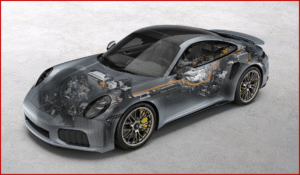
“Equipped with the innovative and particularly lightweight T-Hybrid technology with a 400 V system, it increases power by 61 PS compared to its predecessor. A T-Hybrid powertrain first debuted in 2024 in the 911 Carrera GTS. The technology has since been significantly further developed for use in the new 911 Turbo S. While a single electric exhaust gas turbocharger (eTurbo) is integrated into the T-Hybrid system in the GTS, two eTurbos are used in the new 911 Turbo S. The turbine and compressor were specifically designed to meet the requirements of the top-of-the-range model. The two eTurbos contribute not only to the considerable increase in performance but also improve the responsiveness of the powertrain.
“The particularly compact lightweight high-voltage battery with a capacity of 1.9 kWh is the same as that used in the 911 Carrera GTS (911 Carrera GTS: Fuel consumption** combined (WLTP) 11.0 – 10.4 l/100 km, CO2 emissions* combined (WLTP) 248 – 236 g/km, Class G , Class weighted combined G ). An eight-speed PDK with an integrated electric motor transmits the power to the Porsche Traction Management (PTM) all-wheel drive system. The Turbo S Coupé’s sprint time of 0-100 km/h is reduced by 0.2 seconds to 2.5 seconds compared to its predecessor. It takes just 8.4 seconds to reach 200 km/h, which represents an improvement of 0.5 seconds. The top speed of the new 911 Turbo S is 322 km/h.
“A T-Hybrid powertrain first debuted in 2024 in the 911 Carrera GTS. The technology has since been significantly further developed for use in the new 911 Turbo S. While a single electric exhaust gas turbocharger (eTurbo) is integrated into the T-Hybrid system in the GTS, two eTurbos are used in the new 911 Turbo S. The turbine and compressor were specifically designed to meet the requirements of the top-of-the-range model. The two eTurbos contribute not only to the considerable increase in performance but also improve the responsiveness of the powertrain.
“The particularly compact lightweight high-voltage battery with a capacity of 1.9 kWh is the same as that used in the 911 Carrera GTS (911 Carrera GTS: Fuel consumption* combined (WLTP) 11.0 – 10.4 l/100 km, CO2 emissions* combined (WLTP) 248 – 236 g/km, CO class G , CO2 class weighted combined G ). An eight-speed PDK with an integrated electric motor transmits the power to the Porsche Traction Management (PTM) all-wheel drive system. The Turbo S Coupé’s sprint time of 0-100 km/h is reduced by 0.2 seconds to 2.5 seconds compared to its predecessor. It takes just 8.4 seconds to reach 200 km/h, which represents an improvement of 0.5 seconds. The top speed of the new 911 Turbo S is 322 km/h,” Porsche said.
Nürburgring Nordschleife
Despite the additional components of the performance hybrid system, the new 911 Turbo S weighs only 85 kilograms more than its predecessor. “The increase in weight has been more than compensated for in all areas relevant to driving dynamics. The best demonstration of this is the lap time on the Nürburgring Nordschleife. As part of the final development drives conducted in autumn 2024, a lightly camouflaged 911 Turbo S achieved a time of 7:03.92 minutes under notarial supervision – around 14 seconds faster than its predecessor. ‘You don’t feel the weight gain. On the contrary – the car is much more agile, has more grip and is significantly faster than its predecessor in all relevant sections of the track,’ said Porsche Brand Ambassador Jörg Bergmeister, who was involved in the development and testing of the new 911 Turbo S and set the official lap time.
The new generation of tires used in the 911 Turbo S offers “significantly improved dry handling while maintaining good performance in the wet. The rear axle of the sports car is now fitted with 10 millimeters wider tires compared to the previous model, measuring 325/30 ZR 21. As with its predecessor 255/35 ZR 20 size tires are mounted on the front axle. The standard Porsche Ceramic Composite Brake (PCCB) system is fitted with new brake pads and can withstand enormous loads. This improves braking performance and pedal feel in equal measure. The engineers increased the brake disc diameter on the rear axle from 390 mm to 410 mm. Brake discs with a diameter of 420 mm are used at the front. This means that the new 911 Turbo S is equipped with the largest PCCB brake system that Porsche has ever installed in a two-door model,” Porsche said.
There are Active, vertically arranged cooling air flaps at the front of the vehicle and an active front diffuser, together with an adjustable front spoiler lip and the extendable and tilting rear wing carried over from the predecessor.
“Cooling air flows optimally to the brakes and radiators. Depending on the driving situation, the active aerodynamics intelligently reduce lift or, when retracted, drag. The drag coefficient of the 911 Turbo S Coupé has been reduced by 10% compared to its predecessor, when all active aerodynamic elements are in their most efficient position. In addition, the active aerodynamics improve the wet braking performance of the top model: in wet mode, the front diffusers close to shield the front brake discs from excessive water spray,” Porsche said.
“The new Turbo S marks the introduction of Porsche’s cross-series Turbo design strategy in the 911. Numerous contrasting elements are finished in the color Turbonite, which is reserved exclusively for Turbo variants. These include the Porsche crest and the Turbo S lettering at the rear. In addition, Turbo S-specific inserts in the slats of the rear wing and the side window strips differentiate the top-of-the-range model. The range of wheels for the Turbo S includes new center-lock designs in Turbonite.
“As is typical for the Turbo, the new top-of-the-range model of the current 911 series has a visibly wider body and track compared to the Carrera models, as well as openings in the rear side section. On the redesigned rear fascia, striking ventilation openings additionally emphasize the width. The tailpipes of the titanium exhaust system in a newly interpreted design typical of the Turbo underscore the car’s position in the model line, as does a dynamic pearl structure above the taillight strip. Oval titanium tailpipe trims with a special structure are available as an option. Overall, its exclusive appearance clearly differentiates the Turbo S from other 911 models.
“Turbonite accents also characterize the interior. They can be found in the door panels, on the steering wheel, dashboard and center console surrounds, as decorative stitching, and on the Sport Chrono stopwatch and instrument cluster. Porsche’s designers have also used the color for the seat belts and several buttons in the center console. For the first time, carbon-structured trim strips with neodyme trim and a perforated microfiber headliner with black backing are part of the exclusive interior.
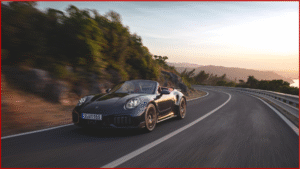
“As a coupé, the 911 Turbo S is delivered as a two-seater as standard. On request, the rear seat system can be configured at no extra charge. The cabriolet is delivered in a 2+2 configuration. Porsche equips the new 911 Turbo S with HD Matrix LED headlights as standard. They feature innovative light functions that increase safety noticeably when driving at night. The Sport Chrono Package including tire temperature gauge, the specifically tuned PASM suspension, the PDCC electro-hydraulic roll support and the titanium sports exhaust system are also standard equipment. In the interior, Adaptive 18-way Sports Seats Plus with memory function and “turbo S” lettering on the headrests are used ex works. The Turbo S-specific embossing on the seat surfaces and door panels is a reinterpretation of the design features of the first 911 Turbo 930. The folding lightweight sports bucket seat familiar from the 911 GT3 is available as an option for the coupé,” Porsche said.
Click for more.
Further customization options are available via the Porsche Exclusive Manufaktur range. In addition to the Paint to Sample program with more than 100 exterior colors, these options include Turbo Exclusive Design wheels with carbon blades painted in Neodyme, a lightweight roof in visible carbon, Exclusive Design rear lights and air intakes in the rear side section made of carbon. For the first time, lightweight wiper arms made of carbon, which are 50% lighter than the standard component, can be ordered. The interior can be further enhanced with details such as decorative stitching in contrasting colors, personalized embossing, seat consoles and sill panels in leather with fine decorative stitching, as well as personalized painted vehicle keys,” Porsche said.
Porsche 911 Turbo S Emission and Fuel Economy Specs
- Preliminary values: Fuel consumption* combined (WLTP) 11.8 – 11.6 l/100 km, CO2emissions* combined (WLTP) 266 – 262 g/km, CO2class G , CO2class weighted combined G , 911 Turbo S Cabriolet (preliminary values): Fuel consumption* combined (WLTP) 11.8 – 11.7 l/100 km, CO2 emissions* combined (WLTP) 267 – 265 g/km, CO2 class G , CO2 class weighted combined G.
*AutoInformed on
**Inevitable Porsche 911 Turbo S Footnote
Where values are indicated as ranges, they do not refer to a single, specific vehicle and are not part of the offered product range. They are only for the purposes of comparison between different vehicle types. Additional equipment and accessories (add-on parts, tire formats etc.) can change relevant vehicle parameters such as weight, rolling resistance and aerodynamics. These factors, in addition to weather, traffic conditions and driving behavior, can influence the fuel/electricity consumption, CO2 emissions, range and performance values of a vehicle.

About Ken Zino
Ken Zino, editor and publisher of AutoInformed, is a versatile auto industry participant with global experience spanning decades in print and broadcast journalism, as well as social media. He has automobile testing, marketing, public relations and communications experience. He is past president of The International Motor Press Assn, the Detroit Press Club, founding member and first President of the Automotive Press Assn. He is a member of APA, IMPA and the Midwest Automotive Press Assn.
He also brings an historical perspective while citing their contemporary relevance of the work of legendary auto writers such as Ken Purdy, Jim Dunne or Jerry Flint, or writers such as Red Smith, Mark Twain, Thomas Jefferson – all to bring perspective to a chaotic automotive universe.
Above all, decades after he first drove a car, Zino still revels in the sound of the exhaust as the throttle is blipped during a downshift and the driver’s rush that occurs when the entry, apex and exit points of a turn are smoothly and swiftly crossed. It’s the beginning of a perfect lap.
AutoInformed has an editorial philosophy that loves transportation machines of all kinds while promoting critical thinking about the future use of cars and trucks.
Zino builds AutoInformed from his background in automotive journalism starting at Hearst Publishing in New York City on Motor and MotorTech Magazines and car testing where he reviewed hundreds of vehicles in his decade-long stint as the Detroit Bureau Chief of Road & Track magazine. Zino has also worked in Europe, and Asia – now the largest automotive market in the world with China at its center.







New Porsche 911 Turbo S Most Powerful 911 Ever
Click for more.
Porsche (P911.DE) showed the new 911 Turbo S series at the IAA Mobility motor show in Munich. The twin-turbo powertrain with so-called T-Hybrid technology makes the new 911 Turbo S the most powerful production 911 thus far. The sports car, available as a coupé and cabriolet, claims more intelligent aerodynamics, an optimized chassis and more exclusive equipment. Prices, inevitably high, are thus far are unknown. They will be influenced negatively by the ongoing Trump Tariff economic chaos.*
“The 911 Turbo S is the most complete and versatile form of driving a Porsche 911. Whether in daily use, on long autobahn journeys or on the racetrack – we have made the new 911 Turbo S even more comfortable, more individual and significantly faster than its predecessor,” said Frank Moser, Vice President of the 911 and 718 model line.**
Twin-Turbo T-Hybrid Powertrain
“The newly developed, high-performance powertrain achieves a system output of 523 kW (711 PS). This makes the new 911 Turbo S the most powerful production 911 to date. The maximum torque of the powertrain is 800 Nm and is available over an extremely wide range of 2,300 to 6,000 rpm. The power curve is also characterized by an unusually broad peak: between 6500 and 7000 crankshaft revolutions, the full power of 711 PS is available.
Click to enlarge.
“Equipped with the innovative and particularly lightweight T-Hybrid technology with a 400 V system, it increases power by 61 PS compared to its predecessor. A T-Hybrid powertrain first debuted in 2024 in the 911 Carrera GTS. The technology has since been significantly further developed for use in the new 911 Turbo S. While a single electric exhaust gas turbocharger (eTurbo) is integrated into the T-Hybrid system in the GTS, two eTurbos are used in the new 911 Turbo S. The turbine and compressor were specifically designed to meet the requirements of the top-of-the-range model. The two eTurbos contribute not only to the considerable increase in performance but also improve the responsiveness of the powertrain.
“The particularly compact lightweight high-voltage battery with a capacity of 1.9 kWh is the same as that used in the 911 Carrera GTS (911 Carrera GTS: Fuel consumption** combined (WLTP) 11.0 – 10.4 l/100 km, CO2 emissions* combined (WLTP) 248 – 236 g/km, Class G , Class weighted combined G ). An eight-speed PDK with an integrated electric motor transmits the power to the Porsche Traction Management (PTM) all-wheel drive system. The Turbo S Coupé’s sprint time of 0-100 km/h is reduced by 0.2 seconds to 2.5 seconds compared to its predecessor. It takes just 8.4 seconds to reach 200 km/h, which represents an improvement of 0.5 seconds. The top speed of the new 911 Turbo S is 322 km/h.
“A T-Hybrid powertrain first debuted in 2024 in the 911 Carrera GTS. The technology has since been significantly further developed for use in the new 911 Turbo S. While a single electric exhaust gas turbocharger (eTurbo) is integrated into the T-Hybrid system in the GTS, two eTurbos are used in the new 911 Turbo S. The turbine and compressor were specifically designed to meet the requirements of the top-of-the-range model. The two eTurbos contribute not only to the considerable increase in performance but also improve the responsiveness of the powertrain.
“The particularly compact lightweight high-voltage battery with a capacity of 1.9 kWh is the same as that used in the 911 Carrera GTS (911 Carrera GTS: Fuel consumption* combined (WLTP) 11.0 – 10.4 l/100 km, CO2 emissions* combined (WLTP) 248 – 236 g/km, CO class G , CO2 class weighted combined G ). An eight-speed PDK with an integrated electric motor transmits the power to the Porsche Traction Management (PTM) all-wheel drive system. The Turbo S Coupé’s sprint time of 0-100 km/h is reduced by 0.2 seconds to 2.5 seconds compared to its predecessor. It takes just 8.4 seconds to reach 200 km/h, which represents an improvement of 0.5 seconds. The top speed of the new 911 Turbo S is 322 km/h,” Porsche said.
Nürburgring Nordschleife
Despite the additional components of the performance hybrid system, the new 911 Turbo S weighs only 85 kilograms more than its predecessor. “The increase in weight has been more than compensated for in all areas relevant to driving dynamics. The best demonstration of this is the lap time on the Nürburgring Nordschleife. As part of the final development drives conducted in autumn 2024, a lightly camouflaged 911 Turbo S achieved a time of 7:03.92 minutes under notarial supervision – around 14 seconds faster than its predecessor. ‘You don’t feel the weight gain. On the contrary – the car is much more agile, has more grip and is significantly faster than its predecessor in all relevant sections of the track,’ said Porsche Brand Ambassador Jörg Bergmeister, who was involved in the development and testing of the new 911 Turbo S and set the official lap time.
The new generation of tires used in the 911 Turbo S offers “significantly improved dry handling while maintaining good performance in the wet. The rear axle of the sports car is now fitted with 10 millimeters wider tires compared to the previous model, measuring 325/30 ZR 21. As with its predecessor 255/35 ZR 20 size tires are mounted on the front axle. The standard Porsche Ceramic Composite Brake (PCCB) system is fitted with new brake pads and can withstand enormous loads. This improves braking performance and pedal feel in equal measure. The engineers increased the brake disc diameter on the rear axle from 390 mm to 410 mm. Brake discs with a diameter of 420 mm are used at the front. This means that the new 911 Turbo S is equipped with the largest PCCB brake system that Porsche has ever installed in a two-door model,” Porsche said.
There are Active, vertically arranged cooling air flaps at the front of the vehicle and an active front diffuser, together with an adjustable front spoiler lip and the extendable and tilting rear wing carried over from the predecessor.
“Cooling air flows optimally to the brakes and radiators. Depending on the driving situation, the active aerodynamics intelligently reduce lift or, when retracted, drag. The drag coefficient of the 911 Turbo S Coupé has been reduced by 10% compared to its predecessor, when all active aerodynamic elements are in their most efficient position. In addition, the active aerodynamics improve the wet braking performance of the top model: in wet mode, the front diffusers close to shield the front brake discs from excessive water spray,” Porsche said.
“The new Turbo S marks the introduction of Porsche’s cross-series Turbo design strategy in the 911. Numerous contrasting elements are finished in the color Turbonite, which is reserved exclusively for Turbo variants. These include the Porsche crest and the Turbo S lettering at the rear. In addition, Turbo S-specific inserts in the slats of the rear wing and the side window strips differentiate the top-of-the-range model. The range of wheels for the Turbo S includes new center-lock designs in Turbonite.
“As is typical for the Turbo, the new top-of-the-range model of the current 911 series has a visibly wider body and track compared to the Carrera models, as well as openings in the rear side section. On the redesigned rear fascia, striking ventilation openings additionally emphasize the width. The tailpipes of the titanium exhaust system in a newly interpreted design typical of the Turbo underscore the car’s position in the model line, as does a dynamic pearl structure above the taillight strip. Oval titanium tailpipe trims with a special structure are available as an option. Overall, its exclusive appearance clearly differentiates the Turbo S from other 911 models.
“Turbonite accents also characterize the interior. They can be found in the door panels, on the steering wheel, dashboard and center console surrounds, as decorative stitching, and on the Sport Chrono stopwatch and instrument cluster. Porsche’s designers have also used the color for the seat belts and several buttons in the center console. For the first time, carbon-structured trim strips with neodyme trim and a perforated microfiber headliner with black backing are part of the exclusive interior.
“As a coupé, the 911 Turbo S is delivered as a two-seater as standard. On request, the rear seat system can be configured at no extra charge. The cabriolet is delivered in a 2+2 configuration. Porsche equips the new 911 Turbo S with HD Matrix LED headlights as standard. They feature innovative light functions that increase safety noticeably when driving at night. The Sport Chrono Package including tire temperature gauge, the specifically tuned PASM suspension, the PDCC electro-hydraulic roll support and the titanium sports exhaust system are also standard equipment. In the interior, Adaptive 18-way Sports Seats Plus with memory function and “turbo S” lettering on the headrests are used ex works. The Turbo S-specific embossing on the seat surfaces and door panels is a reinterpretation of the design features of the first 911 Turbo 930. The folding lightweight sports bucket seat familiar from the 911 GT3 is available as an option for the coupé,” Porsche said.
Click for more.
Further customization options are available via the Porsche Exclusive Manufaktur range. In addition to the Paint to Sample program with more than 100 exterior colors, these options include Turbo Exclusive Design wheels with carbon blades painted in Neodyme, a lightweight roof in visible carbon, Exclusive Design rear lights and air intakes in the rear side section made of carbon. For the first time, lightweight wiper arms made of carbon, which are 50% lighter than the standard component, can be ordered. The interior can be further enhanced with details such as decorative stitching in contrasting colors, personalized embossing, seat consoles and sill panels in leather with fine decorative stitching, as well as personalized painted vehicle keys,” Porsche said.
Porsche 911 Turbo S Emission and Fuel Economy Specs
*AutoInformed on
**Inevitable Porsche 911 Turbo S Footnote
Where values are indicated as ranges, they do not refer to a single, specific vehicle and are not part of the offered product range. They are only for the purposes of comparison between different vehicle types. Additional equipment and accessories (add-on parts, tire formats etc.) can change relevant vehicle parameters such as weight, rolling resistance and aerodynamics. These factors, in addition to weather, traffic conditions and driving behavior, can influence the fuel/electricity consumption, CO2 emissions, range and performance values of a vehicle.
About Ken Zino
Ken Zino, editor and publisher of AutoInformed, is a versatile auto industry participant with global experience spanning decades in print and broadcast journalism, as well as social media. He has automobile testing, marketing, public relations and communications experience. He is past president of The International Motor Press Assn, the Detroit Press Club, founding member and first President of the Automotive Press Assn. He is a member of APA, IMPA and the Midwest Automotive Press Assn. He also brings an historical perspective while citing their contemporary relevance of the work of legendary auto writers such as Ken Purdy, Jim Dunne or Jerry Flint, or writers such as Red Smith, Mark Twain, Thomas Jefferson – all to bring perspective to a chaotic automotive universe. Above all, decades after he first drove a car, Zino still revels in the sound of the exhaust as the throttle is blipped during a downshift and the driver’s rush that occurs when the entry, apex and exit points of a turn are smoothly and swiftly crossed. It’s the beginning of a perfect lap. AutoInformed has an editorial philosophy that loves transportation machines of all kinds while promoting critical thinking about the future use of cars and trucks. Zino builds AutoInformed from his background in automotive journalism starting at Hearst Publishing in New York City on Motor and MotorTech Magazines and car testing where he reviewed hundreds of vehicles in his decade-long stint as the Detroit Bureau Chief of Road & Track magazine. Zino has also worked in Europe, and Asia – now the largest automotive market in the world with China at its center.