Click for more.
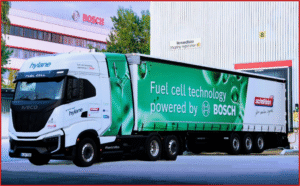
Bosch said today that it has taken another step toward climate-friendly logistics. Its Nuremberg plant recently started using a fuel-cell electric truck in plant traffic. The truck is equipped with the Bosch fuel-cell power module (FCPM). [The Germans, who once scoffed at Japanese technological prowess appear to be trailing them in fuels cells – AutoCrat.]*
“When we decided to make our plant traffic more climate-friendly, it was clear that we wanted a truck featuring Bosch’s FCPM,” said Alexander Weichsel, the commercial plant manager in Nuremberg. “This deployment is an important building block that helps us reduce our emissions in logistics. The fact that several thousand trucks with Bosch fuel-cell systems are already on the road worldwide shows that the concept is proving its worth.”
“By converting hydrogen and oxygen into water and electricity, the 40-ton truck can be operated completely electrically. Using renewable hydrogen even makes the truck’s powertrain climate neutral. By switching to the new vehicle, Bosch also wants to set an example in Nuremberg and play an active role in developing a hydrogen value chain in line with the state of Bavaria’s Hydrogen Strategy 2.0,” said Weichsel.
The Iveco truck in use has a range of up to 800 kilometers. It is operated by the freight forwarder Schäflein on behalf of the Bosch plant. Schäflein in turn rents the vehicle from the rental provider Hylane, which specializes in emissions-free trucks. The vehicle, which primarily transports products from the plant’s own manufacturing operations, is expected to cover 12,000 kilometers per year. As a result, the Nuremberg plant will reduce Bosch’s CO2 emissions – because the vehicle runs on hydrogen instead of diesel.
“Alongside this reduction of emissions in logistics, however, the primary reason for putting the truck into service is initially to gather experience and as much data as possible. This will flow into the further development of future powertrain systems such as the Compact 190 and Compact 300 models,” Bosch said.
“The fact we’ve had no problems operating this truck shows that the fuel cell is ready for volume production,” claimed Weichsel. “The key to a successful hydrogen economy is above all to ensure an abundance of affordable hydrogen and put in place an adequate H2 infrastructure, including in Nuremberg. We’re actively working with industrial partners in the Nuremberg metropolitan region to implement Bavaria’s hydrogen strategy.”
With the Iveco FCPM truck, Bosch has put its own system into real operation in Europe for the first time. The truck’s five hydrogen tanks hold up to 70 kilograms at a pressure of 700 bar. Its fuel-cell system delivers a total output of over 200 kilowatts. Its e-axle is powered by the fuel-cell system, while two battery packs installed centrally in the truck serve as energy storage. The truck has a system output of 400 kilowatts and a gross weight rating of up to 44 metric tons. In addition to its robustness and long range – which, unlike battery-electric vehicles, is not affected by the outside temperature – the truck has short refueling times, which are similar to those of a diesel truck. Large-scale production of the FCPM started in Stuttgart-Feuerbach in mid-2023. The Bosch plant in Bamberg supplies the fuel-cell stack, while the Homburg plant supplies other components such as the electric air compressor and the recirculation blower.
*AutoInformed on

About Ken Zino
Ken Zino, editor and publisher of AutoInformed, is a versatile auto industry participant with global experience spanning decades in print and broadcast journalism, as well as social media. He has automobile testing, marketing, public relations and communications experience. He is past president of The International Motor Press Assn, the Detroit Press Club, founding member and first President of the Automotive Press Assn. He is a member of APA, IMPA and the Midwest Automotive Press Assn.
He also brings an historical perspective while citing their contemporary relevance of the work of legendary auto writers such as Ken Purdy, Jim Dunne or Jerry Flint, or writers such as Red Smith, Mark Twain, Thomas Jefferson – all to bring perspective to a chaotic automotive universe.
Above all, decades after he first drove a car, Zino still revels in the sound of the exhaust as the throttle is blipped during a downshift and the driver’s rush that occurs when the entry, apex and exit points of a turn are smoothly and swiftly crossed. It’s the beginning of a perfect lap.
AutoInformed has an editorial philosophy that loves transportation machines of all kinds while promoting critical thinking about the future use of cars and trucks.
Zino builds AutoInformed from his background in automotive journalism starting at Hearst Publishing in New York City on Motor and MotorTech Magazines and car testing where he reviewed hundreds of vehicles in his decade-long stint as the Detroit Bureau Chief of Road & Track magazine. Zino has also worked in Europe, and Asia – now the largest automotive market in the world with China at its center.








Bosch Puts Its First Hydrogen Fuel Cell Truck Into Service
Click for more.
Bosch said today that it has taken another step toward climate-friendly logistics. Its Nuremberg plant recently started using a fuel-cell electric truck in plant traffic. The truck is equipped with the Bosch fuel-cell power module (FCPM). [The Germans, who once scoffed at Japanese technological prowess appear to be trailing them in fuels cells – AutoCrat.]*
“When we decided to make our plant traffic more climate-friendly, it was clear that we wanted a truck featuring Bosch’s FCPM,” said Alexander Weichsel, the commercial plant manager in Nuremberg. “This deployment is an important building block that helps us reduce our emissions in logistics. The fact that several thousand trucks with Bosch fuel-cell systems are already on the road worldwide shows that the concept is proving its worth.”
“By converting hydrogen and oxygen into water and electricity, the 40-ton truck can be operated completely electrically. Using renewable hydrogen even makes the truck’s powertrain climate neutral. By switching to the new vehicle, Bosch also wants to set an example in Nuremberg and play an active role in developing a hydrogen value chain in line with the state of Bavaria’s Hydrogen Strategy 2.0,” said Weichsel.
The Iveco truck in use has a range of up to 800 kilometers. It is operated by the freight forwarder Schäflein on behalf of the Bosch plant. Schäflein in turn rents the vehicle from the rental provider Hylane, which specializes in emissions-free trucks. The vehicle, which primarily transports products from the plant’s own manufacturing operations, is expected to cover 12,000 kilometers per year. As a result, the Nuremberg plant will reduce Bosch’s CO2 emissions – because the vehicle runs on hydrogen instead of diesel.
“Alongside this reduction of emissions in logistics, however, the primary reason for putting the truck into service is initially to gather experience and as much data as possible. This will flow into the further development of future powertrain systems such as the Compact 190 and Compact 300 models,” Bosch said.
“The fact we’ve had no problems operating this truck shows that the fuel cell is ready for volume production,” claimed Weichsel. “The key to a successful hydrogen economy is above all to ensure an abundance of affordable hydrogen and put in place an adequate H2 infrastructure, including in Nuremberg. We’re actively working with industrial partners in the Nuremberg metropolitan region to implement Bavaria’s hydrogen strategy.”
With the Iveco FCPM truck, Bosch has put its own system into real operation in Europe for the first time. The truck’s five hydrogen tanks hold up to 70 kilograms at a pressure of 700 bar. Its fuel-cell system delivers a total output of over 200 kilowatts. Its e-axle is powered by the fuel-cell system, while two battery packs installed centrally in the truck serve as energy storage. The truck has a system output of 400 kilowatts and a gross weight rating of up to 44 metric tons. In addition to its robustness and long range – which, unlike battery-electric vehicles, is not affected by the outside temperature – the truck has short refueling times, which are similar to those of a diesel truck. Large-scale production of the FCPM started in Stuttgart-Feuerbach in mid-2023. The Bosch plant in Bamberg supplies the fuel-cell stack, while the Homburg plant supplies other components such as the electric air compressor and the recirculation blower.
*AutoInformed on
About Ken Zino
Ken Zino, editor and publisher of AutoInformed, is a versatile auto industry participant with global experience spanning decades in print and broadcast journalism, as well as social media. He has automobile testing, marketing, public relations and communications experience. He is past president of The International Motor Press Assn, the Detroit Press Club, founding member and first President of the Automotive Press Assn. He is a member of APA, IMPA and the Midwest Automotive Press Assn. He also brings an historical perspective while citing their contemporary relevance of the work of legendary auto writers such as Ken Purdy, Jim Dunne or Jerry Flint, or writers such as Red Smith, Mark Twain, Thomas Jefferson – all to bring perspective to a chaotic automotive universe. Above all, decades after he first drove a car, Zino still revels in the sound of the exhaust as the throttle is blipped during a downshift and the driver’s rush that occurs when the entry, apex and exit points of a turn are smoothly and swiftly crossed. It’s the beginning of a perfect lap. AutoInformed has an editorial philosophy that loves transportation machines of all kinds while promoting critical thinking about the future use of cars and trucks. Zino builds AutoInformed from his background in automotive journalism starting at Hearst Publishing in New York City on Motor and MotorTech Magazines and car testing where he reviewed hundreds of vehicles in his decade-long stint as the Detroit Bureau Chief of Road & Track magazine. Zino has also worked in Europe, and Asia – now the largest automotive market in the world with China at its center.