Click for more.
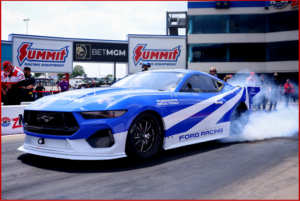
At the NHRA Charlotte competition this weekend, a Mustang Cobra Jet 2200 ran an ET of 6.76s with a top speed of 222 mph in the quarter mile, the fastest EV time. [Slower than Pro Stock – AutoCrat]. Reigning Top Fuel world champion Doug Kalitta shattered the track speed record in the final round en route to the win on Sunday at zMAX Dragway, beating a talent laden final quad of Shawn Langdon, Tony Stewart, and Leah Pruett at the 16th annual NHRA 4-Wide Nationals. Ron Capps (Funny Car), Matt Hartford (Pro Stock) and Gaige Herrera (Pro Stock Motorcycle) also won the fourth of 20 races during the 2026 NHRA Mission Foods Drag Racing Series season.*
“This was our opportunity to put Cobra Jet 2200 in front of fans, racers, media, and the broader performance community to show what this program is capable of in the environment where it matters most.” said Nick Kuhajda, Ford Racing Engineering Manager, Electric VehicleDemonstrators. (sic)”
In a release today Ford noted that the Cobra Jet 2200 is part of a larger Ford Racing story. Before 2200, there was the Cobra Jet 1400. Then there was the Super Cobra Jet 1800. Both programs… “challenged us to think differently about power delivery, battery performance, calibration, traction, and how to package extreme electric performance in a way that could actually perform on the drag strip.” [It should be noted that this is an extremely limited class so far in the larger NHRA world. Ford did not name the driver. – AutoCrat].
“Cobra Jet 2200 is the next step in that progression. What makes this vehicle important is that it reflects a deeper evolution in how we think about EV performance. This is a purpose-built electric drag car created to answer very specific engineering questions at a very high level. What happens when you pursue maximum performance with an electric platform designed for this environment? How do you manage power, traction, serviceability, and safety in a package that has to perform repeatedly under extreme load? How do you take everything you have learned and apply it with precision?,” said Kuhajda.
“To answer, the whole Cobra Jet 2200 system works in three critical steps that have seen incredible engineering developments from our team. What makes this vehicle important is that it reflects a deeper evolution in how we think about EV performance. This is a purpose-built electric drag car created to answer very specific engineering questions at a very high level.
- What happens when you pursue maximum performance with an electric platform designed for this environment?
- How do you manage power, traction, serviceability, and safety in a package that has to perform repeatedly under extreme load?
- How do you take everything you have learned and apply it with precision?”
Ford noted three critical engineering developments.
First: Weight Reduction
A core mission for Cobra Jet 2200 was to shed every pound in pursuit of performance. This can be seen in the world-class power density from two 1,200 horsepower electric motors, a custom tube-frame chassis, carbon-fiber body, a NASCAR-style vinyl wrap (20 pounds lighter than a standard vinyl!). “Peak output always gets attention, and it should, but the bigger story is how much capability the team was able to package into a highly optimized drag racing system. Cobra Jet 2200 is over 900 pounds lighter than the Super Cobra Jet 1800, which was 1000 pounds lighter than the Cobra Jet 1400.”
This is the result of pushing for maximum output, reduced mass, and greater efficiency at the same time. Cobra Jet 2200 represents a major step forward in how much performance can be extracted from an EV package purpose-built for this environment.
Second: A Drag Racing-Derived Driveline to Handle the Power
“Cobra Jet 2200 delivers 2200 horsepower to the wheels, but that is only half of the story. With 1,340 lbs. ft. of torque on tap, the next challenge is making it usable and delivering it in a way that the tire and surface can accept. The Reverse-Acting Centrifugal Clutch (RACC) paired with a 5-speed clutch-less transmission helps manage how power is applied to the track. Our team developed the patented RACC that allows the car to launch in direct drive and then slip during shifts to help prevent tire slip and keep the car controlled as the run develops. It is a critical bridge between raw capability and real performance.
“Behind the a-pillar, you could be mistaken into thinking that this is a gas-powered drag car based on the transmission, driveshaft, and rear end coming right out of a drag racer’s parts bin. This was not a compromise, but the result of racers perfecting their craft over 70 years of competition.
“From an engineering perspective, these components allow us to maximize efficiency and power to the ground throughout the run. No need to reinvent a well-honed wheel. While most EV’s make do with one or two gears, we shift through five to ensure we are achieving the maximum torque at the wheel at every second in the run.”
Third: Safety System Leveraging Pyrofuse Technology
The final piece is protection. In a high-voltage race car operating at this level, safety has to be built into the system from the beginning.
“A pyrotechnic circuit breaker (pyrofuse) is a key part of our strategy. It helps isolate the high-voltage system when needed and is engineered to support safe operation in a true racing environment. It does this by physically breaking the high-voltage circuit with a small detonation. It also helps that pyrofuses are lighter and faster-acting than their melting-fuse counterparts.
“Ford Racing collaborated with the NHRA to develop a cut loop system that allows for safety workers to activate the pyrofuse from outside the vehicle to ensure safety in all situations. It is not separate from performance. It is part of the total system.
“When you are running at this level, safety, control, and power all have to work together. That, to me, is what makes Cobra Jet 2200 so compelling. The ET and speed are impressive. But to solve the challenge in the right order — create extraordinary power density, develop the driveline control to manage it, and build the protection needed to run it safely at the highest level — is a seriously complicated puzzle of engineering ingenuity. Especially because in a drag car, everything is compressed into a few seconds and 150 revolutions of the rear tire, which means every decision gets exposed very quickly,” said Kuhajda.
NHRA National Records
- Top Fuel – 3.623 sec. by Brittany Force, Sept. ‘19, Reading, Pa.; 343.51 mph by B. Force, Sept. ‘25, Indy
- Funny Car – 3.793 sec. by Robert Hight, Aug. ’17, Brainerd, Minn.; 341.68 mph by Austin Prock, Nov. ’24, Pomona, Calif.
- Pro Stock – 6.443 sec. by Greg Anderson, Mar. ’25, Gainesville, Fla.; 215.55 mph by Erica Enders, May ’14, Englishtown N.J.
- Pro Stock Motorcycle – 6.627 sec. by Gaige Herrera, Oct. ‘23, Dallas; 205.04 mph by Matt Smith, July ‘21, Sonoma, Calif.
The NHRA Mission Foods Drag Racing Series returns to action May 1-3 with the NHRA Southern Nationals at South Georgia Motorsports Park in Adel, Georgia.

About Ken Zino
Ken Zino, editor and publisher of AutoInformed, is a versatile auto industry participant with global experience spanning decades in print and broadcast journalism, as well as social media. He has automobile testing, marketing, public relations and communications experience. He is past president of The International Motor Press Assn, the Detroit Press Club, founding member and first President of the Automotive Press Assn. He is a member of APA, IMPA and the Midwest Automotive Press Assn.
He also brings an historical perspective while citing their contemporary relevance of the work of legendary auto writers such as Ken Purdy, Jim Dunne or Jerry Flint, or writers such as Red Smith, Mark Twain, Thomas Jefferson – all to bring perspective to a chaotic automotive universe.
Above all, decades after he first drove a car, Zino still revels in the sound of the exhaust as the throttle is blipped during a downshift and the driver’s rush that occurs when the entry, apex and exit points of a turn are smoothly and swiftly crossed. It’s the beginning of a perfect lap.
AutoInformed has an editorial philosophy that loves transportation machines of all kinds while promoting critical thinking about the future use of cars and trucks.
Zino builds AutoInformed from his background in automotive journalism starting at Hearst Publishing in New York City on Motor and MotorTech Magazines and car testing where he reviewed hundreds of vehicles in his decade-long stint as the Detroit Bureau Chief of Road & Track magazine. Zino has also worked in Europe, and Asia – now the largest automotive market in the world with China at its center.








NHRA Charlotte – Cobra Jet 2200 fastest EV in 1320 Feet
Click for more.
At the NHRA Charlotte competition this weekend, a Mustang Cobra Jet 2200 ran an ET of 6.76s with a top speed of 222 mph in the quarter mile, the fastest EV time. [Slower than Pro Stock – AutoCrat]. Reigning Top Fuel world champion Doug Kalitta shattered the track speed record in the final round en route to the win on Sunday at zMAX Dragway, beating a talent laden final quad of Shawn Langdon, Tony Stewart, and Leah Pruett at the 16th annual NHRA 4-Wide Nationals. Ron Capps (Funny Car), Matt Hartford (Pro Stock) and Gaige Herrera (Pro Stock Motorcycle) also won the fourth of 20 races during the 2026 NHRA Mission Foods Drag Racing Series season.*
“This was our opportunity to put Cobra Jet 2200 in front of fans, racers, media, and the broader performance community to show what this program is capable of in the environment where it matters most.” said Nick Kuhajda, Ford Racing Engineering Manager, Electric VehicleDemonstrators. (sic)”
In a release today Ford noted that the Cobra Jet 2200 is part of a larger Ford Racing story. Before 2200, there was the Cobra Jet 1400. Then there was the Super Cobra Jet 1800. Both programs… “challenged us to think differently about power delivery, battery performance, calibration, traction, and how to package extreme electric performance in a way that could actually perform on the drag strip.” [It should be noted that this is an extremely limited class so far in the larger NHRA world. Ford did not name the driver. – AutoCrat].
“Cobra Jet 2200 is the next step in that progression. What makes this vehicle important is that it reflects a deeper evolution in how we think about EV performance. This is a purpose-built electric drag car created to answer very specific engineering questions at a very high level. What happens when you pursue maximum performance with an electric platform designed for this environment? How do you manage power, traction, serviceability, and safety in a package that has to perform repeatedly under extreme load? How do you take everything you have learned and apply it with precision?,” said Kuhajda.
“To answer, the whole Cobra Jet 2200 system works in three critical steps that have seen incredible engineering developments from our team. What makes this vehicle important is that it reflects a deeper evolution in how we think about EV performance. This is a purpose-built electric drag car created to answer very specific engineering questions at a very high level.
Ford noted three critical engineering developments.
First: Weight Reduction
A core mission for Cobra Jet 2200 was to shed every pound in pursuit of performance. This can be seen in the world-class power density from two 1,200 horsepower electric motors, a custom tube-frame chassis, carbon-fiber body, a NASCAR-style vinyl wrap (20 pounds lighter than a standard vinyl!). “Peak output always gets attention, and it should, but the bigger story is how much capability the team was able to package into a highly optimized drag racing system. Cobra Jet 2200 is over 900 pounds lighter than the Super Cobra Jet 1800, which was 1000 pounds lighter than the Cobra Jet 1400.”
This is the result of pushing for maximum output, reduced mass, and greater efficiency at the same time. Cobra Jet 2200 represents a major step forward in how much performance can be extracted from an EV package purpose-built for this environment.
Second: A Drag Racing-Derived Driveline to Handle the Power
“Cobra Jet 2200 delivers 2200 horsepower to the wheels, but that is only half of the story. With 1,340 lbs. ft. of torque on tap, the next challenge is making it usable and delivering it in a way that the tire and surface can accept. The Reverse-Acting Centrifugal Clutch (RACC) paired with a 5-speed clutch-less transmission helps manage how power is applied to the track. Our team developed the patented RACC that allows the car to launch in direct drive and then slip during shifts to help prevent tire slip and keep the car controlled as the run develops. It is a critical bridge between raw capability and real performance.
“Behind the a-pillar, you could be mistaken into thinking that this is a gas-powered drag car based on the transmission, driveshaft, and rear end coming right out of a drag racer’s parts bin. This was not a compromise, but the result of racers perfecting their craft over 70 years of competition.
“From an engineering perspective, these components allow us to maximize efficiency and power to the ground throughout the run. No need to reinvent a well-honed wheel. While most EV’s make do with one or two gears, we shift through five to ensure we are achieving the maximum torque at the wheel at every second in the run.”
Third: Safety System Leveraging Pyrofuse Technology
The final piece is protection. In a high-voltage race car operating at this level, safety has to be built into the system from the beginning.
“A pyrotechnic circuit breaker (pyrofuse) is a key part of our strategy. It helps isolate the high-voltage system when needed and is engineered to support safe operation in a true racing environment. It does this by physically breaking the high-voltage circuit with a small detonation. It also helps that pyrofuses are lighter and faster-acting than their melting-fuse counterparts.
“Ford Racing collaborated with the NHRA to develop a cut loop system that allows for safety workers to activate the pyrofuse from outside the vehicle to ensure safety in all situations. It is not separate from performance. It is part of the total system.
“When you are running at this level, safety, control, and power all have to work together. That, to me, is what makes Cobra Jet 2200 so compelling. The ET and speed are impressive. But to solve the challenge in the right order — create extraordinary power density, develop the driveline control to manage it, and build the protection needed to run it safely at the highest level — is a seriously complicated puzzle of engineering ingenuity. Especially because in a drag car, everything is compressed into a few seconds and 150 revolutions of the rear tire, which means every decision gets exposed very quickly,” said Kuhajda.
NHRA National Records
The NHRA Mission Foods Drag Racing Series returns to action May 1-3 with the NHRA Southern Nationals at South Georgia Motorsports Park in Adel, Georgia.
About Ken Zino
Ken Zino, editor and publisher of AutoInformed, is a versatile auto industry participant with global experience spanning decades in print and broadcast journalism, as well as social media. He has automobile testing, marketing, public relations and communications experience. He is past president of The International Motor Press Assn, the Detroit Press Club, founding member and first President of the Automotive Press Assn. He is a member of APA, IMPA and the Midwest Automotive Press Assn. He also brings an historical perspective while citing their contemporary relevance of the work of legendary auto writers such as Ken Purdy, Jim Dunne or Jerry Flint, or writers such as Red Smith, Mark Twain, Thomas Jefferson – all to bring perspective to a chaotic automotive universe. Above all, decades after he first drove a car, Zino still revels in the sound of the exhaust as the throttle is blipped during a downshift and the driver’s rush that occurs when the entry, apex and exit points of a turn are smoothly and swiftly crossed. It’s the beginning of a perfect lap. AutoInformed has an editorial philosophy that loves transportation machines of all kinds while promoting critical thinking about the future use of cars and trucks. Zino builds AutoInformed from his background in automotive journalism starting at Hearst Publishing in New York City on Motor and MotorTech Magazines and car testing where he reviewed hundreds of vehicles in his decade-long stint as the Detroit Bureau Chief of Road & Track magazine. Zino has also worked in Europe, and Asia – now the largest automotive market in the world with China at its center.