Click for more.
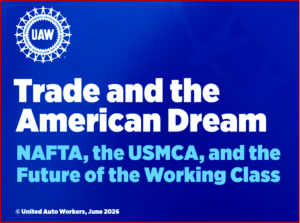
In a new white paper published today, “Trade and the American Dream: NAFTA, the USMCA, and the Future of the Working Class,” the UAW outlines its new vision for pro-worker trade policy amid the framework of United States-Mexico-Canada Agreement (USMCA) renegotiations. Parties to the USMCA are gathering on July 1, a key deadline in the renegotiation process.
“There is no way back to the American Dream without undoing the damage of NAFTA and its successor, the USMCA,” said UAW President Shawn Fain. “There is no future for the U.S. working class that doesn’t address the free trade disaster. Progressives and working-class allies need to understand that trade is at the heart of the rise of global authoritarianism, wealth inequality, and the political weakness of the working class.”
“The moral vision of a society where working-class people reclaim their dignity relies on reining in the rising billionaire dictatorship,” Fain said. “NAFTA and similar trade agreements are the social contract as written by multinational corporations. It’s time we rip it up and start over and take back the American Dream.”
“The UAW wants to thoroughly transform the system of North American trade. Here are some key areas:
- Build Here to Sell Here provisions ensuring that companies create and keep good jobs in the United States if they want to sell in the U.S. market.
- Real Labor Rights that are enforceable and apply to workers in all three countries.
- Strong Standards on Pay & Other Key Issues, including a new Manufacturing Wage Floor for North America as well as strict health and environmental protections.”
“If these standards are not met, the United States should withdraw from the USMCA ,” the UAW said.
Excerpts from the UAW White Paper
For decades, U.S. trade policy has been presented as a neutral application of economic laws – a technocratic exercise that leads unavoidably to good jobs going overseas. In reality, a small elite has rigged our trade agreements to discipline workers, weaken unions, and dismantle domestic manufacturing.
This report examines the evolution of U.S. trade policy and tariffs affecting autos and manufacturing, with a particular focus on the North American Free Trade Agreement (NAFTA) and its successor, the United States-Mexico-Canada Agreement (USMCA). The report documents the high cost of corporate-driven trade deals and lays out a pro-worker trade agreement that can rebuild working-class communities and reclaim the Ameri- can Dream. For decades, U.S. trade policy has been presented as a neutral application of economic laws – a technocratic exercise that leads unavoidably to good jobs going overseas. In reality, a small elite has rigged our trade agreements to discipline workers, weaken unions, and dismantle domestic manufacturing.
NAFTA and the Free Trade Disaster
The negotiations for NAFTA began during the administration of Republican George H.W. Bush. It was passed by a Republican majority in Congress and signed into law by Democratic President Bill Clinton in 1993. It was sold to the public as a bipartisan deal that would unleash economic potential, lift all boats, and create jobs across North America. But reality proved just the opposite. The fact is NAFTA hollowed out U.S. manufacturing, driving a “race to the bottom,” making it easy to move production for the U.S. market to Mexico, where companies can suppress wages and violate workers’ rights with impunity. Corporations didn’t move to Mexico to grow its market. In industry after industry, they have ruthlessly used Mexico as a low- wage platform to flood the U.S. market:
- In 2025, Mexico exported 86% of the autos it made; 78% of those exports went to the U.S., another 11% to Canada — meaning Mexico’s two USMCA partners absorbed 89% of its exported autos.
- Mexico exported 82% of the heavy trucks it produced in 2025, and 94% of those exported heavy trucks went to the U.S. alone.
- The agricultural implement industry is even worse, with 97% of Mexico’s ag-imp exports going to the United States.
Since NAFTA’s passage in 1993 and then China’s 2001 entry into the World Trade Organization, American manufacturing, and manufacturing workers, have been hammered. Between 1993 and 2025, the U.S. trade deficit with Mexico ballooned from:
- $3.5 billion to $79.2 billion in autos.
- $600 million surplus to $35.3 billion deficit in auto parts.
- Overall, the U.S. lost over 4.2 million manufacturing jobs. Every plant closure is a bomb dropped on a blue-collar community. And NAFTA supplied the bombs. Study after study has shown that rates of alcohol and drug abuse, divorce, and suicide all increase after factories are shuttered.
- This all occurred while the needed community support structures were denied funding due to a devastated tax base.
- Plant closures themselves weren’t the only problem. NAFTA made the mere threat to close a factory that much more powerful. After NAFTA, union workers asked for less, non-union workers feared organizing, and the American Dream grew further and further out of reach.
NAFTA 2.0 – The Missed Opportunity of the USMCA
When Donald Trump first took office in 2017, he appointed a U.S. Trade Representative who had a history of working with labor. The administration sought input from unions when negotiating the USMCA, and Congressional Democrats fought to improve the agreement. As a result, some of labor’s ideas made it into the final deal, which went into effect in 2020.
On paper, the USMCA included significant improvements in workers’ rights. Labor rights in the old NAFTA had been addressed in a toothless side agreement, but the USMCA had a labor chapter that required Mexico to strengthen its labor laws. The agreement also included a groundbreaking Rapid Response Mechanism that al- lows the U.S. government, unions, and the public to seek redress for labor rights violations at specific Mexican facilities.
Other improvements on paper were rules intended to tighten access to the North American market and reshore some work to U.S. and Canadian auto plants that paid decent wages. The USMCA created stricter regional content requirements to prevent cheap goods from outside North America getting duty-free treatment. There was also a new Labor Value Content (LVC) rule designed to steer some auto production to plants with decent pay. That LVC provision was expected to return some auto manufacturing back to the U.S. and Canada.
Unfortunately, the USMCA turned out to be a paper tiger. Here’s how provisions that looked good on paper failed in practice:
- Inadequate Protections for Mexican Workers — Although Mexico did pass comprehensive new labor laws, enforcement has been sorely lacking. The Rapid Response Mechanism (RRM) has also come up short. The RRM has been able to win justice for some individual workers in Mexico, but it cannot confront the systemic abuse of workers across companies and industries. Corporations and corrupt protection unions remain free to keep suppressing wages and busting independent unions.
- Overly Complex Rules & Meager Penalties Undermine Reshoring Efforts: The new LVC rules were so complicated that complying with them was a nightmare. Since the penalty for non-compliance was so small — just a 2.5% tariff — corporations mostly ignored the LVC and paid the tariff. As a result, it’s applied almost no pressure to return production to the United States or Canada.
- The failed reforms of the USMCA turned it into NAFTA 2.0: Mexican wages and labor standards are still low, and the U.S. trade deficit with Mexico has risen nearly 98% since 2019 to $197 billion in 2025.
- In auto and auto parts, it jumped from $78 billion in 2018 to $115 billion in 2025.
- The reality is corporations still have strong incentives to send U.S. jobs to Mexico.
A Pro-Worker Trade Agreement for North America
In 2026, all three countries in the USMCA must decide whether or not to renew the deal. The UAW believes we need a top-to-bottom revamp of the USMCA to protect workers and finally end the corporate race to the bottom. A new North American trade deal must include three core objectives:
- Build Here to Sell Here provisions ensuring that companies create and keep good jobs in the United States if they want to sell in the U.S. market. A new trade deal should reward companies for investing in America while punishing firms with targeted tariffs and other measures if they offshore work. And it’s essential to pair those measures with strategic industrial policies that bolster U.S. manufacturing.
- Real Labor Rights that are enforceable and apply to workers in all three countries. That means guaranteeing their right to form independent unions, and requiring companies to be neutral during a union election. Products that receive tariff relief must be built in plants that respect workers’ rights and pay a living wage. There must be serious consequences, including targeted tariffs, for companies and countries that abuse workers.
- Strong Standards on Pay & Other Key Issues, including a new Manufacturing Wage Floor for North America. The new wage floor would provide a straightforward way to strengthen pay for manufacturing workers in all three countries. It would also allow the overly complex and readily ignored LVC rules to be scrapped. In addition to improving pay, we also must set strong, enforceable standards that protect the environment and workers’ health and safety.
“None of these ideas are radical. They are, in fact, the building blocks of the American Dream that workers enjoyed for decades. Trade is just one part of the dream, but it’s a crucial one. If we can end the free trade disaster once and for all, we’ll be neutralizing a brutal union-busting weapon and raising living standards and bargaining power for workers everywhere. We believe all three core objectives are achievable. But if these standards are not met, the United States should withdraw from the USMCA,” the UAW said.
*AutoInformed on

About Ken Zino
Ken Zino, editor and publisher of AutoInformed, is a versatile auto industry participant with global experience spanning decades in print and broadcast journalism, as well as social media. He has automobile testing, marketing, public relations and communications experience. He is past president of The International Motor Press Assn, the Detroit Press Club, founding member and first President of the Automotive Press Assn. He is a member of APA, IMPA and the Midwest Automotive Press Assn.
He also brings an historical perspective while citing their contemporary relevance of the work of legendary auto writers such as Ken Purdy, Jim Dunne or Jerry Flint, or writers such as Red Smith, Mark Twain, Thomas Jefferson – all to bring perspective to a chaotic automotive universe.
Above all, decades after he first drove a car, Zino still revels in the sound of the exhaust as the throttle is blipped during a downshift and the driver’s rush that occurs when the entry, apex and exit points of a turn are smoothly and swiftly crossed. It’s the beginning of a perfect lap.
AutoInformed has an editorial philosophy that loves transportation machines of all kinds while promoting critical thinking about the future use of cars and trucks.
Zino builds AutoInformed from his background in automotive journalism starting at Hearst Publishing in New York City on Motor and MotorTech Magazines and car testing where he reviewed hundreds of vehicles in his decade-long stint as the Detroit Bureau Chief of Road & Track magazine. Zino has also worked in Europe, and Asia – now the largest automotive market in the world with China at its center.







“Disasters” – UAW on NAFTA, U.S.-Mexico-Canada Agreements
Click for more.
In a new white paper published today, “Trade and the American Dream: NAFTA, the USMCA, and the Future of the Working Class,” the UAW outlines its new vision for pro-worker trade policy amid the framework of United States-Mexico-Canada Agreement (USMCA) renegotiations. Parties to the USMCA are gathering on July 1, a key deadline in the renegotiation process.
“There is no way back to the American Dream without undoing the damage of NAFTA and its successor, the USMCA,” said UAW President Shawn Fain. “There is no future for the U.S. working class that doesn’t address the free trade disaster. Progressives and working-class allies need to understand that trade is at the heart of the rise of global authoritarianism, wealth inequality, and the political weakness of the working class.”
“The moral vision of a society where working-class people reclaim their dignity relies on reining in the rising billionaire dictatorship,” Fain said. “NAFTA and similar trade agreements are the social contract as written by multinational corporations. It’s time we rip it up and start over and take back the American Dream.”
“The UAW wants to thoroughly transform the system of North American trade. Here are some key areas:
“If these standards are not met, the United States should withdraw from the USMCA ,” the UAW said.
Excerpts from the UAW White Paper
For decades, U.S. trade policy has been presented as a neutral application of economic laws – a technocratic exercise that leads unavoidably to good jobs going overseas. In reality, a small elite has rigged our trade agreements to discipline workers, weaken unions, and dismantle domestic manufacturing.
This report examines the evolution of U.S. trade policy and tariffs affecting autos and manufacturing, with a particular focus on the North American Free Trade Agreement (NAFTA) and its successor, the United States-Mexico-Canada Agreement (USMCA). The report documents the high cost of corporate-driven trade deals and lays out a pro-worker trade agreement that can rebuild working-class communities and reclaim the Ameri- can Dream. For decades, U.S. trade policy has been presented as a neutral application of economic laws – a technocratic exercise that leads unavoidably to good jobs going overseas. In reality, a small elite has rigged our trade agreements to discipline workers, weaken unions, and dismantle domestic manufacturing.
NAFTA and the Free Trade Disaster
The negotiations for NAFTA began during the administration of Republican George H.W. Bush. It was passed by a Republican majority in Congress and signed into law by Democratic President Bill Clinton in 1993. It was sold to the public as a bipartisan deal that would unleash economic potential, lift all boats, and create jobs across North America. But reality proved just the opposite. The fact is NAFTA hollowed out U.S. manufacturing, driving a “race to the bottom,” making it easy to move production for the U.S. market to Mexico, where companies can suppress wages and violate workers’ rights with impunity. Corporations didn’t move to Mexico to grow its market. In industry after industry, they have ruthlessly used Mexico as a low- wage platform to flood the U.S. market:
Since NAFTA’s passage in 1993 and then China’s 2001 entry into the World Trade Organization, American manufacturing, and manufacturing workers, have been hammered. Between 1993 and 2025, the U.S. trade deficit with Mexico ballooned from:
NAFTA 2.0 – The Missed Opportunity of the USMCA
When Donald Trump first took office in 2017, he appointed a U.S. Trade Representative who had a history of working with labor. The administration sought input from unions when negotiating the USMCA, and Congressional Democrats fought to improve the agreement. As a result, some of labor’s ideas made it into the final deal, which went into effect in 2020.
On paper, the USMCA included significant improvements in workers’ rights. Labor rights in the old NAFTA had been addressed in a toothless side agreement, but the USMCA had a labor chapter that required Mexico to strengthen its labor laws. The agreement also included a groundbreaking Rapid Response Mechanism that al- lows the U.S. government, unions, and the public to seek redress for labor rights violations at specific Mexican facilities.
Other improvements on paper were rules intended to tighten access to the North American market and reshore some work to U.S. and Canadian auto plants that paid decent wages. The USMCA created stricter regional content requirements to prevent cheap goods from outside North America getting duty-free treatment. There was also a new Labor Value Content (LVC) rule designed to steer some auto production to plants with decent pay. That LVC provision was expected to return some auto manufacturing back to the U.S. and Canada.
Unfortunately, the USMCA turned out to be a paper tiger. Here’s how provisions that looked good on paper failed in practice:
A Pro-Worker Trade Agreement for North America
In 2026, all three countries in the USMCA must decide whether or not to renew the deal. The UAW believes we need a top-to-bottom revamp of the USMCA to protect workers and finally end the corporate race to the bottom. A new North American trade deal must include three core objectives:
“None of these ideas are radical. They are, in fact, the building blocks of the American Dream that workers enjoyed for decades. Trade is just one part of the dream, but it’s a crucial one. If we can end the free trade disaster once and for all, we’ll be neutralizing a brutal union-busting weapon and raising living standards and bargaining power for workers everywhere. We believe all three core objectives are achievable. But if these standards are not met, the United States should withdraw from the USMCA,” the UAW said.
*AutoInformed on
About Ken Zino
Ken Zino, editor and publisher of AutoInformed, is a versatile auto industry participant with global experience spanning decades in print and broadcast journalism, as well as social media. He has automobile testing, marketing, public relations and communications experience. He is past president of The International Motor Press Assn, the Detroit Press Club, founding member and first President of the Automotive Press Assn. He is a member of APA, IMPA and the Midwest Automotive Press Assn. He also brings an historical perspective while citing their contemporary relevance of the work of legendary auto writers such as Ken Purdy, Jim Dunne or Jerry Flint, or writers such as Red Smith, Mark Twain, Thomas Jefferson – all to bring perspective to a chaotic automotive universe. Above all, decades after he first drove a car, Zino still revels in the sound of the exhaust as the throttle is blipped during a downshift and the driver’s rush that occurs when the entry, apex and exit points of a turn are smoothly and swiftly crossed. It’s the beginning of a perfect lap. AutoInformed has an editorial philosophy that loves transportation machines of all kinds while promoting critical thinking about the future use of cars and trucks. Zino builds AutoInformed from his background in automotive journalism starting at Hearst Publishing in New York City on Motor and MotorTech Magazines and car testing where he reviewed hundreds of vehicles in his decade-long stint as the Detroit Bureau Chief of Road & Track magazine. Zino has also worked in Europe, and Asia – now the largest automotive market in the world with China at its center.