What are societies going to do with all these toxic EV batteries? Who pays for the cleanup?
Safety, human-centric technology and energy grid participation are shaping Asia’s mobility, according to the region’s industry experts at Nissan Futures held in Hong Kong. In this latest egghead view, cars are energy assets, humans have a role in autonomous driving systems and safety is important in mobility innovations.
The seventh edition of the global event was held early in March in Hong Kong. Under the theme “Transform the way we live and drive,” it brought together representatives from 13 countries to discuss how vehicles, cities and mobility infrastructures are evolving.
Government representatives, industry leaders and Nissan executives spoke on the future of mobility and the future of cities, identifying three trends:
Vehicles as Mobile Energy Units
Panelists discussed whether the uptake of electric vehicles (EVs) could lie in re-imagining usage from just a mode of transportation, to a means to power homes and return energy to the grid.
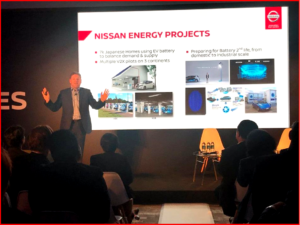
Nicholas Thomas, global director of Nissan’s electric vehicle division, proposed that electrification of mobility could be a solution to energy market disruption. He showcased how EV batteries can be used on a larger scale to power homes, office and the grid.
Humans Need to Form the Center of Future Technology Interactions
Current autonomous vehicle discussions largely center on technology. Participants agreed that humans buy gabapentin will still hold the key to transforming mobility and our cities.
“We can think, we can sense, we can act,” said Dr. Maarten Sierhuis, chief technology officer at the Nissan Research Center in Silicon Valley, thereby negating the while reason often given for autonomous vehicles. “This is what cars need to do as well. Autonomous driving is about how human systems and cars interact. Show me a system without humans, and I show you a useless system.” It could also be devoid of customers.
Next Frontier for Smart Mobility: Zero Fatalities
The Future of Mobility panel presented how creating zero accidents and safety should be the main driver behind technology innovations. This oft repeated claim has no basis whatsoever in safety data thus far, but it sounds good.
“Smart mobility can improve society in many ways but the primary objective should be to reduce death and injury,” said panelist Iim Fahima from Queenrides in Indonesia. “Road accidents are a big global issue. Every 25 seconds one person dies. We need an integrated solution with the primary objective to reduce road deaths.”
Nissan Futures was held in conjunction with the 2019 HKT Hong Kong E-Prix race, a racing series that highlights the problems of electric vehicles, notably an inability to complete a race on one charge. Nissan participated in the race with two vehicles through the Nissan e.dams team.

About Ken Zino
Ken Zino, editor and publisher of AutoInformed, is a versatile auto industry participant with global experience spanning decades in print and broadcast journalism, as well as social media. He has automobile testing, marketing, public relations and communications experience. He is past president of The International Motor Press Assn, the Detroit Press Club, founding member and first President of the Automotive Press Assn. He is a member of APA, IMPA and the Midwest Automotive Press Assn.
He also brings an historical perspective while citing their contemporary relevance of the work of legendary auto writers such as Ken Purdy, Jim Dunne or Jerry Flint, or writers such as Red Smith, Mark Twain, Thomas Jefferson – all to bring perspective to a chaotic automotive universe.
Above all, decades after he first drove a car, Zino still revels in the sound of the exhaust as the throttle is blipped during a downshift and the driver’s rush that occurs when the entry, apex and exit points of a turn are smoothly and swiftly crossed. It’s the beginning of a perfect lap.
AutoInformed has an editorial philosophy that loves transportation machines of all kinds while promoting critical thinking about the future use of cars and trucks.
Zino builds AutoInformed from his background in automotive journalism starting at Hearst Publishing in New York City on Motor and MotorTech Magazines and car testing where he reviewed hundreds of vehicles in his decade-long stint as the Detroit Bureau Chief of Road & Track magazine. Zino has also worked in Europe, and Asia – now the largest automotive market in the world with China at its center.








Nissan on Asia and Oceania’s Mobility Trends
What are societies going to do with all these toxic EV batteries? Who pays for the cleanup?
Safety, human-centric technology and energy grid participation are shaping Asia’s mobility, according to the region’s industry experts at Nissan Futures held in Hong Kong. In this latest egghead view, cars are energy assets, humans have a role in autonomous driving systems and safety is important in mobility innovations.
The seventh edition of the global event was held early in March in Hong Kong. Under the theme “Transform the way we live and drive,” it brought together representatives from 13 countries to discuss how vehicles, cities and mobility infrastructures are evolving.
Government representatives, industry leaders and Nissan executives spoke on the future of mobility and the future of cities, identifying three trends:
Vehicles as Mobile Energy Units
Panelists discussed whether the uptake of electric vehicles (EVs) could lie in re-imagining usage from just a mode of transportation, to a means to power homes and return energy to the grid.
Nicholas Thomas, global director of Nissan’s electric vehicle division, proposed that electrification of mobility could be a solution to energy market disruption. He showcased how EV batteries can be used on a larger scale to power homes, office and the grid.
Humans Need to Form the Center of Future Technology Interactions
Current autonomous vehicle discussions largely center on technology. Participants agreed that humans buy gabapentin will still hold the key to transforming mobility and our cities.
“We can think, we can sense, we can act,” said Dr. Maarten Sierhuis, chief technology officer at the Nissan Research Center in Silicon Valley, thereby negating the while reason often given for autonomous vehicles. “This is what cars need to do as well. Autonomous driving is about how human systems and cars interact. Show me a system without humans, and I show you a useless system.” It could also be devoid of customers.
Next Frontier for Smart Mobility: Zero Fatalities
The Future of Mobility panel presented how creating zero accidents and safety should be the main driver behind technology innovations. This oft repeated claim has no basis whatsoever in safety data thus far, but it sounds good.
“Smart mobility can improve society in many ways but the primary objective should be to reduce death and injury,” said panelist Iim Fahima from Queenrides in Indonesia. “Road accidents are a big global issue. Every 25 seconds one person dies. We need an integrated solution with the primary objective to reduce road deaths.”
Nissan Futures was held in conjunction with the 2019 HKT Hong Kong E-Prix race, a racing series that highlights the problems of electric vehicles, notably an inability to complete a race on one charge. Nissan participated in the race with two vehicles through the Nissan e.dams team.
About Ken Zino
Ken Zino, editor and publisher of AutoInformed, is a versatile auto industry participant with global experience spanning decades in print and broadcast journalism, as well as social media. He has automobile testing, marketing, public relations and communications experience. He is past president of The International Motor Press Assn, the Detroit Press Club, founding member and first President of the Automotive Press Assn. He is a member of APA, IMPA and the Midwest Automotive Press Assn. He also brings an historical perspective while citing their contemporary relevance of the work of legendary auto writers such as Ken Purdy, Jim Dunne or Jerry Flint, or writers such as Red Smith, Mark Twain, Thomas Jefferson – all to bring perspective to a chaotic automotive universe. Above all, decades after he first drove a car, Zino still revels in the sound of the exhaust as the throttle is blipped during a downshift and the driver’s rush that occurs when the entry, apex and exit points of a turn are smoothly and swiftly crossed. It’s the beginning of a perfect lap. AutoInformed has an editorial philosophy that loves transportation machines of all kinds while promoting critical thinking about the future use of cars and trucks. Zino builds AutoInformed from his background in automotive journalism starting at Hearst Publishing in New York City on Motor and MotorTech Magazines and car testing where he reviewed hundreds of vehicles in his decade-long stint as the Detroit Bureau Chief of Road & Track magazine. Zino has also worked in Europe, and Asia – now the largest automotive market in the world with China at its center.