Click for more awakened humanity-saving policies.
Honda Motor, Tokuyama Corp., and Mitsubishi Corp. will run a joint demonstration to operate a data center using by-product hydrogen and a stationary fuel cell (FC) power station. It will reuse FC systems from fuel cell electric vehicles (FCEVs). Project Members will explore the potential of reusing automotive FC systems in a stationary application. The objective of the Demonstration Project is to reduce the economic liability on customers installing and operating stationary FC systems, which will contribute to the decarbonization of electric power. (AutoInformed: Toyota Developing Hydrogen Engine with Motorsports)
This awakened Demonstration Project was proposed to and adopted by the New Energy and Industrial Technology Development Organization (NEDO)* as one of the projects for the “Development of Technologies for Realizing a Hydrogen Society / Development of Technologies for Regional Hydrogen Utilization.” In short, Japanese industries are increasingly embracing the switch to a carbon fuel free society.
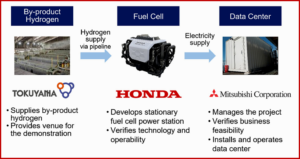
This Demonstration Project will be conducted in Shunan City, Yamaguchi Prefecture, Japan using by-product hydrogen produced by Tokuyama’s salt water electrolysis business to supply electricity to a distributed data center operated by Mitsubishi from a stationary fuel cell power station that Honda will develop based on the assumption of reusing fuel cells from FCEVs.
The impetus here is the virtual certainty of a further increase in power demand for data centers that is projected over time due to the advancement of technologies that require large-volume data processing, such as generative AI and automated driving. In the face of this market environment, by utilizing by-product hydrogen and FCs to power distributed data centers, the Project Members aim to assist the decarbonization of data centers and the digital transformation of municipalities and local businesses.
“Based on the knowledge gained from this Demonstration Project, the Project Members will look into the feasibility of the installation and expansion of data centers using clean power in the region, as well as explore further business opportunities both inside and outside Japan,” the companies said in a joint release today.
*New Energy and Industrial Technology Development Organization is Governed by MITI, the Japanese Minister of Economy, Trade and Industry.
NEDO, originally established on 1 October 1980 was reorganized as an incorporated administrative agency on 1 October 2003 as a Japanese national research and development agency. It has a budget of~¥156.8 billion and employs ~1400 people. The goal of NEDO is to enhance industrial technology and promote commercialization by comprehensively performing functions such as:
- Promoting research and development (R&D) carried out using skills from the private sector.
- Promoting R&D carried out by the private sector with regard to technology for non-fossil energies, combustible natural gas, and coal.
- Promoting the technology required for the rational use of energy and technology in mining and industry.
- Promoting the use of such technology in cooperation with the international community – to thereby contribute to ensuring a stable and efficient energy supply in accordance with the changes in the domestic and foreign economic and social environments and to the development of the economy and industry.
In addition to the above, the following programs will be funded and conducted as publicly solicited research and development projects.
- Moonshot Research and Development Program – ¥25.2 billion.
- Research and Development Project for Enhancement of the Bases for Post-5G Information and Communication Systems – ¥310.0 billion.
- Green Innovation Funding Program-¥2 trillion.
- Program for Developing Important Economic Security Technologies : 1¥25 billion.
- Specified Semiconductor Funding Program – ¥617 billion.

About Ken Zino
Ken Zino, editor and publisher of AutoInformed, is a versatile auto industry participant with global experience spanning decades in print and broadcast journalism, as well as social media. He has automobile testing, marketing, public relations and communications experience. He is past president of The International Motor Press Assn, the Detroit Press Club, founding member and first President of the Automotive Press Assn. He is a member of APA, IMPA and the Midwest Automotive Press Assn.
He also brings an historical perspective while citing their contemporary relevance of the work of legendary auto writers such as Ken Purdy, Jim Dunne or Jerry Flint, or writers such as Red Smith, Mark Twain, Thomas Jefferson – all to bring perspective to a chaotic automotive universe.
Above all, decades after he first drove a car, Zino still revels in the sound of the exhaust as the throttle is blipped during a downshift and the driver’s rush that occurs when the entry, apex and exit points of a turn are smoothly and swiftly crossed. It’s the beginning of a perfect lap.
AutoInformed has an editorial philosophy that loves transportation machines of all kinds while promoting critical thinking about the future use of cars and trucks.
Zino builds AutoInformed from his background in automotive journalism starting at Hearst Publishing in New York City on Motor and MotorTech Magazines and car testing where he reviewed hundreds of vehicles in his decade-long stint as the Detroit Bureau Chief of Road & Track magazine. Zino has also worked in Europe, and Asia – now the largest automotive market in the world with China at its center.








Honda, Mitsubishi, Tokuyama Studying Fuel Cell Recycling
Click for more awakened humanity-saving policies.
Honda Motor, Tokuyama Corp., and Mitsubishi Corp. will run a joint demonstration to operate a data center using by-product hydrogen and a stationary fuel cell (FC) power station. It will reuse FC systems from fuel cell electric vehicles (FCEVs). Project Members will explore the potential of reusing automotive FC systems in a stationary application. The objective of the Demonstration Project is to reduce the economic liability on customers installing and operating stationary FC systems, which will contribute to the decarbonization of electric power. (AutoInformed: Toyota Developing Hydrogen Engine with Motorsports)
This awakened Demonstration Project was proposed to and adopted by the New Energy and Industrial Technology Development Organization (NEDO)* as one of the projects for the “Development of Technologies for Realizing a Hydrogen Society / Development of Technologies for Regional Hydrogen Utilization.” In short, Japanese industries are increasingly embracing the switch to a carbon fuel free society.
This Demonstration Project will be conducted in Shunan City, Yamaguchi Prefecture, Japan using by-product hydrogen produced by Tokuyama’s salt water electrolysis business to supply electricity to a distributed data center operated by Mitsubishi from a stationary fuel cell power station that Honda will develop based on the assumption of reusing fuel cells from FCEVs.
The impetus here is the virtual certainty of a further increase in power demand for data centers that is projected over time due to the advancement of technologies that require large-volume data processing, such as generative AI and automated driving. In the face of this market environment, by utilizing by-product hydrogen and FCs to power distributed data centers, the Project Members aim to assist the decarbonization of data centers and the digital transformation of municipalities and local businesses.
“Based on the knowledge gained from this Demonstration Project, the Project Members will look into the feasibility of the installation and expansion of data centers using clean power in the region, as well as explore further business opportunities both inside and outside Japan,” the companies said in a joint release today.
*New Energy and Industrial Technology Development Organization is Governed by MITI, the Japanese Minister of Economy, Trade and Industry.
NEDO, originally established on 1 October 1980 was reorganized as an incorporated administrative agency on 1 October 2003 as a Japanese national research and development agency. It has a budget of~¥156.8 billion and employs ~1400 people. The goal of NEDO is to enhance industrial technology and promote commercialization by comprehensively performing functions such as:
In addition to the above, the following programs will be funded and conducted as publicly solicited research and development projects.
About Ken Zino
Ken Zino, editor and publisher of AutoInformed, is a versatile auto industry participant with global experience spanning decades in print and broadcast journalism, as well as social media. He has automobile testing, marketing, public relations and communications experience. He is past president of The International Motor Press Assn, the Detroit Press Club, founding member and first President of the Automotive Press Assn. He is a member of APA, IMPA and the Midwest Automotive Press Assn. He also brings an historical perspective while citing their contemporary relevance of the work of legendary auto writers such as Ken Purdy, Jim Dunne or Jerry Flint, or writers such as Red Smith, Mark Twain, Thomas Jefferson – all to bring perspective to a chaotic automotive universe. Above all, decades after he first drove a car, Zino still revels in the sound of the exhaust as the throttle is blipped during a downshift and the driver’s rush that occurs when the entry, apex and exit points of a turn are smoothly and swiftly crossed. It’s the beginning of a perfect lap. AutoInformed has an editorial philosophy that loves transportation machines of all kinds while promoting critical thinking about the future use of cars and trucks. Zino builds AutoInformed from his background in automotive journalism starting at Hearst Publishing in New York City on Motor and MotorTech Magazines and car testing where he reviewed hundreds of vehicles in his decade-long stint as the Detroit Bureau Chief of Road & Track magazine. Zino has also worked in Europe, and Asia – now the largest automotive market in the world with China at its center.