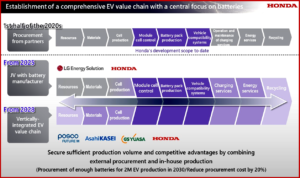
Click for more strategy.
Honda Motor Co., Ltd. said that it and IBM have signed a Memorandum of Understanding (MOU) outlining their intent to collaborate on the long-term joint research and development of next-generation computing technologies *[1] needed to overcome challenges related to processing capability, power consumption, and design complexity for the completion of the software-defined vehicles (SDV) of the future.
The agreement begs the question about the future of Honda’s EV development agreement in 2020 with General Motors based on GM’s global EV platform powered by Ultium batteries. The exteriors and interiors of the new EVs will be exclusively designed by Honda, and the platform “will be engineered to support Honda’s driving character.” (AutoInformed: GM and Honda to Jointly Develop Honda Electric Vehicles)+
“The MOU outlines areas of potential joint research of specialized semiconductor technologies such as brain-inspired computing *[2 ] and chiplet technologies, with the aim to dramatically improve processing performance while, simultaneously, decreasing power consumption. Hardware and software co-optimization is important to ensure high performance and fast time to market. To achieve such benefits and manage design complexity for future SDVs, the two companies also plan to explore open and flexible software solutions,” Honda said in a release from Tokyo.
The use of intelligence/AI technologies is expected to accelerate widely in 2030 and beyond, potentially allowing new opportunities for the development of SDVs. Honda and IBM anticipate that SDVs will dramatically increase the design complexity, processing performance, and corresponding power consumption of semiconductors compared to conventional mobility products.
Honda said today that it is “planning to invest approximately 10 trillion yen in resources over the 10-year period through FY2031, when the period of full-fledged popularization of EVs is expected to start. Honda will pursue both bold investments for future growth and shareholder returns.”
“In order to solve anticipated challenges and realize highly-competitive SDVs, it is critical to develop capabilities in the independent research and development of next-generation computing technologies. Based on this understanding, the two companies began considering long-term joint research and development opportunities,” Honda said.
*Inevitable Footnotes
- Computing technology being developed with an aim to achieve both high processing performance and low power consumption in the 2030s and beyond.
- Computer architecture and algorithms that mimic the brain’s structure and function while optimizing for silicon.
+AutoInformed on

About Ken Zino
Ken Zino, editor and publisher of AutoInformed, is a versatile auto industry participant with global experience spanning decades in print and broadcast journalism, as well as social media. He has automobile testing, marketing, public relations and communications experience. He is past president of The International Motor Press Assn, the Detroit Press Club, founding member and first President of the Automotive Press Assn. He is a member of APA, IMPA and the Midwest Automotive Press Assn.
He also brings an historical perspective while citing their contemporary relevance of the work of legendary auto writers such as Ken Purdy, Jim Dunne or Jerry Flint, or writers such as Red Smith, Mark Twain, Thomas Jefferson – all to bring perspective to a chaotic automotive universe.
Above all, decades after he first drove a car, Zino still revels in the sound of the exhaust as the throttle is blipped during a downshift and the driver’s rush that occurs when the entry, apex and exit points of a turn are smoothly and swiftly crossed. It’s the beginning of a perfect lap.
AutoInformed has an editorial philosophy that loves transportation machines of all kinds while promoting critical thinking about the future use of cars and trucks.
Zino builds AutoInformed from his background in automotive journalism starting at Hearst Publishing in New York City on Motor and MotorTech Magazines and car testing where he reviewed hundreds of vehicles in his decade-long stint as the Detroit Bureau Chief of Road & Track magazine. Zino has also worked in Europe, and Asia – now the largest automotive market in the world with China at its center.







Honda and IBM MoU on Software-Defined Vehicles
Click for more strategy.
Honda Motor Co., Ltd. said that it and IBM have signed a Memorandum of Understanding (MOU) outlining their intent to collaborate on the long-term joint research and development of next-generation computing technologies *[1] needed to overcome challenges related to processing capability, power consumption, and design complexity for the completion of the software-defined vehicles (SDV) of the future.
The agreement begs the question about the future of Honda’s EV development agreement in 2020 with General Motors based on GM’s global EV platform powered by Ultium batteries. The exteriors and interiors of the new EVs will be exclusively designed by Honda, and the platform “will be engineered to support Honda’s driving character.” (AutoInformed: GM and Honda to Jointly Develop Honda Electric Vehicles)+
“The MOU outlines areas of potential joint research of specialized semiconductor technologies such as brain-inspired computing *[2 ] and chiplet technologies, with the aim to dramatically improve processing performance while, simultaneously, decreasing power consumption. Hardware and software co-optimization is important to ensure high performance and fast time to market. To achieve such benefits and manage design complexity for future SDVs, the two companies also plan to explore open and flexible software solutions,” Honda said in a release from Tokyo.
The use of intelligence/AI technologies is expected to accelerate widely in 2030 and beyond, potentially allowing new opportunities for the development of SDVs. Honda and IBM anticipate that SDVs will dramatically increase the design complexity, processing performance, and corresponding power consumption of semiconductors compared to conventional mobility products.
Honda said today that it is “planning to invest approximately 10 trillion yen in resources over the 10-year period through FY2031, when the period of full-fledged popularization of EVs is expected to start. Honda will pursue both bold investments for future growth and shareholder returns.”
“In order to solve anticipated challenges and realize highly-competitive SDVs, it is critical to develop capabilities in the independent research and development of next-generation computing technologies. Based on this understanding, the two companies began considering long-term joint research and development opportunities,” Honda said.
*Inevitable Footnotes
+AutoInformed on
About Ken Zino
Ken Zino, editor and publisher of AutoInformed, is a versatile auto industry participant with global experience spanning decades in print and broadcast journalism, as well as social media. He has automobile testing, marketing, public relations and communications experience. He is past president of The International Motor Press Assn, the Detroit Press Club, founding member and first President of the Automotive Press Assn. He is a member of APA, IMPA and the Midwest Automotive Press Assn. He also brings an historical perspective while citing their contemporary relevance of the work of legendary auto writers such as Ken Purdy, Jim Dunne or Jerry Flint, or writers such as Red Smith, Mark Twain, Thomas Jefferson – all to bring perspective to a chaotic automotive universe. Above all, decades after he first drove a car, Zino still revels in the sound of the exhaust as the throttle is blipped during a downshift and the driver’s rush that occurs when the entry, apex and exit points of a turn are smoothly and swiftly crossed. It’s the beginning of a perfect lap. AutoInformed has an editorial philosophy that loves transportation machines of all kinds while promoting critical thinking about the future use of cars and trucks. Zino builds AutoInformed from his background in automotive journalism starting at Hearst Publishing in New York City on Motor and MotorTech Magazines and car testing where he reviewed hundreds of vehicles in his decade-long stint as the Detroit Bureau Chief of Road & Track magazine. Zino has also worked in Europe, and Asia – now the largest automotive market in the world with China at its center.