Click for more.
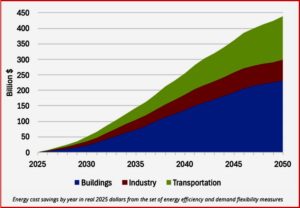
Improving energy efficiency in buildings, transportation, and industry in the United States could save about $4.8 trillion in energy and related costs in the next decades, according to The American Council for an Energy-Efficient Economy (ACEEE). The new report released today says that totals to ~$31,000 a household. Households that are currently struggling with energy prices under Trump mis-administration wars and other expensive anti-clean energy policies.*
“High utility bills and gasoline costs are straining family budgets. Improving energy efficiency can save consumers thousands of dollars while easing strain on the electric grid and slashing pollution,” said Lowell Ungar, senior fellow at ACEEE and lead author of the report. “The opportunity to cut energy waste is enormous, from our homes to our factories and our cars and trucks. The costly option would be inaction. We need to unlock ways that consumers, businesses, and communities can benefit from the savings.”
The ACEEE report finds that energy efficiency improvements and demand flexibility measures made between now and 2050 could also:
- Reduce growing peak electric demand by 20% on average, a reduction equivalent to the output of more than 400 large power plants (this is from the electric efficiency measures alone);
- Spur an additional 1 million jobs (net) per year, on average;
- Reduce climate pollution by a third in 2050, avoiding 22 billion metric tons of emissions cumulatively; and
- Cut small particulate and other air pollution by about a quarter and thus avert approximately 280,000 premature deaths cumulatively.
ACEEE found opportunities for progress in eight broad areas: buildings equipment efficiency, zero-emissions new buildings, existing building improvements, industrial energy efficiency and electric heat, reduced industrial materials, efficient and electric vehicles, transportation system efficiency and access, and electricity demand flexibility.
Executive Summary
ACEEE modeled eight broad opportunities to reduce energy waste by deploying energy efficiency and demand flexibility throughout the economy. Using Energy Innovation’s Energy Policy Simulator (EPS), ACEEE found that between now and 2050 these could significantly lower energy bills, help manage rising peak electricity demand, and strengthen the economy and the environment:
- Families and businesses avoid about $4.8 trillion in wasted energy and related costs cumulatively, almost $31,000 per household.
- Energy costs savings average $215 billion a year.
- Electric efficiency measures reduce growing peak demand by 20% on average; the 208-GW average reduction is equivalent to the output of more than 400 large power plants.
- The U.S. economy nets an additional 1 million jobs per year on average.
- The U.S. avoids 22 billion metric tons of climate pollution cumulatively.
- Thousands of tons of small particulates and other air pollution are eliminated, resulting in ~278,000 fewer premature deaths cumulatively.
*AutoInformed on

About Ken Zino
Ken Zino, editor and publisher of AutoInformed, is a versatile auto industry participant with global experience spanning decades in print and broadcast journalism, as well as social media. He has automobile testing, marketing, public relations and communications experience. He is past president of The International Motor Press Assn, the Detroit Press Club, founding member and first President of the Automotive Press Assn. He is a member of APA, IMPA and the Midwest Automotive Press Assn.
He also brings an historical perspective while citing their contemporary relevance of the work of legendary auto writers such as Ken Purdy, Jim Dunne or Jerry Flint, or writers such as Red Smith, Mark Twain, Thomas Jefferson – all to bring perspective to a chaotic automotive universe.
Above all, decades after he first drove a car, Zino still revels in the sound of the exhaust as the throttle is blipped during a downshift and the driver’s rush that occurs when the entry, apex and exit points of a turn are smoothly and swiftly crossed. It’s the beginning of a perfect lap.
AutoInformed has an editorial philosophy that loves transportation machines of all kinds while promoting critical thinking about the future use of cars and trucks.
Zino builds AutoInformed from his background in automotive journalism starting at Hearst Publishing in New York City on Motor and MotorTech Magazines and car testing where he reviewed hundreds of vehicles in his decade-long stint as the Detroit Bureau Chief of Road & Track magazine. Zino has also worked in Europe, and Asia – now the largest automotive market in the world with China at its center.








Cut Energy Waste. Save $4.8 Trillion or $31,000 a Household!
Click for more.
Improving energy efficiency in buildings, transportation, and industry in the United States could save about $4.8 trillion in energy and related costs in the next decades, according to The American Council for an Energy-Efficient Economy (ACEEE). The new report released today says that totals to ~$31,000 a household. Households that are currently struggling with energy prices under Trump mis-administration wars and other expensive anti-clean energy policies.*
“High utility bills and gasoline costs are straining family budgets. Improving energy efficiency can save consumers thousands of dollars while easing strain on the electric grid and slashing pollution,” said Lowell Ungar, senior fellow at ACEEE and lead author of the report. “The opportunity to cut energy waste is enormous, from our homes to our factories and our cars and trucks. The costly option would be inaction. We need to unlock ways that consumers, businesses, and communities can benefit from the savings.”
The ACEEE report finds that energy efficiency improvements and demand flexibility measures made between now and 2050 could also:
ACEEE found opportunities for progress in eight broad areas: buildings equipment efficiency, zero-emissions new buildings, existing building improvements, industrial energy efficiency and electric heat, reduced industrial materials, efficient and electric vehicles, transportation system efficiency and access, and electricity demand flexibility.
Executive Summary
ACEEE modeled eight broad opportunities to reduce energy waste by deploying energy efficiency and demand flexibility throughout the economy. Using Energy Innovation’s Energy Policy Simulator (EPS), ACEEE found that between now and 2050 these could significantly lower energy bills, help manage rising peak electricity demand, and strengthen the economy and the environment:
*AutoInformed on
About Ken Zino
Ken Zino, editor and publisher of AutoInformed, is a versatile auto industry participant with global experience spanning decades in print and broadcast journalism, as well as social media. He has automobile testing, marketing, public relations and communications experience. He is past president of The International Motor Press Assn, the Detroit Press Club, founding member and first President of the Automotive Press Assn. He is a member of APA, IMPA and the Midwest Automotive Press Assn. He also brings an historical perspective while citing their contemporary relevance of the work of legendary auto writers such as Ken Purdy, Jim Dunne or Jerry Flint, or writers such as Red Smith, Mark Twain, Thomas Jefferson – all to bring perspective to a chaotic automotive universe. Above all, decades after he first drove a car, Zino still revels in the sound of the exhaust as the throttle is blipped during a downshift and the driver’s rush that occurs when the entry, apex and exit points of a turn are smoothly and swiftly crossed. It’s the beginning of a perfect lap. AutoInformed has an editorial philosophy that loves transportation machines of all kinds while promoting critical thinking about the future use of cars and trucks. Zino builds AutoInformed from his background in automotive journalism starting at Hearst Publishing in New York City on Motor and MotorTech Magazines and car testing where he reviewed hundreds of vehicles in his decade-long stint as the Detroit Bureau Chief of Road & Track magazine. Zino has also worked in Europe, and Asia – now the largest automotive market in the world with China at its center.