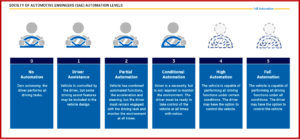
SAE Autonomous Vehicle Driving Levels. Click for more information.
The Center for Auto Safety today released a draft of what it says are the “minimum requirements for autonomous vehicle safety.” The issues raised will no doubt be controversial. Some – legal liability, operational data collection and reporting, as well as personal information gathered on the drivers and occupants – are ongoing current public policy challenges in a wide variety of areas.
Simply put the draft – covering a wide and formidable list of potential issues – says AVs should “Do no harm!” The draft is an ambitious attempt to learn from the more than a century of automobility and apply the knowledge at the outset of what is expected to be widespread AV use sometime in the, oh, next decade or three.
Some key points of the Autonomous Vehicle working paper, dubbed the AV Bill of Rights.
AVs shall not increase risk of injury or death inside or outside of an AV.
- The bare minimum standard for introduction of AVs into commerce is that an AV does not degrade the safety of the highways, highway users, or accessible property. (Do no harm!)
- No vehicle design version may be deployed that increases the frequency of crashes or the likely magnitude of property damage due to crashes or fire.
- No vehicle design may be deployed that increases the probability of injury or death to vehicle occupants, to other motorists or their vehicles, to structures that might contain the AV (including by battery or other electrical fires), to police, fire fighters and other emergency personnel, construction personnel, or other vulnerable road users.
- AVs must include automatic fallback to a safe state in the event of mechanical failure, software or data processing failure or fault, inability to safely continue based on Object Event Detection and Response processing failure, other consequential operational problem, or occupant demand.
- NHTSA 2017 paper shows minimum standard for AV-specific reliability ~1/140 million hours of operation between critical factors in fatal crashes.
AVs shall not sell or distribute personally identifiable information of any person to any third parties without their explicit consent.
- AVs generate tremendous amounts of data that may reveal intimate details of its passengers’ private lives. AVs must not provide any personally identifiable information to any third parties without explicit permission on a per-transaction basis. (In other words, AV passengers must opt-in to data release each and every time it has been collected by an AV.)
- The scope of the third-party data distribution prohibition must include not only the authorized user but also other passengers, occupants, and other persons who may have been identified by, for example, facial recognition algorithms.
AV OEMs, their agents, representatives, and dealers shall assume legal responsibility and liability for safe AV operation. In no case shall a vehicle occupant who is not actively driving an AV be held responsible for the actions or consequences of its automated controls.
- Liability for AV operation must lie with the entity that is controlling the vehicle. If no occupant is directly controlling the vehicle, then the liability must be vested in those who designed, built, and introduced the vehicle into commerce
- No one who is not actually controlling an AV may be held liable for its operation any more than a passenger in a taxi is responsible for its safe operation.
AVs shall collect and report operational data to support research and development to improve safety, performance, and reliability.
- As a quid pro quo for licensing or permission to operate on public roads and to assess the impact of AVs on highway safety, AVs must record and report on demand of responsible investigators video, parametric, and dynamic vehicle operational data needed to objectively determine AV safety, safety metrics, and safety trends.
- AVs must expedite and not make it difficult or impossible for responsible third-party requests to recover or interpret data supporting investigations of failures, fires, crashes, or cybersecurity violations.
AVs shall not increase the transportation sector environmental burden over their design lifetime.
- AV manufacturers must plan for safe handling, post-deployment protection of humans and the environment, and end-of-life sequestration or recycling of hazardous chemicals and materials used in AV manufacturing or operation.
- AVs must not increase vehicle lifetime end-to-end fuel consumption compared to conventional vehicles with due consideration of electrical generation, distribution, conversion, and storage efficiencies and the impact of unoccupied operation.

About Ken Zino
Ken Zino, editor and publisher of AutoInformed, is a versatile auto industry participant with global experience spanning decades in print and broadcast journalism, as well as social media. He has automobile testing, marketing, public relations and communications experience. He is past president of The International Motor Press Assn, the Detroit Press Club, founding member and first President of the Automotive Press Assn. He is a member of APA, IMPA and the Midwest Automotive Press Assn.
He also brings an historical perspective while citing their contemporary relevance of the work of legendary auto writers such as Ken Purdy, Jim Dunne or Jerry Flint, or writers such as Red Smith, Mark Twain, Thomas Jefferson – all to bring perspective to a chaotic automotive universe.
Above all, decades after he first drove a car, Zino still revels in the sound of the exhaust as the throttle is blipped during a downshift and the driver’s rush that occurs when the entry, apex and exit points of a turn are smoothly and swiftly crossed. It’s the beginning of a perfect lap.
AutoInformed has an editorial philosophy that loves transportation machines of all kinds while promoting critical thinking about the future use of cars and trucks.
Zino builds AutoInformed from his background in automotive journalism starting at Hearst Publishing in New York City on Motor and MotorTech Magazines and car testing where he reviewed hundreds of vehicles in his decade-long stint as the Detroit Bureau Chief of Road & Track magazine. Zino has also worked in Europe, and Asia – now the largest automotive market in the world with China at its center.








Do No Harm – Center for Auto Safety Drafts AV Bill of Rights
SAE Autonomous Vehicle Driving Levels. Click for more information.
The Center for Auto Safety today released a draft of what it says are the “minimum requirements for autonomous vehicle safety.” The issues raised will no doubt be controversial. Some – legal liability, operational data collection and reporting, as well as personal information gathered on the drivers and occupants – are ongoing current public policy challenges in a wide variety of areas.
Simply put the draft – covering a wide and formidable list of potential issues – says AVs should “Do no harm!” The draft is an ambitious attempt to learn from the more than a century of automobility and apply the knowledge at the outset of what is expected to be widespread AV use sometime in the, oh, next decade or three.
Some key points of the Autonomous Vehicle working paper, dubbed the AV Bill of Rights.
AVs shall not increase risk of injury or death inside or outside of an AV.
AVs shall not sell or distribute personally identifiable information of any person to any third parties without their explicit consent.
AV OEMs, their agents, representatives, and dealers shall assume legal responsibility and liability for safe AV operation. In no case shall a vehicle occupant who is not actively driving an AV be held responsible for the actions or consequences of its automated controls.
AVs shall collect and report operational data to support research and development to improve safety, performance, and reliability.
AVs shall not increase the transportation sector environmental burden over their design lifetime.
About Ken Zino
Ken Zino, editor and publisher of AutoInformed, is a versatile auto industry participant with global experience spanning decades in print and broadcast journalism, as well as social media. He has automobile testing, marketing, public relations and communications experience. He is past president of The International Motor Press Assn, the Detroit Press Club, founding member and first President of the Automotive Press Assn. He is a member of APA, IMPA and the Midwest Automotive Press Assn. He also brings an historical perspective while citing their contemporary relevance of the work of legendary auto writers such as Ken Purdy, Jim Dunne or Jerry Flint, or writers such as Red Smith, Mark Twain, Thomas Jefferson – all to bring perspective to a chaotic automotive universe. Above all, decades after he first drove a car, Zino still revels in the sound of the exhaust as the throttle is blipped during a downshift and the driver’s rush that occurs when the entry, apex and exit points of a turn are smoothly and swiftly crossed. It’s the beginning of a perfect lap. AutoInformed has an editorial philosophy that loves transportation machines of all kinds while promoting critical thinking about the future use of cars and trucks. Zino builds AutoInformed from his background in automotive journalism starting at Hearst Publishing in New York City on Motor and MotorTech Magazines and car testing where he reviewed hundreds of vehicles in his decade-long stint as the Detroit Bureau Chief of Road & Track magazine. Zino has also worked in Europe, and Asia – now the largest automotive market in the world with China at its center.