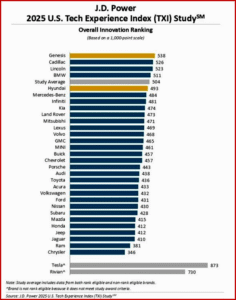
Click to enlarge.
The J.D. Power* 2025 U.S. Tech Experience Index (TXI) StudySM just released says that Artificial Intelligence can improve the customer’s experience. However, Artificial Intelligence use presents its own difficulties.
“Smart technologies appear to not only anticipate the driver’s needs but also reduce the cognitive workload and some of the difficulties that drivers face with digital systems,” said Kathleen Rizk, senior director of user experience benchmarking and technology at J.D. Power. “Ultimately, what matters most to vehicle owners – and therefore to automakers and suppliers – is how useful the technology is and whether it enhances their driving experience. While smart technologies are not without issues, they represent a meaningful step forward. Continued development will be essential to address current challenges and maximize their effectiveness.”
Findings of the 2025 TXI Study
- “Smart technologies can improve vehicle quality and satisfaction scores: Certain smart technologies are beginning to positively affect initial vehicle quality scores. For instance, smart climate control systems—which can automatically adjust the vehicle’s heating, ventilation, and air conditioning (HVAC) system to improve comfort and efficiency, have shown a notable improvement year over year in user experience, with a reported drop of 6.3 problems per 100 vehicles (PP100),” according to the J.D. Power 2025 U.S. Initial Quality Study (IQS)SM. “This offers a much-needed workaround to address the increasing complexity of climate controls being migrated into the infotainment system.
- “Car wash mode a shiny promise with muddied execution: Car wash mode, a new feature tracked in the TXI Study this year, is intended to automatically prepare the vehicle to go through a car wash, initiating actions such as closing all windows and disabling the windshield wipers, among others. It is a feature that sounds good in theory, but is often buried within the infotainment system, making it difficult to find, which causes delays and frustration, especially when in line at a car wash. This results in more than one-third (38%) of owners who say they need better instructions to use it. Another 15% say the feature is too slow to perform the necessary tasks to prepare the vehicle for a wash. Ultimately, despite its potential benefits, the complicated accessibility of the car wash mode and lack of user guidance are preventing it from becoming a widely adopted feature.”
- In-vehicle payments making a comeback: “Previous executions of in-vehicle shopping and payment systems within the infotainment system have been hindered by limited app offerings, complex interfaces, and lengthy purchasing processes, all of which have contributed to low adoption. However, in-vehicle payment capabilities are gaining interest, with 62% of owners expressing a desire for this feature. At present, the most common uses are paying for charging, fuel, parking, and tolls. The next generation of in-vehicle shopping and payment systems has the potential to succeed if automakers focus on convenience purchases that directly enhance the vehicle experience, such as parking and fuel, and design access within the infotainment system to be simple and user-friendly,” Rizk said.
- “Recognition technologies now next challenge drivers face: Owners’ perceptions of vehicle quality have shifted from broken components to issues with usability, mainly due to complex infotainment and advanced driver assistance systems (ADAS). Currently, problems increasingly focus on technology requiring connectivity. In the future, according to findings in the TXI Study, the next evolution of vehicle quality problems owners will likely face will be related to inconsistent performance of recognition and authentication technologies. These technologies include biometric authentication (29.2 PP100); touchless or hidden controls (19.6 PP100); and direct driver monitoring (19.4 PP100), which are the technologies with the highest number of problems reported in the TXI Study. As automakers navigate challenges with recognition technologies, the focus must remain on ensuring that advancements enhance – rather than hinder – the overall driving experience.”
- “Blind spot camera is a customer must-have technology: A large majority (93%) of customers say they use the blind spot camera most of the time, and 74% say they desire the feature in a future vehicle. Notably, vehicles that include this feature also spend less time on dealer lots compared with those that lack it,” J.D. Power said.
AutoInformed on

About Ken Zino
Ken Zino, editor and publisher of AutoInformed, is a versatile auto industry participant with global experience spanning decades in print and broadcast journalism, as well as social media. He has automobile testing, marketing, public relations and communications experience. He is past president of The International Motor Press Assn, the Detroit Press Club, founding member and first President of the Automotive Press Assn. He is a member of APA, IMPA and the Midwest Automotive Press Assn.
He also brings an historical perspective while citing their contemporary relevance of the work of legendary auto writers such as Ken Purdy, Jim Dunne or Jerry Flint, or writers such as Red Smith, Mark Twain, Thomas Jefferson – all to bring perspective to a chaotic automotive universe.
Above all, decades after he first drove a car, Zino still revels in the sound of the exhaust as the throttle is blipped during a downshift and the driver’s rush that occurs when the entry, apex and exit points of a turn are smoothly and swiftly crossed. It’s the beginning of a perfect lap.
AutoInformed has an editorial philosophy that loves transportation machines of all kinds while promoting critical thinking about the future use of cars and trucks.
Zino builds AutoInformed from his background in automotive journalism starting at Hearst Publishing in New York City on Motor and MotorTech Magazines and car testing where he reviewed hundreds of vehicles in his decade-long stint as the Detroit Bureau Chief of Road & Track magazine. Zino has also worked in Europe, and Asia – now the largest automotive market in the world with China at its center.







Mixed Results – Automaker Use of AI-Technology
Click to enlarge.
The J.D. Power* 2025 U.S. Tech Experience Index (TXI) StudySM just released says that Artificial Intelligence can improve the customer’s experience. However, Artificial Intelligence use presents its own difficulties.
“Smart technologies appear to not only anticipate the driver’s needs but also reduce the cognitive workload and some of the difficulties that drivers face with digital systems,” said Kathleen Rizk, senior director of user experience benchmarking and technology at J.D. Power. “Ultimately, what matters most to vehicle owners – and therefore to automakers and suppliers – is how useful the technology is and whether it enhances their driving experience. While smart technologies are not without issues, they represent a meaningful step forward. Continued development will be essential to address current challenges and maximize their effectiveness.”
Findings of the 2025 TXI Study
AutoInformed on
About Ken Zino
Ken Zino, editor and publisher of AutoInformed, is a versatile auto industry participant with global experience spanning decades in print and broadcast journalism, as well as social media. He has automobile testing, marketing, public relations and communications experience. He is past president of The International Motor Press Assn, the Detroit Press Club, founding member and first President of the Automotive Press Assn. He is a member of APA, IMPA and the Midwest Automotive Press Assn. He also brings an historical perspective while citing their contemporary relevance of the work of legendary auto writers such as Ken Purdy, Jim Dunne or Jerry Flint, or writers such as Red Smith, Mark Twain, Thomas Jefferson – all to bring perspective to a chaotic automotive universe. Above all, decades after he first drove a car, Zino still revels in the sound of the exhaust as the throttle is blipped during a downshift and the driver’s rush that occurs when the entry, apex and exit points of a turn are smoothly and swiftly crossed. It’s the beginning of a perfect lap. AutoInformed has an editorial philosophy that loves transportation machines of all kinds while promoting critical thinking about the future use of cars and trucks. Zino builds AutoInformed from his background in automotive journalism starting at Hearst Publishing in New York City on Motor and MotorTech Magazines and car testing where he reviewed hundreds of vehicles in his decade-long stint as the Detroit Bureau Chief of Road & Track magazine. Zino has also worked in Europe, and Asia – now the largest automotive market in the world with China at its center.