Click for more.
Stellantis (NYSE: STLA. STLAM.MI) said today that it is accelerating the establishment of renewable energy generation and storage across its European manufacturing network. The company is maintaining its long-term goal of decarbonized electricity to reach carbon net-zero operations. Photovoltaic installations are being scaled across 27 manufacturing sites in Europe.
“Energy management is a critical enabler of our decarbonization roadmap. By expanding on‑site renewable solutions — including solar, wind, geothermal and biomass – together with energy storage, we are reducing emissions, improving energy autonomy and reinforcing the competitiveness of our manufacturing footprint,” said Francesco Ciancia, Global Head of Manufacturing at Stellantis.
Stellantis ECO Friendly Status
Decarbonized electricity accounts for 68% of power across European manufacturing operations.
- In 2026, on-site self-consumption is targeted to represent 31% of the energy used by Stellantis’ European plants, with leading sites aiming to reach as high as 80%.
- Battery Energy Storage Systems (BESS) are planned across 20 sites, with seven plants expected to be operational by 2026.
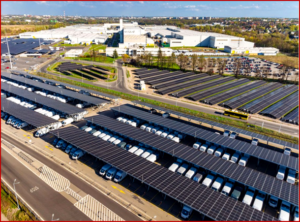
Thus far, photovoltaic [electronic devices that convert sunlight directly into electricity using so-called photovoltaic effects – AutoCrat.] projects have been completed or are underway at 27 European manufacturing sites, representing more than 500 MW of installed capacity. At sites such as Tychy (Poland), self-consumption could reach around 60% by the end of 2026. In Zaragoza (Spain), where a hybrid system combining photovoltaic power and on-site wind turbines is already operating, self-consumption could rise to as much as 80% by year-end.
- Depending on site configuration, the photovoltaic systems are installed on rooftops, parking canopies or ground‑mounted areas. Once fully operational, they are expected to result in more than 100,000 tons of avoided CO2 emissions per year.
Battery Energy Storage Systems to Optimize Energy Use and Grid Balance
In parallel with photovoltaic deployment, Stellantis is rolling out Battery Energy Storage Systems (BESS) to further optimize energy usage and support grid stability across its manufacturing sites.
- The BESS program will cover 20 manufacturing sites across Europe, with a total installed storage capacity of approximately 200 MWh, rolled out in two phases. The first wave is at an advanced stage, with BESS expected to be operational at seven plants by 2026, while deployment across the remaining sites is planned to be completed within a three‑year time period.
- These systems are managed by advanced Energy Management Systems (EMS) that dynamically optimize battery operation based on energy availability and demand, improving overall efficiency. At plants equipped with photovoltaic generation, the storage systems also maximize solar self‑consumption by storing surplus energy.
- In addition, the installations can provide grid services in collaboration with local system operators, helping support grid stability by adjusting consumption when needed. The Stellantis Madrid site in Spain already operates a battery energy storage system and serves as the pilot plant for scaling and standardizing this technical approach.
- By combining renewable energy generation with energy storage, Stellantis is reinforcing its commitment to sustainable manufacturing, reducing CO2 emissions and enhancing energy resilience, while mitigating exposure to energy market volatility.
Diversifying the Energy Mix to Increase Competitiveness
“These initiatives complement other energy contracts and decarbonization actions already launched by Stellantis across its global operations. Together, they represent a concrete step toward long‑term industrial sustainability and reflect the Company’s broader energy transformation approach, which combines energy efficiency with the deployment of decarbonized solutions across its industrial footprint,” Stellantis said in a release.
- In addition, Stellantis is expanding the use of geothermal energy as a low‑carbon solution for industrial heating and cooling. The geothermal installation at the Caen site in France, inaugurated last year, is a world‑first for Stellantis and one of the first industrial applications of this technology in the country. The system supplies renewable heat to buildings and cooling for industrial processes, enabling the site to cover around 30% of its energy needs autonomously.
- Several manufacturing sites are also deploying biomass‑based energy solutions to decarbonize industrial heating. These include Rennes (France), where a zero‑carbon heating network based on locally sourced biomass was launched in 2025, as well as Sochaux and Vesoul (France), Trnava (Slovakia) and Kragujevac (Serbia), where biomass‑based solutions have recently become operational.
AutoInformed on

About Ken Zino
Ken Zino, editor and publisher of AutoInformed, is a versatile auto industry participant with global experience spanning decades in print and broadcast journalism, as well as social media. He has automobile testing, marketing, public relations and communications experience. He is past president of The International Motor Press Assn, the Detroit Press Club, founding member and first President of the Automotive Press Assn. He is a member of APA, IMPA and the Midwest Automotive Press Assn.
He also brings an historical perspective while citing their contemporary relevance of the work of legendary auto writers such as Ken Purdy, Jim Dunne or Jerry Flint, or writers such as Red Smith, Mark Twain, Thomas Jefferson – all to bring perspective to a chaotic automotive universe.
Above all, decades after he first drove a car, Zino still revels in the sound of the exhaust as the throttle is blipped during a downshift and the driver’s rush that occurs when the entry, apex and exit points of a turn are smoothly and swiftly crossed. It’s the beginning of a perfect lap.
AutoInformed has an editorial philosophy that loves transportation machines of all kinds while promoting critical thinking about the future use of cars and trucks.
Zino builds AutoInformed from his background in automotive journalism starting at Hearst Publishing in New York City on Motor and MotorTech Magazines and car testing where he reviewed hundreds of vehicles in his decade-long stint as the Detroit Bureau Chief of Road & Track magazine. Zino has also worked in Europe, and Asia – now the largest automotive market in the world with China at its center.







Stellantis – Solar Now Powers Two-Thirds of EU Plants
Click for more.
Stellantis (NYSE: STLA. STLAM.MI) said today that it is accelerating the establishment of renewable energy generation and storage across its European manufacturing network. The company is maintaining its long-term goal of decarbonized electricity to reach carbon net-zero operations. Photovoltaic installations are being scaled across 27 manufacturing sites in Europe.
“Energy management is a critical enabler of our decarbonization roadmap. By expanding on‑site renewable solutions — including solar, wind, geothermal and biomass – together with energy storage, we are reducing emissions, improving energy autonomy and reinforcing the competitiveness of our manufacturing footprint,” said Francesco Ciancia, Global Head of Manufacturing at Stellantis.
Stellantis ECO Friendly Status
Decarbonized electricity accounts for 68% of power across European manufacturing operations.
Thus far, photovoltaic [electronic devices that convert sunlight directly into electricity using so-called photovoltaic effects – AutoCrat.] projects have been completed or are underway at 27 European manufacturing sites, representing more than 500 MW of installed capacity. At sites such as Tychy (Poland), self-consumption could reach around 60% by the end of 2026. In Zaragoza (Spain), where a hybrid system combining photovoltaic power and on-site wind turbines is already operating, self-consumption could rise to as much as 80% by year-end.
Battery Energy Storage Systems to Optimize Energy Use and Grid Balance
In parallel with photovoltaic deployment, Stellantis is rolling out Battery Energy Storage Systems (BESS) to further optimize energy usage and support grid stability across its manufacturing sites.
Diversifying the Energy Mix to Increase Competitiveness
“These initiatives complement other energy contracts and decarbonization actions already launched by Stellantis across its global operations. Together, they represent a concrete step toward long‑term industrial sustainability and reflect the Company’s broader energy transformation approach, which combines energy efficiency with the deployment of decarbonized solutions across its industrial footprint,” Stellantis said in a release.
AutoInformed on
About Ken Zino
Ken Zino, editor and publisher of AutoInformed, is a versatile auto industry participant with global experience spanning decades in print and broadcast journalism, as well as social media. He has automobile testing, marketing, public relations and communications experience. He is past president of The International Motor Press Assn, the Detroit Press Club, founding member and first President of the Automotive Press Assn. He is a member of APA, IMPA and the Midwest Automotive Press Assn. He also brings an historical perspective while citing their contemporary relevance of the work of legendary auto writers such as Ken Purdy, Jim Dunne or Jerry Flint, or writers such as Red Smith, Mark Twain, Thomas Jefferson – all to bring perspective to a chaotic automotive universe. Above all, decades after he first drove a car, Zino still revels in the sound of the exhaust as the throttle is blipped during a downshift and the driver’s rush that occurs when the entry, apex and exit points of a turn are smoothly and swiftly crossed. It’s the beginning of a perfect lap. AutoInformed has an editorial philosophy that loves transportation machines of all kinds while promoting critical thinking about the future use of cars and trucks. Zino builds AutoInformed from his background in automotive journalism starting at Hearst Publishing in New York City on Motor and MotorTech Magazines and car testing where he reviewed hundreds of vehicles in his decade-long stint as the Detroit Bureau Chief of Road & Track magazine. Zino has also worked in Europe, and Asia – now the largest automotive market in the world with China at its center.