Click to enlarge.
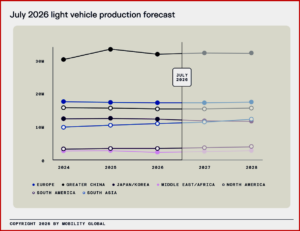
Whistling past the graveyard? Well, according to Mobility Global (formerly S&P Global Mobility) the “global auto market is settling into a ‘new normal’ of uncertainty. Middle East risk is still in the mix, but oil prices and vehicle demand have held up better than the worst-case scenarios.”*
“Against that backdrop, our near-term forecast moves mostly higher, except in Greater China, where soft consumer sentiment is still dragging sales and pulling production down,” said Mike Wall, Executive Director, Automotive Analysis, Mobility Global. “The important nuance: Chinese OEMs are leaning harder on exports to keep plants running, and that is reshaping pricing and competitive intensity across multiple regions.**
“At the same time, inflation is keeping buyers price-sensitive. Demand is resilient in many markets, but it can turn quickly if fuel prices rise, credit tightens, or confidence slips, especially in higher-priced segments where mix and margins move first,” said Wall.
Highlights and Lowlights in Mobility Global’s View
Europe: Europe’s light vehicle production was raised by 144,000 units for 2026 and 115,000 units for 2027. The main driver is a better macro backdrop than we expected, with near-term volume supported by non-battery electric vehicle backfill through the first half of 2026.
Chinese OEM momentum in Europe, largely via imports, is lifting the sales outlook more than it lifts regional production. For 2027, most of the production upside is concentrated in battery electric vehicles (to keep pace with emissions targets) and light commercial vehicles, where Chinese import pressure is less pronounced.
Greater China: Greater China’s light vehicle production was cut by 208,000 units for 2026 and 235,000 units for 2027. Domestic demand is still struggling as consumers stay cautious and underlying growth looks fragile even when monthly headlines improve. Exports are now the primary support for the industry, which is why production cuts are less severe than the sales downgrades. But that support comes with a cost: discounting is intensifying, and margins are getting squeezed.
Japan/Korea: Japan’s short-term production outlook was upgraded by 111,000 units, reflecting stronger production plans, especially into the third quarter, supported by export momentum to the United States and Europe for fuel-efficient full hybrid electric vehicles. However, the long-term Japan outlook was reduced by roughly 100,000 units per year due to program and sourcing changes, including the Lexus C-CUV electric vehicle cancellation and more North America localization for select models.
South Korea production was increased by about 56,000 units for 2026 with an additional increase of 62,000 units in 2027 as exports remain the growth engine. Even with tariffs and disruption risk near the Strait of Hormuz, North America demand is keeping Korean output on a firmer footing.
Middle East/Africa: Middle East and Africa light vehicle production was increased by 65,000 units for 2026 and 13,000 units for 2027. The upgrades are mainly about faster-than-expected recovery in Iran and stronger light commercial vehicle growth in Algeria. That strength is partially offset by the transfer of facelifted Peugeot 208 production from Morocco to Spain. Looking ahead, we still see a broader recovery building from 2029 as new projects in Iran and Morocco reach full scale.
North America: North America’s light vehicle production was raised by 66,000 units for 2026 and by 5,000 units for 2027. The 2026 outlook now totals 15.06 million units, driven by stronger production results through June. Full-size pickup inventories are the key near-term constraint with Detroit Three supply reaching seventy-seven days, while Ram is sitting at one hundred thirteen days; so we’re factoring in a build slowdown from the fourth quarter of 2026 through the first half of 2027 as OEMs manage transitions and volume recovery. If demand remains resilient, there is upside of roughly 150,000 to 200,000 units in 2027 and 300,000 to 350,000 units in 2028 to maintain inventory around 2.8 million units.
South America: South America’s light vehicle production was increased by 26,000 units for 2026 and 12,000 units for 2027, with a larger lift of 99,000 units for 2028. Brazil is the main reason: sales momentum is holding, and production should continue to follow demand higher. Chinese imports will remain a major factor, but stronger demand should still support domestic builds. For 2027 and 2028, we also lifted the region by about 56,000 units per year, split between Brazil and Argentina, with Chinese brands—especially BYD, Changan, and MG—gaining share faster.
South Asia: South Asia’s light vehicle production was raised by 181,000 units for 2026 and 183,000 units for 2027. ASEAN production fell 9.5% year-over-year in June as output softened across Thailand, Indonesia, and the Philippines, driven by more cautious scheduling and inventory adjustments. Even so, our 2026 ASEAN outlook rose by 30,000 units on stronger-than-expected OEM production, with Chinese OEMs ramping battery electric vehicles and hybrids accelerating on incentives and changing buyer preferences. India remains the anchor: we increased production by 140,000 units for 2026 and 183,000 units for 2027 as the GST cut, new launches, and low inventories continue to translate into steady builds.
*AutoInformed on
**About Mobility Global (www.mobilityglobal.com, formerly S&P Global Mobility) says it “helps people and businesses make vital decisions in the automotive industry with confidence. Every day, billions of decisions shape how vehicles are built, sold, bought, and maintained. As the industry becomes more complex, from electrification to software-defined vehicles and geopolitical trade disruptions, those decisions are happening faster, with higher stakes. Built on more than 100 years of automotive insights, we give you the data, expertise, and perspective you need to see what’s coming and act on it. From planning and forecasting to sales and ownership, we connect the signals across consumers, vehicles, and markets so you can move forward with clarity. That means sharper insight, faster innovation, and answers you can trust. We work with the people who build, sell, buy, and maintain vehicles from automakers and suppliers to dealers and consumers helping them turn complex questions into clear, actionable decisions.”

About Ken Zino
Ken Zino, editor and publisher of AutoInformed, is a versatile auto industry participant with global experience spanning decades in print and broadcast journalism, as well as social media. He has automobile testing, marketing, public relations and communications experience. He is past president of The International Motor Press Assn, the Detroit Press Club, founding member and first President of the Automotive Press Assn. He is a member of APA, IMPA and the Midwest Automotive Press Assn.
He also brings an historical perspective while citing their contemporary relevance of the work of legendary auto writers such as Ken Purdy, Jim Dunne or Jerry Flint, or writers such as Red Smith, Mark Twain, Thomas Jefferson – all to bring perspective to a chaotic automotive universe.
Above all, decades after he first drove a car, Zino still revels in the sound of the exhaust as the throttle is blipped during a downshift and the driver’s rush that occurs when the entry, apex and exit points of a turn are smoothly and swiftly crossed. It’s the beginning of a perfect lap.
AutoInformed has an editorial philosophy that loves transportation machines of all kinds while promoting critical thinking about the future use of cars and trucks.
Zino builds AutoInformed from his background in automotive journalism starting at Hearst Publishing in New York City on Motor and MotorTech Magazines and car testing where he reviewed hundreds of vehicles in his decade-long stint as the Detroit Bureau Chief of Road & Track magazine. Zino has also worked in Europe, and Asia – now the largest automotive market in the world with China at its center.








July 2026 Light Vehicle Production Forecast Slightly Higher
Click to enlarge.
Whistling past the graveyard? Well, according to Mobility Global (formerly S&P Global Mobility) the “global auto market is settling into a ‘new normal’ of uncertainty. Middle East risk is still in the mix, but oil prices and vehicle demand have held up better than the worst-case scenarios.”*
“Against that backdrop, our near-term forecast moves mostly higher, except in Greater China, where soft consumer sentiment is still dragging sales and pulling production down,” said Mike Wall, Executive Director, Automotive Analysis, Mobility Global. “The important nuance: Chinese OEMs are leaning harder on exports to keep plants running, and that is reshaping pricing and competitive intensity across multiple regions.**
“At the same time, inflation is keeping buyers price-sensitive. Demand is resilient in many markets, but it can turn quickly if fuel prices rise, credit tightens, or confidence slips, especially in higher-priced segments where mix and margins move first,” said Wall.
Highlights and Lowlights in Mobility Global’s View
Europe: Europe’s light vehicle production was raised by 144,000 units for 2026 and 115,000 units for 2027. The main driver is a better macro backdrop than we expected, with near-term volume supported by non-battery electric vehicle backfill through the first half of 2026.
Chinese OEM momentum in Europe, largely via imports, is lifting the sales outlook more than it lifts regional production. For 2027, most of the production upside is concentrated in battery electric vehicles (to keep pace with emissions targets) and light commercial vehicles, where Chinese import pressure is less pronounced.
Greater China: Greater China’s light vehicle production was cut by 208,000 units for 2026 and 235,000 units for 2027. Domestic demand is still struggling as consumers stay cautious and underlying growth looks fragile even when monthly headlines improve. Exports are now the primary support for the industry, which is why production cuts are less severe than the sales downgrades. But that support comes with a cost: discounting is intensifying, and margins are getting squeezed.
Japan/Korea: Japan’s short-term production outlook was upgraded by 111,000 units, reflecting stronger production plans, especially into the third quarter, supported by export momentum to the United States and Europe for fuel-efficient full hybrid electric vehicles. However, the long-term Japan outlook was reduced by roughly 100,000 units per year due to program and sourcing changes, including the Lexus C-CUV electric vehicle cancellation and more North America localization for select models.
South Korea production was increased by about 56,000 units for 2026 with an additional increase of 62,000 units in 2027 as exports remain the growth engine. Even with tariffs and disruption risk near the Strait of Hormuz, North America demand is keeping Korean output on a firmer footing.
Middle East/Africa: Middle East and Africa light vehicle production was increased by 65,000 units for 2026 and 13,000 units for 2027. The upgrades are mainly about faster-than-expected recovery in Iran and stronger light commercial vehicle growth in Algeria. That strength is partially offset by the transfer of facelifted Peugeot 208 production from Morocco to Spain. Looking ahead, we still see a broader recovery building from 2029 as new projects in Iran and Morocco reach full scale.
North America: North America’s light vehicle production was raised by 66,000 units for 2026 and by 5,000 units for 2027. The 2026 outlook now totals 15.06 million units, driven by stronger production results through June. Full-size pickup inventories are the key near-term constraint with Detroit Three supply reaching seventy-seven days, while Ram is sitting at one hundred thirteen days; so we’re factoring in a build slowdown from the fourth quarter of 2026 through the first half of 2027 as OEMs manage transitions and volume recovery. If demand remains resilient, there is upside of roughly 150,000 to 200,000 units in 2027 and 300,000 to 350,000 units in 2028 to maintain inventory around 2.8 million units.
South America: South America’s light vehicle production was increased by 26,000 units for 2026 and 12,000 units for 2027, with a larger lift of 99,000 units for 2028. Brazil is the main reason: sales momentum is holding, and production should continue to follow demand higher. Chinese imports will remain a major factor, but stronger demand should still support domestic builds. For 2027 and 2028, we also lifted the region by about 56,000 units per year, split between Brazil and Argentina, with Chinese brands—especially BYD, Changan, and MG—gaining share faster.
South Asia: South Asia’s light vehicle production was raised by 181,000 units for 2026 and 183,000 units for 2027. ASEAN production fell 9.5% year-over-year in June as output softened across Thailand, Indonesia, and the Philippines, driven by more cautious scheduling and inventory adjustments. Even so, our 2026 ASEAN outlook rose by 30,000 units on stronger-than-expected OEM production, with Chinese OEMs ramping battery electric vehicles and hybrids accelerating on incentives and changing buyer preferences. India remains the anchor: we increased production by 140,000 units for 2026 and 183,000 units for 2027 as the GST cut, new launches, and low inventories continue to translate into steady builds.
*AutoInformed on
**About Mobility Global (www.mobilityglobal.com, formerly S&P Global Mobility) says it “helps people and businesses make vital decisions in the automotive industry with confidence. Every day, billions of decisions shape how vehicles are built, sold, bought, and maintained. As the industry becomes more complex, from electrification to software-defined vehicles and geopolitical trade disruptions, those decisions are happening faster, with higher stakes. Built on more than 100 years of automotive insights, we give you the data, expertise, and perspective you need to see what’s coming and act on it. From planning and forecasting to sales and ownership, we connect the signals across consumers, vehicles, and markets so you can move forward with clarity. That means sharper insight, faster innovation, and answers you can trust. We work with the people who build, sell, buy, and maintain vehicles from automakers and suppliers to dealers and consumers helping them turn complex questions into clear, actionable decisions.”
About Ken Zino
Ken Zino, editor and publisher of AutoInformed, is a versatile auto industry participant with global experience spanning decades in print and broadcast journalism, as well as social media. He has automobile testing, marketing, public relations and communications experience. He is past president of The International Motor Press Assn, the Detroit Press Club, founding member and first President of the Automotive Press Assn. He is a member of APA, IMPA and the Midwest Automotive Press Assn. He also brings an historical perspective while citing their contemporary relevance of the work of legendary auto writers such as Ken Purdy, Jim Dunne or Jerry Flint, or writers such as Red Smith, Mark Twain, Thomas Jefferson – all to bring perspective to a chaotic automotive universe. Above all, decades after he first drove a car, Zino still revels in the sound of the exhaust as the throttle is blipped during a downshift and the driver’s rush that occurs when the entry, apex and exit points of a turn are smoothly and swiftly crossed. It’s the beginning of a perfect lap. AutoInformed has an editorial philosophy that loves transportation machines of all kinds while promoting critical thinking about the future use of cars and trucks. Zino builds AutoInformed from his background in automotive journalism starting at Hearst Publishing in New York City on Motor and MotorTech Magazines and car testing where he reviewed hundreds of vehicles in his decade-long stint as the Detroit Bureau Chief of Road & Track magazine. Zino has also worked in Europe, and Asia – now the largest automotive market in the world with China at its center.