![Ken Zino of AutoInformed.com on IIHS - Driver Death Rate Data and Vehicles That Kill other Drivers. [Deaths per million registered vehicle years, 2023 and equivalent earlier models, 2021-24]](https://autoinformed.com/wp-content/uploads/2026/07/Lowest-Rates-Of-Driver-Deaths-Courtesy-of-and-Copyright-IIHS-July-2026-all-rights-reserved-256x300.png)
Click to enlarge.
“Even the safest small cars don’t fare well in crashes with large pickups and heavy SUVs,” IIHS President David Harkey said. “Powerful engines and marketing that attracts aggressive drivers is the issue for sports cars and muscle cars. They’re dangerous mainly because of how they’re driven.”
Click to enlarge
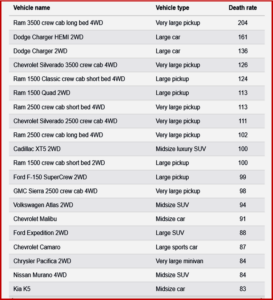
Looking at all makes and models, the average driver death rate was 37 drivers per million registration years. The average other-driver death rate was 53. “The other-driver death rate was most likely higher than the driver death rate because many of the crash partner vehicles were of older vintage and offered occupants less protection,” IIHS said in a release.” The rates include only driver deaths because all vehicles on the road have drivers, but not all of them have passengers or the same number of passengers. The number of deaths is derived from the federal Fatality Analysis Reporting System [The so-called FARS is subject to much criticism – fair and unfair – for its variables and problems. Given that the first responders are dealing with gory and tragic accidents with gruesome deaths sometimes accompanied by large traffic jams, it’s not surprising the reports are less than scientifically pristine – AutoCrat.] Registration data used in the study come from Mobility Global.
The Best and Worst Players
- The model with the highest driver death rate was the Kia Rio, with 170 deaths per million registration years. The Ram 3500 crew cab long-bed four-wheel-drive had the highest other-driver death rate, at 204 deaths per million registration years.
- Eighteen out of the 20 models with the lowest driver death rates are SUVs, including four small, nine mid-size, four large and one very large model. Six models had death rates of 0.
- The Chevrolet Camaro, Chevrolet Malibu and the two-wheel-drive versions of the Dodge Charger and Dodge Charger HEMI are among the models with both the highest driver death rates and those with the highest other-driver death rates.
- All but one of the six models among the vehicles with both the lowest driver and other-driver death rates are luxury SUVs. The models on both these lists are the BMW X5 four-wheel-drive, BMW X7 four-wheel-drive, Porsche Cayenne four-wheel-drive, Volkswagen Atlas four-wheel-drive, Volvo XC60 four-wheel-drive and Volvo XC90 four-wheel-drive.
The latest rates are based on fatalities that occurred from 2021 to 2024 for vehicles from the 2023 model year, as well as earlier models with the same designs and features. The numbers represent the estimated risks for 2023 models, but the data include models from as far back as 2020 if the vehicles were not substantially redesigned during the intervening period. Including these older, equivalent vehicles makes the sample size larger and therefore increases the reliability of the results. To be included, a vehicle must have had at least 100,000 registered vehicle years of exposure from 2021 to 2024 or at least 20 deaths, which means certain models with the same characteristics of those with the highest driver or other-driver death rates were not evaluated. Click here for > death rates for all models< that meet the criteria for inclusion.
*AutoInformed on

About Ken Zino
Ken Zino, editor and publisher of AutoInformed, is a versatile auto industry participant with global experience spanning decades in print and broadcast journalism, as well as social media. He has automobile testing, marketing, public relations and communications experience. He is past president of The International Motor Press Assn, the Detroit Press Club, founding member and first President of the Automotive Press Assn. He is a member of APA, IMPA and the Midwest Automotive Press Assn.
He also brings an historical perspective while citing their contemporary relevance of the work of legendary auto writers such as Ken Purdy, Jim Dunne or Jerry Flint, or writers such as Red Smith, Mark Twain, Thomas Jefferson – all to bring perspective to a chaotic automotive universe.
Above all, decades after he first drove a car, Zino still revels in the sound of the exhaust as the throttle is blipped during a downshift and the driver’s rush that occurs when the entry, apex and exit points of a turn are smoothly and swiftly crossed. It’s the beginning of a perfect lap.
AutoInformed has an editorial philosophy that loves transportation machines of all kinds while promoting critical thinking about the future use of cars and trucks.
Zino builds AutoInformed from his background in automotive journalism starting at Hearst Publishing in New York City on Motor and MotorTech Magazines and car testing where he reviewed hundreds of vehicles in his decade-long stint as the Detroit Bureau Chief of Road & Track magazine. Zino has also worked in Europe, and Asia – now the largest automotive market in the world with China at its center.








IIHS – Driver Death Rates and Vehicles That Kill other Drivers
Click to enlarge.
“Even the safest small cars don’t fare well in crashes with large pickups and heavy SUVs,” IIHS President David Harkey said. “Powerful engines and marketing that attracts aggressive drivers is the issue for sports cars and muscle cars. They’re dangerous mainly because of how they’re driven.”
Click to enlarge
Looking at all makes and models, the average driver death rate was 37 drivers per million registration years. The average other-driver death rate was 53. “The other-driver death rate was most likely higher than the driver death rate because many of the crash partner vehicles were of older vintage and offered occupants less protection,” IIHS said in a release.” The rates include only driver deaths because all vehicles on the road have drivers, but not all of them have passengers or the same number of passengers. The number of deaths is derived from the federal Fatality Analysis Reporting System [The so-called FARS is subject to much criticism – fair and unfair – for its variables and problems. Given that the first responders are dealing with gory and tragic accidents with gruesome deaths sometimes accompanied by large traffic jams, it’s not surprising the reports are less than scientifically pristine – AutoCrat.] Registration data used in the study come from Mobility Global.
The Best and Worst Players
The latest rates are based on fatalities that occurred from 2021 to 2024 for vehicles from the 2023 model year, as well as earlier models with the same designs and features. The numbers represent the estimated risks for 2023 models, but the data include models from as far back as 2020 if the vehicles were not substantially redesigned during the intervening period. Including these older, equivalent vehicles makes the sample size larger and therefore increases the reliability of the results. To be included, a vehicle must have had at least 100,000 registered vehicle years of exposure from 2021 to 2024 or at least 20 deaths, which means certain models with the same characteristics of those with the highest driver or other-driver death rates were not evaluated. Click here for > death rates for all models< that meet the criteria for inclusion.
*AutoInformed on
About Ken Zino
Ken Zino, editor and publisher of AutoInformed, is a versatile auto industry participant with global experience spanning decades in print and broadcast journalism, as well as social media. He has automobile testing, marketing, public relations and communications experience. He is past president of The International Motor Press Assn, the Detroit Press Club, founding member and first President of the Automotive Press Assn. He is a member of APA, IMPA and the Midwest Automotive Press Assn. He also brings an historical perspective while citing their contemporary relevance of the work of legendary auto writers such as Ken Purdy, Jim Dunne or Jerry Flint, or writers such as Red Smith, Mark Twain, Thomas Jefferson – all to bring perspective to a chaotic automotive universe. Above all, decades after he first drove a car, Zino still revels in the sound of the exhaust as the throttle is blipped during a downshift and the driver’s rush that occurs when the entry, apex and exit points of a turn are smoothly and swiftly crossed. It’s the beginning of a perfect lap. AutoInformed has an editorial philosophy that loves transportation machines of all kinds while promoting critical thinking about the future use of cars and trucks. Zino builds AutoInformed from his background in automotive journalism starting at Hearst Publishing in New York City on Motor and MotorTech Magazines and car testing where he reviewed hundreds of vehicles in his decade-long stint as the Detroit Bureau Chief of Road & Track magazine. Zino has also worked in Europe, and Asia – now the largest automotive market in the world with China at its center.