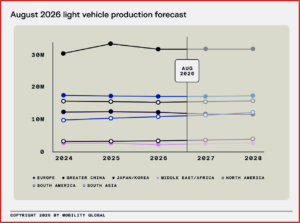
Click to enlarge.
The fog of war is in the latest global light vehicle production forecast released today by Mobility Global.*
“The global auto industry is holding up better than many expected, with small near-term upgrades in several regions, partly offset by meaningful downgrades in Greater China,” said Mike Wall, Executive Director, Automotive Analysis, Mobility Global.**
“China is the clearest two-speed story: weak domestic demand is dragging the baseline, while exports are doing a lot of the heavy lifting to keep factories running. Europe is improving on the back of stronger first-half production and backfill orders, while North America remains resilient thanks to higher-income demand even as inventory remains uneven. Japan and South Korea continue to benefit from solid export pull, despite disruption and geopolitical noise,” said Wall.
“Across emerging regions, we are seeing selective strength – Brazil and India stand out—though inflation pressures and geopolitical risk still keep demand vulnerability on the radar,” said Wall.
Regional Ruminations from Mobility Global
Europe: Europe light-vehicle production is revised up by 123,000 units for 2026 and 23,000 units for 2027.
- This is mainly a “better actuals” story: stronger first-half results and backfill orders, with Volvo and Volkswagen leading the outperformance. We also added 30,000 units into the second half of 2026 to reflect continued momentum.
- Beyond that, upgrades are smaller and spread across select Western and Central European markets, with tariffs and macro assumptions broadly unchanged.
Greater China: Greater China production is revised down by 193,000 units for 2026 and 496,000 units for 2027 as domestic demand continues to underwhelm.
- Recent results reinforce the gap between soft retail demand and relatively stronger production and wholesale activity.
- Exports remain the stabilizer and the growth engine, helping absorb capacity as Chinese automakers push well-equipped vehicles into overseas markets at very competitive prices.
“Our view is straightforward: the near-term outlook stays cautious until domestic demand improves more consistently, and OEMs will need tight inventory control, firmer pricing discipline, and faster international localization to sustain momentum,” said Wall.
- Japan/Korea: Japan’s near-term production is upgraded by 60,000 units, even after roughly 65,000 units of disruption tied to the Kumamoto earthquake and a typhoon.
- The key driver is a fourth-quarter 2026 upgrade of more than 100,000 units as we expect momentum to hold, supported by fiscal expansion at home and strong hybrid export demand to Europe and the United States
- South Korea is upgraded by nearly 17,000 units for 2026 on strong North America export performance despite tariffs and wider geopolitical risk. That strength carries forward, with increases of 70,000 units for 2027 and 40,000 units for 2028.
Middle East/Africa: Middle East and Africa production is revised up by 36,000 units for 2026 and 6,000 units for 2027, with 2028 only marginally changed.
- The near-term lift is mostly explained by stronger realized output in Iran, South Africa, and Morocco. This is a practical “execution and throughput” improvement more than a demand breakout. The region still sits under a higher geopolitical and inflation risk umbrella, so we are not getting ahead of ourselves.
North America: North America production is revised up by 22,000 units for 2026 and 224,000 units for 2027.
- The US market continues to show resilience, with upper-income buyers supporting demand even as inventory remains uneven and creates pockets of production pressure.
- Under the surface, Stellantis is revised down by 86,000 units for 2026 due to shutdown timing, inventory and launch challenges, and tariff impacts tied to Mexico-built models. For 2027, the uplift is broad-based – Honda, Ford, and Stellantis benefit most – while Hyundai is revised down by 33,000 units due to sourcing shifts favoring South Korea.
South America: South America production is revised up by 25,000 units for 2026, 23,000 units for 2027, and 4,000 units for 2028.
- It is all about Brazil. Production is tracking well and the sales momentum looks durable, so we pulled forward a modest upgrade that likely foreshadows a stronger sales view in the next round. Outer-year improvements are modest – about 13,000 units per year on average – and remain concentrated in Brazil. Lifecycle timing also provides some incremental support into 2027.
South Asia: South Asia production is revised up by 104,000 units for 2026 and 40,000 units for 2027 but revised down by 27,000 units for 2028.
- ASEAN performance is increasingly split: Thailand has improved while Indonesia, Malaysia, and Vietnam were softer in July.
- The Philippines remains the weakest – yet year-to-date trends and stronger OEM schedules support a 60,000-unit lift to 2026.
- India continues to be the bright spot, with the Goods and Services Tax cut supporting demand and dealer inventories still relatively lean. As a result, India production is increased by 41,000 units for both 2026 and 2027.
*AutoInformed on
**[Mobility Global, formerly S&P Global Mobility, is different from S&P Global Ratings, which is a separately managed division of S&P Global – AutoCrat.]

About Ken Zino
Ken Zino, editor and publisher of AutoInformed, is a versatile auto industry participant with global experience spanning decades in print and broadcast journalism, as well as social media. He has automobile testing, marketing, public relations and communications experience. He is past president of The International Motor Press Assn, the Detroit Press Club, founding member and first President of the Automotive Press Assn. He is a member of APA, IMPA and the Midwest Automotive Press Assn.
He also brings an historical perspective while citing their contemporary relevance of the work of legendary auto writers such as Ken Purdy, Jim Dunne or Jerry Flint, or writers such as Red Smith, Mark Twain, Thomas Jefferson – all to bring perspective to a chaotic automotive universe.
Above all, decades after he first drove a car, Zino still revels in the sound of the exhaust as the throttle is blipped during a downshift and the driver’s rush that occurs when the entry, apex and exit points of a turn are smoothly and swiftly crossed. It’s the beginning of a perfect lap.
AutoInformed has an editorial philosophy that loves transportation machines of all kinds while promoting critical thinking about the future use of cars and trucks.
Zino builds AutoInformed from his background in automotive journalism starting at Hearst Publishing in New York City on Motor and MotorTech Magazines and car testing where he reviewed hundreds of vehicles in his decade-long stint as the Detroit Bureau Chief of Road & Track magazine. Zino has also worked in Europe, and Asia – now the largest automotive market in the world with China at its center.








August 2026 Light Vehicle Production Forecast – Fog of War
Click to enlarge.
The fog of war is in the latest global light vehicle production forecast released today by Mobility Global.*
“The global auto industry is holding up better than many expected, with small near-term upgrades in several regions, partly offset by meaningful downgrades in Greater China,” said Mike Wall, Executive Director, Automotive Analysis, Mobility Global.**
“China is the clearest two-speed story: weak domestic demand is dragging the baseline, while exports are doing a lot of the heavy lifting to keep factories running. Europe is improving on the back of stronger first-half production and backfill orders, while North America remains resilient thanks to higher-income demand even as inventory remains uneven. Japan and South Korea continue to benefit from solid export pull, despite disruption and geopolitical noise,” said Wall.
“Across emerging regions, we are seeing selective strength – Brazil and India stand out—though inflation pressures and geopolitical risk still keep demand vulnerability on the radar,” said Wall.
Regional Ruminations from Mobility Global
Europe: Europe light-vehicle production is revised up by 123,000 units for 2026 and 23,000 units for 2027.
Greater China: Greater China production is revised down by 193,000 units for 2026 and 496,000 units for 2027 as domestic demand continues to underwhelm.
“Our view is straightforward: the near-term outlook stays cautious until domestic demand improves more consistently, and OEMs will need tight inventory control, firmer pricing discipline, and faster international localization to sustain momentum,” said Wall.
Middle East/Africa: Middle East and Africa production is revised up by 36,000 units for 2026 and 6,000 units for 2027, with 2028 only marginally changed.
North America: North America production is revised up by 22,000 units for 2026 and 224,000 units for 2027.
South America: South America production is revised up by 25,000 units for 2026, 23,000 units for 2027, and 4,000 units for 2028.
South Asia: South Asia production is revised up by 104,000 units for 2026 and 40,000 units for 2027 but revised down by 27,000 units for 2028.
*AutoInformed on
**[Mobility Global, formerly S&P Global Mobility, is different from S&P Global Ratings, which is a separately managed division of S&P Global – AutoCrat.]
About Ken Zino
Ken Zino, editor and publisher of AutoInformed, is a versatile auto industry participant with global experience spanning decades in print and broadcast journalism, as well as social media. He has automobile testing, marketing, public relations and communications experience. He is past president of The International Motor Press Assn, the Detroit Press Club, founding member and first President of the Automotive Press Assn. He is a member of APA, IMPA and the Midwest Automotive Press Assn. He also brings an historical perspective while citing their contemporary relevance of the work of legendary auto writers such as Ken Purdy, Jim Dunne or Jerry Flint, or writers such as Red Smith, Mark Twain, Thomas Jefferson – all to bring perspective to a chaotic automotive universe. Above all, decades after he first drove a car, Zino still revels in the sound of the exhaust as the throttle is blipped during a downshift and the driver’s rush that occurs when the entry, apex and exit points of a turn are smoothly and swiftly crossed. It’s the beginning of a perfect lap. AutoInformed has an editorial philosophy that loves transportation machines of all kinds while promoting critical thinking about the future use of cars and trucks. Zino builds AutoInformed from his background in automotive journalism starting at Hearst Publishing in New York City on Motor and MotorTech Magazines and car testing where he reviewed hundreds of vehicles in his decade-long stint as the Detroit Bureau Chief of Road & Track magazine. Zino has also worked in Europe, and Asia – now the largest automotive market in the world with China at its center.