Click for more.
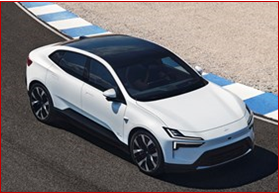
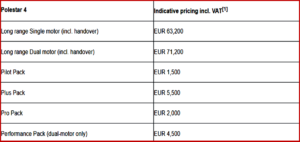
Polestar (Nasdaq: PSNY), the Volvo owned Chinese EV company, said today that the Polestar 4 is now on sale in Europe and Australia. Following start of production and first deliveries in China at the end of 2023, online sales of what is called an SUV coupe in the D segment commence with a starting price of €63,200 [1] and AUD 81,500. Production is planned to start towards the middle of 2024, with first deliveries expected in August. [2] (AutoInformed.com:Polestar 4 Production Starts at Geely Hangzhou Bay Plant; EV Tech-aches 2023 – More Problems than ICE Vehicles)
“The introduction of Polestar 4 into all our markets through the course of 2024 is key to our success, adding this third model to our line-up. Polestar 4 tackles the premium performance class in the D-SUV segment. Polestar 4’s innovative interpretation of an SUV coupé offers great interior space and a stunning appearance,” said Thomas Ingenlath, Polestar CEO.
Polestar 4 is the fastest production car the brand has developed to date. The 0-100 km/h acceleration time is 3.8 seconds [3] and maximum power output is 400 kW (544 hp). Motors are a permanent magnet, synchronous design. Both dual- and single-motor variants are available, with the single-motor using rear-wheel drive. Semi-active suspension is used in the dual-motor version for an additional layer of adjustment between comfort and performance dynamics. Wheels range from 20 to 22-inches in size, with tires supplied by Pirelli and Michelin, depending on configuration.
Click for more.
A 100 kWh battery is fitted to both long-range versions. The Long range Dual motor has 400 kW (544 hp), 686 Nm and a preliminary range target of up to 580 km WLTP [4]. A disconnect clutch allows the car to disengage the front electric motor when not needed, to maximize range and efficiency.
The Long range Single motor version has a 200 kW (272 hp) and 343 Nm motor at the rear, and preliminary range target of up to 610 km WLTP [4].
Up to 200 kW DC and 22 kW AC charging is included for both versions, and the charge lid is motorized. Bi-directional charging hardware is included, with vehicle-to-load (V2L) functionality planned to be made available at a later date, providing for external devices to draw power from Polestar 4. A heat pump is standard, allowing the car to capitalize on ambient heat when preconditioning the cabin and battery.
A new drive optimization function allows the driver to select between Range or Performance driving modes in the Long range Dual motor version. Performance mode sharpens responsiveness from the powertrain and engages both motors at all times for full power delivery and best performance. Range mode prioritizes efficiency, adapting the powertrain to a calmer style and forces use of only the rear motor.
Polestar 4 is produced in Geely Holdings’ SEA factory in Hangzhou Bay, China, which combines green hydro power electricity (I-REC certificate,) with photovoltaic electricity from the roof of the plant. A higher use of low-carbon aluminum from smelters using hydro-power electricity helps reduce the climate impact further.
In addition, data regarding the share of recycled aluminum has been included in the assessment for the first time. The Polestar 4 Long range Single motor version has a cradle-to-gate carbon footprint of 19.9 tCO2e, while the Long range Dual motor has one of 21.4 tCO2e. Aluminum represents 22.4-24% of the carbon footprint, while steel and iron constitute 20%, and battery modules account for the highest share of the carbon footprint of materials production and refining at 36-40%.
The mono-material approach, first used in the Polestar electric roadster concept in 2022, is applied to interior materials, where all layers of certain components are produced from the same base material. This it’s claimed allows them to be recycled more effectively and efficiently by eliminating the need for incompatible materials to be separated before recycling.
New interior materials include a tailored knit textile which consists of 100% recycled PET, along with bio-attributed MicroTech vinyl, and traced leather from Bridge of Weir – where the raw hides are by-products of the food industry and come from Scottish farms that are independently rated by the Animal Protection Index as being of the highest global standard.
The tailored knit upholstery is a new technique for the automotive industry. First shown in the Precept concept car, the textile is made from 100% recycled polyester. The material and the design have been created by Polestar designers together with the Swedish School of Textiles (Borås Textilhögskolan) and further developed with suppliers. It is made to fit, producing minimal offcuts and reduced overall waste.
Inlay carpets in the interior are made using recycled PET and floor carpets are made using ECONYL, which includes reclaimed fishing nets. Specific door trim panels are made from NFPP (natural fiber polypropylene) which results in up to 50% less virgin plastic and a weight saving of up to 40%. MicroTech, first introduced in Polestar 3, is a bio-attributed vinyl that replaces crude oil with pine oil in its construction and has a recycled textile backing.
Inside Polestar 4, the infotainment system the Android Automotive OS and the Snapdragon Cockpit Platform. It now has 5.4-inch landscape-oriented screen. It comes with Google built-in, including Google Assistant, Google Maps and Google Play. A Harman Kardon audio system is available as an option with 12 speakers and 1400-Watt channel-hybrid amplifier. An additional two headrest speakers are added to each front seat with the optional Nappa Pack – raising the total to 16. Wireless Apple CarPlay is included. As with other Polestar cars, regular over-the-air (OTA) updates allow for new features and improvements to be sent remotely to all vehicles.
Inevitable Polestar footnotes
- Indicative pricing in Germany, including handover fee and VAT.
- Launch in other Asia Pacific and Middle East markets is planned through the course of H1 2024. Launch in North America and South Korea is expected in the middle of 2024. Pricing for all remaining markets will be confirmed when sales start.
- Preliminary data.
- Preliminary data. Certified range and energy consumption data to be confirmed at a later date.
Google, Google Play, and Google Maps are trademarks of Google LLC.

About Ken Zino
Ken Zino, editor and publisher of AutoInformed, is a versatile auto industry participant with global experience spanning decades in print and broadcast journalism, as well as social media. He has automobile testing, marketing, public relations and communications experience. He is past president of The International Motor Press Assn, the Detroit Press Club, founding member and first President of the Automotive Press Assn. He is a member of APA, IMPA and the Midwest Automotive Press Assn.
He also brings an historical perspective while citing their contemporary relevance of the work of legendary auto writers such as Ken Purdy, Jim Dunne or Jerry Flint, or writers such as Red Smith, Mark Twain, Thomas Jefferson – all to bring perspective to a chaotic automotive universe.
Above all, decades after he first drove a car, Zino still revels in the sound of the exhaust as the throttle is blipped during a downshift and the driver’s rush that occurs when the entry, apex and exit points of a turn are smoothly and swiftly crossed. It’s the beginning of a perfect lap.
AutoInformed has an editorial philosophy that loves transportation machines of all kinds while promoting critical thinking about the future use of cars and trucks.
Zino builds AutoInformed from his background in automotive journalism starting at Hearst Publishing in New York City on Motor and MotorTech Magazines and car testing where he reviewed hundreds of vehicles in his decade-long stint as the Detroit Bureau Chief of Road & Track magazine. Zino has also worked in Europe, and Asia – now the largest automotive market in the world with China at its center.








Polestar 4 now on Sale in Europe and Australia
Click for more.
Polestar (Nasdaq: PSNY), the Volvo owned Chinese EV company, said today that the Polestar 4 is now on sale in Europe and Australia. Following start of production and first deliveries in China at the end of 2023, online sales of what is called an SUV coupe in the D segment commence with a starting price of €63,200 [1] and AUD 81,500. Production is planned to start towards the middle of 2024, with first deliveries expected in August. [2] (AutoInformed.com:Polestar 4 Production Starts at Geely Hangzhou Bay Plant; EV Tech-aches 2023 – More Problems than ICE Vehicles)
“The introduction of Polestar 4 into all our markets through the course of 2024 is key to our success, adding this third model to our line-up. Polestar 4 tackles the premium performance class in the D-SUV segment. Polestar 4’s innovative interpretation of an SUV coupé offers great interior space and a stunning appearance,” said Thomas Ingenlath, Polestar CEO.
Polestar 4 is the fastest production car the brand has developed to date. The 0-100 km/h acceleration time is 3.8 seconds [3] and maximum power output is 400 kW (544 hp). Motors are a permanent magnet, synchronous design. Both dual- and single-motor variants are available, with the single-motor using rear-wheel drive. Semi-active suspension is used in the dual-motor version for an additional layer of adjustment between comfort and performance dynamics. Wheels range from 20 to 22-inches in size, with tires supplied by Pirelli and Michelin, depending on configuration.
Click for more.
A 100 kWh battery is fitted to both long-range versions. The Long range Dual motor has 400 kW (544 hp), 686 Nm and a preliminary range target of up to 580 km WLTP [4]. A disconnect clutch allows the car to disengage the front electric motor when not needed, to maximize range and efficiency.
The Long range Single motor version has a 200 kW (272 hp) and 343 Nm motor at the rear, and preliminary range target of up to 610 km WLTP [4].
Up to 200 kW DC and 22 kW AC charging is included for both versions, and the charge lid is motorized. Bi-directional charging hardware is included, with vehicle-to-load (V2L) functionality planned to be made available at a later date, providing for external devices to draw power from Polestar 4. A heat pump is standard, allowing the car to capitalize on ambient heat when preconditioning the cabin and battery.
A new drive optimization function allows the driver to select between Range or Performance driving modes in the Long range Dual motor version. Performance mode sharpens responsiveness from the powertrain and engages both motors at all times for full power delivery and best performance. Range mode prioritizes efficiency, adapting the powertrain to a calmer style and forces use of only the rear motor.
Polestar 4 is produced in Geely Holdings’ SEA factory in Hangzhou Bay, China, which combines green hydro power electricity (I-REC certificate,) with photovoltaic electricity from the roof of the plant. A higher use of low-carbon aluminum from smelters using hydro-power electricity helps reduce the climate impact further.
In addition, data regarding the share of recycled aluminum has been included in the assessment for the first time. The Polestar 4 Long range Single motor version has a cradle-to-gate carbon footprint of 19.9 tCO2e, while the Long range Dual motor has one of 21.4 tCO2e. Aluminum represents 22.4-24% of the carbon footprint, while steel and iron constitute 20%, and battery modules account for the highest share of the carbon footprint of materials production and refining at 36-40%.
The mono-material approach, first used in the Polestar electric roadster concept in 2022, is applied to interior materials, where all layers of certain components are produced from the same base material. This it’s claimed allows them to be recycled more effectively and efficiently by eliminating the need for incompatible materials to be separated before recycling.
New interior materials include a tailored knit textile which consists of 100% recycled PET, along with bio-attributed MicroTech vinyl, and traced leather from Bridge of Weir – where the raw hides are by-products of the food industry and come from Scottish farms that are independently rated by the Animal Protection Index as being of the highest global standard.
The tailored knit upholstery is a new technique for the automotive industry. First shown in the Precept concept car, the textile is made from 100% recycled polyester. The material and the design have been created by Polestar designers together with the Swedish School of Textiles (Borås Textilhögskolan) and further developed with suppliers. It is made to fit, producing minimal offcuts and reduced overall waste.
Inlay carpets in the interior are made using recycled PET and floor carpets are made using ECONYL, which includes reclaimed fishing nets. Specific door trim panels are made from NFPP (natural fiber polypropylene) which results in up to 50% less virgin plastic and a weight saving of up to 40%. MicroTech, first introduced in Polestar 3, is a bio-attributed vinyl that replaces crude oil with pine oil in its construction and has a recycled textile backing.
Inside Polestar 4, the infotainment system the Android Automotive OS and the Snapdragon Cockpit Platform. It now has 5.4-inch landscape-oriented screen. It comes with Google built-in, including Google Assistant, Google Maps and Google Play. A Harman Kardon audio system is available as an option with 12 speakers and 1400-Watt channel-hybrid amplifier. An additional two headrest speakers are added to each front seat with the optional Nappa Pack – raising the total to 16. Wireless Apple CarPlay is included. As with other Polestar cars, regular over-the-air (OTA) updates allow for new features and improvements to be sent remotely to all vehicles.
Inevitable Polestar footnotes
Google, Google Play, and Google Maps are trademarks of Google LLC.
About Ken Zino
Ken Zino, editor and publisher of AutoInformed, is a versatile auto industry participant with global experience spanning decades in print and broadcast journalism, as well as social media. He has automobile testing, marketing, public relations and communications experience. He is past president of The International Motor Press Assn, the Detroit Press Club, founding member and first President of the Automotive Press Assn. He is a member of APA, IMPA and the Midwest Automotive Press Assn. He also brings an historical perspective while citing their contemporary relevance of the work of legendary auto writers such as Ken Purdy, Jim Dunne or Jerry Flint, or writers such as Red Smith, Mark Twain, Thomas Jefferson – all to bring perspective to a chaotic automotive universe. Above all, decades after he first drove a car, Zino still revels in the sound of the exhaust as the throttle is blipped during a downshift and the driver’s rush that occurs when the entry, apex and exit points of a turn are smoothly and swiftly crossed. It’s the beginning of a perfect lap. AutoInformed has an editorial philosophy that loves transportation machines of all kinds while promoting critical thinking about the future use of cars and trucks. Zino builds AutoInformed from his background in automotive journalism starting at Hearst Publishing in New York City on Motor and MotorTech Magazines and car testing where he reviewed hundreds of vehicles in his decade-long stint as the Detroit Bureau Chief of Road & Track magazine. Zino has also worked in Europe, and Asia – now the largest automotive market in the world with China at its center.