Click to enlarge.
Virtually all automakers now have some type automated driving system categorized as Level 2 or Level 2+ on the SAE Autonomous Driving Levels standard.* These include General Motors’ Super Cruise; Tesla Autopilot; and numerous Mercedes, BMW and Stellantis systems in Europe and Nio in mainland China. More options are becoming obtainable each year.
“The choice between Level 3 automation [conditional] and Level 2/Level 2+ systems [partial automation] often divides the industry, resulting in notable differences in strategies among autonomous vehicle companies,” said Vivek Beriwal of S&P Global Mobility, a distinct part of S&P Global. “A key assumption of Level 3 systems is that the automaker assumes liability for its safe operation in “autonomous mode.” This has caused some automakers to focus on expanding functionality within Level 2+ while delaying any potential Level 3 upgrades,” Beriwal observes.
S&P Global Autonomous Driving Consumer Survey
To explore consumer sentiment toward autonomous driving technologies, S&P Global Mobility conducts an annual survey. New-vehicle “intenders” are asked a series of questions to gauge the desirability and packaging of autonomy features, their willingness to pay for such features, and their overall perception of these technologies.
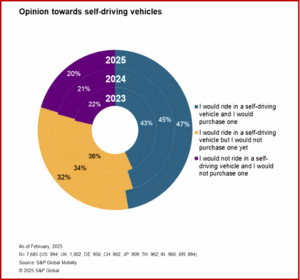
The 2025 S&P Global Autonomous Driving Consumer Survey, conducted online among nearly 8000 respondents across eight countries, showed that there is a gradual increase in consumer trust regarding autonomous vehicles, with approximately two-thirds of respondents expressing interest in using autonomous features for highway driving. “However, full trust in self-driving technology is still developing, as consumers remain cautiously optimistic,” said Beriwal.
Executive Summary
- Advanced Driver Assistance Systems (ADAS) features are generally preferred over higher levels of automation. Consumers show a greater desire for Level 2 and Level 2+ systems, which provide partial automation, compared to Level 3 systems that require less driver interaction.
- Consumers are willing to pay extra for autonomous features, particularly for fully automatic parking. Interestingly, despite lower desirability, self-driving cars are among the features consumers are most inclined to invest in, indicating recognition of their potential value.
- Safety ratings and certifications significantly influence consumer purchasing decisions. Many respondents indicated a willingness to pay extra for vehicles with higher safety ratings. Nearly 54% of global respondents believed the automated car would drive more efficiently and 47% believed it would be safer.
- While safety is often touted as the primary driver, there is also an opportunity to emphasize operational efficiency, which could capture even more consumer interest. Both use cases for automated driving have seen slight growth since the 2023 survey; nevertheless, the general increased openness to conditional autonomy suggests a growing trust in this technology
Challenges for Autonomous Vehicle Acceptance
- Frequent crashes involving autonomous vehicles (e.g., Tesla, Uber, and Cruise autonomous vehicles) have made headlines, reinforcing consumer fear that the technology isn’t ready. Consumers also worry about how these vehicles will handle unpredictable situations, such as jaywalkers, construction zones, and bad weather.
- A lack of transparency about how AI systems make decisions further adds to the discomfort.
- Additionally, consumers are concerned about how autonomous vehicles will prioritize lives in unavoidable crash scenarios.
- Liability in accidents remains unclear; who’s at fault – the carmaker, software developer, or vehicle owner?
“Trust in autonomous vehicles is growing slowly but remains low overall. To shift perception, consumers need more real-world exposure, transparent communication, and consistent safety records. Consumer reluctance stems from a combination of fear, uncertainty, and lack of perceived benefits – all of which will take time, trust-building, and proven performance to overcome as we look to the future of autonomous vehicles,” said Beriwal.
*AutoInformed on

About Ken Zino
Ken Zino, editor and publisher of AutoInformed, is a versatile auto industry participant with global experience spanning decades in print and broadcast journalism, as well as social media. He has automobile testing, marketing, public relations and communications experience. He is past president of The International Motor Press Assn, the Detroit Press Club, founding member and first President of the Automotive Press Assn. He is a member of APA, IMPA and the Midwest Automotive Press Assn.
He also brings an historical perspective while citing their contemporary relevance of the work of legendary auto writers such as Ken Purdy, Jim Dunne or Jerry Flint, or writers such as Red Smith, Mark Twain, Thomas Jefferson – all to bring perspective to a chaotic automotive universe.
Above all, decades after he first drove a car, Zino still revels in the sound of the exhaust as the throttle is blipped during a downshift and the driver’s rush that occurs when the entry, apex and exit points of a turn are smoothly and swiftly crossed. It’s the beginning of a perfect lap.
AutoInformed has an editorial philosophy that loves transportation machines of all kinds while promoting critical thinking about the future use of cars and trucks.
Zino builds AutoInformed from his background in automotive journalism starting at Hearst Publishing in New York City on Motor and MotorTech Magazines and car testing where he reviewed hundreds of vehicles in his decade-long stint as the Detroit Bureau Chief of Road & Track magazine. Zino has also worked in Europe, and Asia – now the largest automotive market in the world with China at its center.







Autonomous Vehicles – Skepticism Rules Consumers
Click to enlarge.
Virtually all automakers now have some type automated driving system categorized as Level 2 or Level 2+ on the SAE Autonomous Driving Levels standard.* These include General Motors’ Super Cruise; Tesla Autopilot; and numerous Mercedes, BMW and Stellantis systems in Europe and Nio in mainland China. More options are becoming obtainable each year.
“The choice between Level 3 automation [conditional] and Level 2/Level 2+ systems [partial automation] often divides the industry, resulting in notable differences in strategies among autonomous vehicle companies,” said Vivek Beriwal of S&P Global Mobility, a distinct part of S&P Global. “A key assumption of Level 3 systems is that the automaker assumes liability for its safe operation in “autonomous mode.” This has caused some automakers to focus on expanding functionality within Level 2+ while delaying any potential Level 3 upgrades,” Beriwal observes.
S&P Global Autonomous Driving Consumer Survey
To explore consumer sentiment toward autonomous driving technologies, S&P Global Mobility conducts an annual survey. New-vehicle “intenders” are asked a series of questions to gauge the desirability and packaging of autonomy features, their willingness to pay for such features, and their overall perception of these technologies.
The 2025 S&P Global Autonomous Driving Consumer Survey, conducted online among nearly 8000 respondents across eight countries, showed that there is a gradual increase in consumer trust regarding autonomous vehicles, with approximately two-thirds of respondents expressing interest in using autonomous features for highway driving. “However, full trust in self-driving technology is still developing, as consumers remain cautiously optimistic,” said Beriwal.
Executive Summary
Challenges for Autonomous Vehicle Acceptance
“Trust in autonomous vehicles is growing slowly but remains low overall. To shift perception, consumers need more real-world exposure, transparent communication, and consistent safety records. Consumer reluctance stems from a combination of fear, uncertainty, and lack of perceived benefits – all of which will take time, trust-building, and proven performance to overcome as we look to the future of autonomous vehicles,” said Beriwal.
*AutoInformed on
About Ken Zino
Ken Zino, editor and publisher of AutoInformed, is a versatile auto industry participant with global experience spanning decades in print and broadcast journalism, as well as social media. He has automobile testing, marketing, public relations and communications experience. He is past president of The International Motor Press Assn, the Detroit Press Club, founding member and first President of the Automotive Press Assn. He is a member of APA, IMPA and the Midwest Automotive Press Assn. He also brings an historical perspective while citing their contemporary relevance of the work of legendary auto writers such as Ken Purdy, Jim Dunne or Jerry Flint, or writers such as Red Smith, Mark Twain, Thomas Jefferson – all to bring perspective to a chaotic automotive universe. Above all, decades after he first drove a car, Zino still revels in the sound of the exhaust as the throttle is blipped during a downshift and the driver’s rush that occurs when the entry, apex and exit points of a turn are smoothly and swiftly crossed. It’s the beginning of a perfect lap. AutoInformed has an editorial philosophy that loves transportation machines of all kinds while promoting critical thinking about the future use of cars and trucks. Zino builds AutoInformed from his background in automotive journalism starting at Hearst Publishing in New York City on Motor and MotorTech Magazines and car testing where he reviewed hundreds of vehicles in his decade-long stint as the Detroit Bureau Chief of Road & Track magazine. Zino has also worked in Europe, and Asia – now the largest automotive market in the world with China at its center.