Click for more.
The Executive Board of the Volkswagen Group (VOW.DE)* yesterday presented the Supervisory Board with 12 initiatives to make the financially bedridden Group [Share price is down 66% during the last five years; -25% year-over-year at ~€76. The Wolf in the room from a company with a history starting in Wolfsburg is how many German IG Metall jobs will be devoured. Furthermore, stakeholders have a legitimate question about why these steps weren’t taken long ago – AutoCrat?] competitive by 2030.
“Our goal is clear: by 2030, we will make the Volkswagen Group the most attractive automotive company in the world – with iconic brands, inspiring products, leading technologies, robust financial results, reliable capital market performance and a team spirit in action,” claimed Oliver Blume, CEO of the Group. “With our future plan, we are moving into the next phase of transformation by our own means. We are making the Volkswagen Group faster, more resilient and more competitive: through less complexity, focused technologies, an even stronger alignment of products, development and production with regional markets, the reduction of over-capacities, a streamlined equity portfolio and significantly leaner structures. In this way, we are creating the conditions for sustained success – even in an increasingly demanding environment.”
“In the global market environment, it is essential to make the company even more resilient, efficient and agile. The Executive Board has already begun implementing initial measures of its future plan. These include, with immediate effect, reducing complexity and variant complexity in the product portfolio, aligning products, technologies and development more closely with regional markets, adjusting capacities in the production network to market expectations, and streamlining structures and the equity portfolio,” Volkswagen said in a press release.
Volkswagen acknowledged that during the past twelve months, the global situation is beset with geopolitical tensions, rising costs – driven primarily by tariffs – growing regulatory requirements and an increasingly intense global competitive environment have compounded the challenges facing the automotive industry in an already far-reaching phase of transformation. Following is the recovery plan:
Reduced Offering Complexity
The model lineup will be progressively streamlined by up to 50 % and concentrated on the most attractive market segments. Offering complexity such as the number of available equipment options will be reduced by up to 75 %. “This allows investments and development resources to be focused on the products and technologies that deliver the greatest added value for customers and the highest value contribution to the Group,” VW claimed.
Harmonized Technology Fields
The key technology fields of platforms, electronic architectures and software will each be harmonized and concentrated to meet the requirements of the western and eastern hemispheres respectively. “The objective is to realize Group-wide synergies more effectively, eliminate technological parallel structures, and further strengthen technology leadership. To this end, the Volkswagen Group is focusing on competitive technologies with high scaling potential and clear customer benefit,” VW said.
Adjusted Technical Capacities
The cross-brand target is a demand-appropriate level of ~9 million units per year. Prior to the COVID-19 pandemic, the VW Group had invested ~12 million vehicles. A reduction of 2 million units has already been made.* “Further steps will follow in China and Europe. In parallel, development and indirect functions are being made more efficient. Digitalization, artificial intelligence and shared services will help increase productivity and speed. Leaner management structures are simplifying decision-making processes,” VW said.
Focus on the Automotive Core Business
The Volkswagen Group is focusing on its automotive core business. “The equity and investment portfolio is being aligned with strategic contribution, return and capital commitment – with the objective of achieving greater focus, lower complexity and additional financial flexibility. The agreement reached at the end of June on the divestiture of a majority stake in Everllence reflects the consistent execution of this strategy. With a cash inflow of approximately €7.4 billion, the transaction simultaneously strengthens the Group’s balance sheet and expands the financial room to maneuver for the further strategic development of the Volkswagen Group,” VW said.
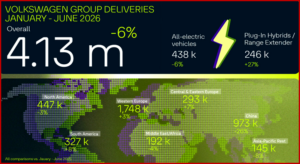
Volkswagen Group delivers 4.1 million vehicles in H1 2026
“The Volkswagen Group grew by around 2% overall in the first half of the year outside of China. We continued to gain ground, particularly in South America and Europe. It is especially pleasing to note that in our home region, the Electric Urban Car Family – launched just a few weeks ago – is being very well received by our customers. We have already taken more than 54,000 orders for these attractive entry-level vehicles from VW, Škoda, and CUPRA, even though only three of the four models are currently available. This is well above our expectations. The order book for all-electric vehicles in Europe has risen by more than 50% overall compared to the end of last year. The situation in China remains challenging, where we were unable to escape a significant total market decline of around -20%, despite initial positive momentum from our newly introduced, locally developed electric vehicles. Globally, we are seeing a decline in deliveries of around -6%,” said Marco Schubert Member of the Group’s Extended Executive Committee for Sales.
Growth in South America (+8 %), Western Europe (+3%), and Central and Eastern Europe (+7%) only partially offset significant decline in China (-26%) driven by total market development; North America, after 8% growth in Q2, saw only a slight decline after six months (-3%)
*AutoInformed on

About Ken Zino
Ken Zino, editor and publisher of AutoInformed, is a versatile auto industry participant with global experience spanning decades in print and broadcast journalism, as well as social media. He has automobile testing, marketing, public relations and communications experience. He is past president of The International Motor Press Assn, the Detroit Press Club, founding member and first President of the Automotive Press Assn. He is a member of APA, IMPA and the Midwest Automotive Press Assn.
He also brings an historical perspective while citing their contemporary relevance of the work of legendary auto writers such as Ken Purdy, Jim Dunne or Jerry Flint, or writers such as Red Smith, Mark Twain, Thomas Jefferson – all to bring perspective to a chaotic automotive universe.
Above all, decades after he first drove a car, Zino still revels in the sound of the exhaust as the throttle is blipped during a downshift and the driver’s rush that occurs when the entry, apex and exit points of a turn are smoothly and swiftly crossed. It’s the beginning of a perfect lap.
AutoInformed has an editorial philosophy that loves transportation machines of all kinds while promoting critical thinking about the future use of cars and trucks.
Zino builds AutoInformed from his background in automotive journalism starting at Hearst Publishing in New York City on Motor and MotorTech Magazines and car testing where he reviewed hundreds of vehicles in his decade-long stint as the Detroit Bureau Chief of Road & Track magazine. Zino has also worked in Europe, and Asia – now the largest automotive market in the world with China at its center.







Loss Making Survival Diet – VW Group Efficiency Quest
Click for more.
The Executive Board of the Volkswagen Group (VOW.DE)* yesterday presented the Supervisory Board with 12 initiatives to make the financially bedridden Group [Share price is down 66% during the last five years; -25% year-over-year at ~€76. The Wolf in the room from a company with a history starting in Wolfsburg is how many German IG Metall jobs will be devoured. Furthermore, stakeholders have a legitimate question about why these steps weren’t taken long ago – AutoCrat?] competitive by 2030.
“Our goal is clear: by 2030, we will make the Volkswagen Group the most attractive automotive company in the world – with iconic brands, inspiring products, leading technologies, robust financial results, reliable capital market performance and a team spirit in action,” claimed Oliver Blume, CEO of the Group. “With our future plan, we are moving into the next phase of transformation by our own means. We are making the Volkswagen Group faster, more resilient and more competitive: through less complexity, focused technologies, an even stronger alignment of products, development and production with regional markets, the reduction of over-capacities, a streamlined equity portfolio and significantly leaner structures. In this way, we are creating the conditions for sustained success – even in an increasingly demanding environment.”
“In the global market environment, it is essential to make the company even more resilient, efficient and agile. The Executive Board has already begun implementing initial measures of its future plan. These include, with immediate effect, reducing complexity and variant complexity in the product portfolio, aligning products, technologies and development more closely with regional markets, adjusting capacities in the production network to market expectations, and streamlining structures and the equity portfolio,” Volkswagen said in a press release.
Volkswagen acknowledged that during the past twelve months, the global situation is beset with geopolitical tensions, rising costs – driven primarily by tariffs – growing regulatory requirements and an increasingly intense global competitive environment have compounded the challenges facing the automotive industry in an already far-reaching phase of transformation. Following is the recovery plan:
Reduced Offering Complexity
The model lineup will be progressively streamlined by up to 50 % and concentrated on the most attractive market segments. Offering complexity such as the number of available equipment options will be reduced by up to 75 %. “This allows investments and development resources to be focused on the products and technologies that deliver the greatest added value for customers and the highest value contribution to the Group,” VW claimed.
Harmonized Technology Fields
The key technology fields of platforms, electronic architectures and software will each be harmonized and concentrated to meet the requirements of the western and eastern hemispheres respectively. “The objective is to realize Group-wide synergies more effectively, eliminate technological parallel structures, and further strengthen technology leadership. To this end, the Volkswagen Group is focusing on competitive technologies with high scaling potential and clear customer benefit,” VW said.
Adjusted Technical Capacities
The cross-brand target is a demand-appropriate level of ~9 million units per year. Prior to the COVID-19 pandemic, the VW Group had invested ~12 million vehicles. A reduction of 2 million units has already been made.* “Further steps will follow in China and Europe. In parallel, development and indirect functions are being made more efficient. Digitalization, artificial intelligence and shared services will help increase productivity and speed. Leaner management structures are simplifying decision-making processes,” VW said.
Focus on the Automotive Core Business
The Volkswagen Group is focusing on its automotive core business. “The equity and investment portfolio is being aligned with strategic contribution, return and capital commitment – with the objective of achieving greater focus, lower complexity and additional financial flexibility. The agreement reached at the end of June on the divestiture of a majority stake in Everllence reflects the consistent execution of this strategy. With a cash inflow of approximately €7.4 billion, the transaction simultaneously strengthens the Group’s balance sheet and expands the financial room to maneuver for the further strategic development of the Volkswagen Group,” VW said.
Volkswagen Group delivers 4.1 million vehicles in H1 2026
“The Volkswagen Group grew by around 2% overall in the first half of the year outside of China. We continued to gain ground, particularly in South America and Europe. It is especially pleasing to note that in our home region, the Electric Urban Car Family – launched just a few weeks ago – is being very well received by our customers. We have already taken more than 54,000 orders for these attractive entry-level vehicles from VW, Škoda, and CUPRA, even though only three of the four models are currently available. This is well above our expectations. The order book for all-electric vehicles in Europe has risen by more than 50% overall compared to the end of last year. The situation in China remains challenging, where we were unable to escape a significant total market decline of around -20%, despite initial positive momentum from our newly introduced, locally developed electric vehicles. Globally, we are seeing a decline in deliveries of around -6%,” said Marco Schubert Member of the Group’s Extended Executive Committee for Sales.
Growth in South America (+8 %), Western Europe (+3%), and Central and Eastern Europe (+7%) only partially offset significant decline in China (-26%) driven by total market development; North America, after 8% growth in Q2, saw only a slight decline after six months (-3%)
*AutoInformed on
About Ken Zino
Ken Zino, editor and publisher of AutoInformed, is a versatile auto industry participant with global experience spanning decades in print and broadcast journalism, as well as social media. He has automobile testing, marketing, public relations and communications experience. He is past president of The International Motor Press Assn, the Detroit Press Club, founding member and first President of the Automotive Press Assn. He is a member of APA, IMPA and the Midwest Automotive Press Assn. He also brings an historical perspective while citing their contemporary relevance of the work of legendary auto writers such as Ken Purdy, Jim Dunne or Jerry Flint, or writers such as Red Smith, Mark Twain, Thomas Jefferson – all to bring perspective to a chaotic automotive universe. Above all, decades after he first drove a car, Zino still revels in the sound of the exhaust as the throttle is blipped during a downshift and the driver’s rush that occurs when the entry, apex and exit points of a turn are smoothly and swiftly crossed. It’s the beginning of a perfect lap. AutoInformed has an editorial philosophy that loves transportation machines of all kinds while promoting critical thinking about the future use of cars and trucks. Zino builds AutoInformed from his background in automotive journalism starting at Hearst Publishing in New York City on Motor and MotorTech Magazines and car testing where he reviewed hundreds of vehicles in his decade-long stint as the Detroit Bureau Chief of Road & Track magazine. Zino has also worked in Europe, and Asia – now the largest automotive market in the world with China at its center.