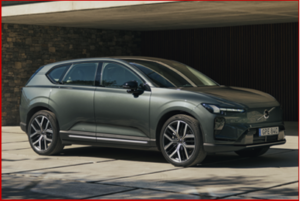
Click for more.
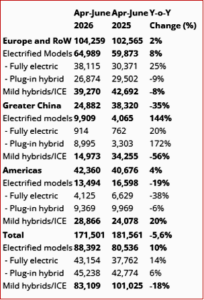
Volvo Cars (VOLCAR B:STO)* today reported global sales of 171,501 cars in the second quarter of 2026, down 5.6% from Q2 last year. This is partially due to the difficult operating environment across regions, especially in China, that global automakers are enduring along with the Trump mis-administration tax, trade and foreign policy strategies. [Part of the solution to the Chinese problem is that Chinese-owned Volvo cars can export Chinese EVs to global markets, which it is increasingly doing – AutoCrat.]
“Overall market conditions remain challenging, specifically in China, but we are encouraged by the momentum for the fully electric cars in our largest market Europe,” said Erik Severinson, Chief Commercial Officer at Volvo Cars.** “We see increased deliveries and order intake for our EX30, even in less electrified South European markets. This is reflected in our higher market share in the growing electric car segments compared to traditional petrol and diesel cars.”
Click to enlarge.
“The EX60 will further strengthen our share in the growing fully electric segment and continues to surpass expectations with robust customer orders. We expect increased interest in the car as customers will now be able to experience it in our showrooms as we start the first deliveries. We are now gearing up to ramp up production in the second half of the year.”
Overall, electrified models – fully electric and plug-in hybrid cars – represented 52% of all cars sold during the quarter,” said Severinson. [During 2025, Volvo Cars sold more than 710,000 cars, with an electrified share of 46% – AutoCrat.]
In Europe and Rest of the World, sales reached 104,259 cars during the second quarter, up 2% year-over-year. Sales of electrified models increased by 8% with a strong increase in deliveries of fully electric cars. Overall, the electrified models comprised 62% of all cars sold in the region.
In the Americas region, sales increased by 4% to 42,630 cars, a gradual and fragile recovery in the U.S. market for two straight months. “The overall market still remains impacted by low customer sentiment, increased competition in the SUV segment and a slower than expected recovery in sales of electric and plug-in hybrid cars after the subsidy removal,” Volvo Cars said. [Chinese EVs have distinct price and systems advantages, and short product revision cycles – AutoCrat.]
In the Greater China region sales were negatively impacted by intensifying competitive pressure, regulatory changes and a weak macro environment in the World’s largest vehicle market. Deliveries stood at 24,882 cars, down 35% compared to the same period last year, reflecting the broader downturn in the industry. Nonetheless, sales of electrified models increased by 144% to 9909 cars, with a 172% increase in plug-in hybrid deliveries from an increase in sales of the XC70 long-range plugin hybrid.
*AutoInformed on
**Volvo Cars is a subsidiary of Geely Holding (GEELY.UL), which owns ~78.7% of the company’s outstanding shares. Geely Holding, a Chinese multinational enterprise, bought Volvo from Ford Motor in 2010 after years of cultural clashes between American Ford and Swedish Volvo employees and senior managers. During 2025, Volvo Cars on average had 42,600 full-time employees. Volvo Cars’ head office, product development, marketing and administration functions are mainly located in Gothenburg, Sweden. Volvo Cars’ production plants are located in Gothenburg, Ghent (Belgium), South Carolina (US), Chengdu, Daqing and Taizhou (China). The company also has R&D and design centers in Gothenburg and Shanghai (China). – AutoCrat.

About Ken Zino
Ken Zino, editor and publisher of AutoInformed, is a versatile auto industry participant with global experience spanning decades in print and broadcast journalism, as well as social media. He has automobile testing, marketing, public relations and communications experience. He is past president of The International Motor Press Assn, the Detroit Press Club, founding member and first President of the Automotive Press Assn. He is a member of APA, IMPA and the Midwest Automotive Press Assn.
He also brings an historical perspective while citing their contemporary relevance of the work of legendary auto writers such as Ken Purdy, Jim Dunne or Jerry Flint, or writers such as Red Smith, Mark Twain, Thomas Jefferson – all to bring perspective to a chaotic automotive universe.
Above all, decades after he first drove a car, Zino still revels in the sound of the exhaust as the throttle is blipped during a downshift and the driver’s rush that occurs when the entry, apex and exit points of a turn are smoothly and swiftly crossed. It’s the beginning of a perfect lap.
AutoInformed has an editorial philosophy that loves transportation machines of all kinds while promoting critical thinking about the future use of cars and trucks.
Zino builds AutoInformed from his background in automotive journalism starting at Hearst Publishing in New York City on Motor and MotorTech Magazines and car testing where he reviewed hundreds of vehicles in his decade-long stint as the Detroit Bureau Chief of Road & Track magazine. Zino has also worked in Europe, and Asia – now the largest automotive market in the world with China at its center.







Volvo Cars Q2 2026 Sales Drop ~6%
Click for more.
Volvo Cars (VOLCAR B:STO)* today reported global sales of 171,501 cars in the second quarter of 2026, down 5.6% from Q2 last year. This is partially due to the difficult operating environment across regions, especially in China, that global automakers are enduring along with the Trump mis-administration tax, trade and foreign policy strategies. [Part of the solution to the Chinese problem is that Chinese-owned Volvo cars can export Chinese EVs to global markets, which it is increasingly doing – AutoCrat.]
“Overall market conditions remain challenging, specifically in China, but we are encouraged by the momentum for the fully electric cars in our largest market Europe,” said Erik Severinson, Chief Commercial Officer at Volvo Cars.** “We see increased deliveries and order intake for our EX30, even in less electrified South European markets. This is reflected in our higher market share in the growing electric car segments compared to traditional petrol and diesel cars.”
Click to enlarge.
“The EX60 will further strengthen our share in the growing fully electric segment and continues to surpass expectations with robust customer orders. We expect increased interest in the car as customers will now be able to experience it in our showrooms as we start the first deliveries. We are now gearing up to ramp up production in the second half of the year.”
Overall, electrified models – fully electric and plug-in hybrid cars – represented 52% of all cars sold during the quarter,” said Severinson. [During 2025, Volvo Cars sold more than 710,000 cars, with an electrified share of 46% – AutoCrat.]
In Europe and Rest of the World, sales reached 104,259 cars during the second quarter, up 2% year-over-year. Sales of electrified models increased by 8% with a strong increase in deliveries of fully electric cars. Overall, the electrified models comprised 62% of all cars sold in the region.
In the Americas region, sales increased by 4% to 42,630 cars, a gradual and fragile recovery in the U.S. market for two straight months. “The overall market still remains impacted by low customer sentiment, increased competition in the SUV segment and a slower than expected recovery in sales of electric and plug-in hybrid cars after the subsidy removal,” Volvo Cars said. [Chinese EVs have distinct price and systems advantages, and short product revision cycles – AutoCrat.]
In the Greater China region sales were negatively impacted by intensifying competitive pressure, regulatory changes and a weak macro environment in the World’s largest vehicle market. Deliveries stood at 24,882 cars, down 35% compared to the same period last year, reflecting the broader downturn in the industry. Nonetheless, sales of electrified models increased by 144% to 9909 cars, with a 172% increase in plug-in hybrid deliveries from an increase in sales of the XC70 long-range plugin hybrid.
*AutoInformed on
**Volvo Cars is a subsidiary of Geely Holding (GEELY.UL), which owns ~78.7% of the company’s outstanding shares. Geely Holding, a Chinese multinational enterprise, bought Volvo from Ford Motor in 2010 after years of cultural clashes between American Ford and Swedish Volvo employees and senior managers. During 2025, Volvo Cars on average had 42,600 full-time employees. Volvo Cars’ head office, product development, marketing and administration functions are mainly located in Gothenburg, Sweden. Volvo Cars’ production plants are located in Gothenburg, Ghent (Belgium), South Carolina (US), Chengdu, Daqing and Taizhou (China). The company also has R&D and design centers in Gothenburg and Shanghai (China). – AutoCrat.
About Ken Zino
Ken Zino, editor and publisher of AutoInformed, is a versatile auto industry participant with global experience spanning decades in print and broadcast journalism, as well as social media. He has automobile testing, marketing, public relations and communications experience. He is past president of The International Motor Press Assn, the Detroit Press Club, founding member and first President of the Automotive Press Assn. He is a member of APA, IMPA and the Midwest Automotive Press Assn. He also brings an historical perspective while citing their contemporary relevance of the work of legendary auto writers such as Ken Purdy, Jim Dunne or Jerry Flint, or writers such as Red Smith, Mark Twain, Thomas Jefferson – all to bring perspective to a chaotic automotive universe. Above all, decades after he first drove a car, Zino still revels in the sound of the exhaust as the throttle is blipped during a downshift and the driver’s rush that occurs when the entry, apex and exit points of a turn are smoothly and swiftly crossed. It’s the beginning of a perfect lap. AutoInformed has an editorial philosophy that loves transportation machines of all kinds while promoting critical thinking about the future use of cars and trucks. Zino builds AutoInformed from his background in automotive journalism starting at Hearst Publishing in New York City on Motor and MotorTech Magazines and car testing where he reviewed hundreds of vehicles in his decade-long stint as the Detroit Bureau Chief of Road & Track magazine. Zino has also worked in Europe, and Asia – now the largest automotive market in the world with China at its center.