
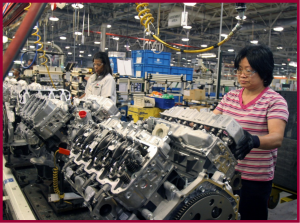
LaShannon Oldham (left) and Thu Dang install lower head covers onto Duramax diesel engines at the Dmax plant in Dayton, Ohio.
General Motors and Isuzu announced today a $175 million investment through its DMAX joint venture to build an all-new, diesel engine components plant in Brookville, Ohio. The new 251,000 square-foot facility would expand the production of engine components for the company’s current DMAX diesel engine manufacturing operation in Moraine, Ohio. DMAX is a joint venture, 60% owned by GM, 40% owned by Isuzu Diesel Services of America, Inc.
The new investment it’s claimed will create more than 100 new manufacturing jobs at the Brookville. Preliminary work has begun and construction on the new facility will be completed by the end of 2020. When the new Brookville site is up and running, it will operate concurrently with the current DMAX operations in Moraine. Continue reading





Continental, 3M to Develop Intelligent Infrastructure Technology
V2V allows vehicles to send and receive from each other information such as location, speed, direction of travel. V2I shares data about traffic signal phase, road attributes and surface conditions. This has the potential to mitigate traffic collisions and congestion. They can be integrated with active safety features, such as forward collision warning and side blind zone alert, already available on production cars. Crucial is also infrastructure-to-vehicle (I2V) interface between infrastructure-related objects and technologies. It’s a complex problem in execution.
In the latest twist on the bumpy road to autonomous vehicles, Continental has entered into a “collaborative evaluation partnership” with 3M to assess the infrastructure-to-vehicle (I2V) interface between infrastructure-related objects and technologies. This includes pavement markings, conspicuity film, signs and other landmarks on or near the roadways as well as vehicle-related technologies. In short, many milestones that need to be safely and repeatedly passed if and/or when vehicles are to become more autonomous.
By Continental’s admission, and an awareness of the enormity of the task that is becoming more collective admitted among previously unbridled automaker promoters, “current infrastructure is lacking some aspects of consistency, uniformity, performance specifications, and maintenance standards that are important for the industry to optimize the perception and localization capabilities of automated vehicles…
Continue reading →