Click for more to worry about.
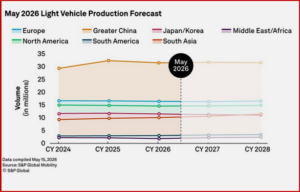
S&P Global Mobility’s May forecast has altered to an oil price scenario that assumes a more sustained impact through 2027, increasing pressure on vehicle demand, production costs, and supply chains. This is a modification from an earlier forecast from the respected consultancy that assumed the Iranian war and the Strait of Hormuz shut down would have only temporary negative effects on the global auto industry. [S&P Global Mobility is different from S&P Global Ratings, which is a separately managed division of S&P Global- AutoCrat.]*
“For May, S&P Global Mobility has shifted to an oil price scenario that assumes a more sustained impact through 2027, increasing pressure on vehicle demand, production costs, and supply chains. There is some early evidence that automakers are pulling forward select production as a hedge against potential feedstock and parts shortages, though existing inventories and limited alternative supply sources are helping cushion the immediate effect,” said Mike Wall, Executive Director, Automotive Analysis, S&P Global Mobility. “At the same time, region-specific challenges, especially weaker near-term demand in mainland China, are contributing to broader downward revisions across the short-term forecast horizon. The most meaningful cuts this month are concentrated in Greater China, Japan/Korea, and South Asia,” said Wall.
Regional Highlights and Stresses
Europe
“Europe’s light vehicle production outlook was reduced by 67,000 units for 2026 and 183,000 units for 2027. The downgrade reflects worsening macroeconomic conditions tied to higher-than-expected oil prices from the prolonged Iran conflict, with demand destruction expected to emerge in the second half of 2026. While production should remain broadly stable through Q2-2026 following a strong March back-fill, most brands face weaker outlooks into H2 and 2027. A few exceptions stand out, including Tesla, Nissan, and Xpeng, which saw improved model-level expectations.”
Greater China
“Greater China’s light vehicle production outlook was reduced by 197,000 units for 2026 and 146,000 units for 2027. Mainland China’s market is showing clearer signs of softness, with weakening demand, fading policy stimulus, and diminishing returns from ongoing price competition. The Middle East conflict is adding further economic pressure, contributing to weaker consumer confidence and rising stock levels. The revisions also reflect structural headwinds as the market transitions from a high-growth phase to a more mature and highly competitive environment.”
Japan / Korea
“Japan’s production outlook was reduced by 93,000 units for 2026 and 143,000 units for 2027, while South Korea was lowered by 16,000 units for 2026 and 64,000 units for 2027. These cuts reflect expectations that normalization of the Strait of Hormuz will be delayed beyond June, extending inflationary pressure and softening demand. South Korea’s near-term outlook has weakened despite stronger-than-expected March production, as global demand is expected to contract under higher oil prices. Longer term, South Korea’s outlook improves modestly with the addition of Kia’s new EV1 beginning in late 2028.”
Middle East/ Africa
The Middle East and Africa production outlook was reduced by 32,000 units for 2026 and 54,000 units for 2027. The revisions are driven primarily by the continuing impact of the Iran war on regional demand, production, logistics, and supply chain capabilities. This month’s near-term downgrade is focused particularly on Iran, where disruption remains most acute. Broader regional conditions remain fragile as conflict-related constraints persist.”
North America
“North America’s vehicle production outlook was reduced by 13,000 units for 2026 and 339,000 units for 2027. Near-term production remains relatively steady as automakers continue building key high-volume vehicles to meet demand and support lean inventory levels, especially in pickups and core utility segments. However, the forecast assumes manufacturers will not cut output preemptively unless demand weakness or supply disruptions become more visible. As a result, the brunt of the downside risk shifts into 2027, especially for vehicles and segments more exposed to high fuel costs and softer consumer spending,” said Wall. [Such as the gas guzzling pickup trucks and SUVs that are (were?) extremely profitable offerings from what used to called the Detroit Three. Now GM, Ford and Stellantis – AutoCrat.]
South America
“South America’s production outlook was reduced by 12,000 units for 2026 and 45,000 units for 2027. The near-term downgrade reflects a more cautious view tied to the Iran war, even as Brazil’s April performance continued to exceed expectations. Argentina, by contrast, came in below forecast and remains more vulnerable to worsening macro conditions. The broader regional outlook for 2027 and 2028 was also revised lower due to the prospect of prolonged conflict-related pressure on input costs and economic expectations.”
South Asia
“South Asia’s production outlook was reduced by 70,000 units for 2026 and 228,000 units for 2027. Although ASEAN production rebounded in April, the gain appears to have been driven more by fiscal year-end production timing than by underlying market strength. OEMs have so far managed through the disruption by drawing down pre-secured inventories, but those buffers are expected to diminish soon. India remains especially vulnerable given its heavy reliance on Gulf energy imports, leading to specific cuts of 38,000 units for 2026 and 134,000 units for 2027.”
*AutoInformed on

About Ken Zino
Ken Zino, editor and publisher of AutoInformed, is a versatile auto industry participant with global experience spanning decades in print and broadcast journalism, as well as social media. He has automobile testing, marketing, public relations and communications experience. He is past president of The International Motor Press Assn, the Detroit Press Club, founding member and first President of the Automotive Press Assn. He is a member of APA, IMPA and the Midwest Automotive Press Assn.
He also brings an historical perspective while citing their contemporary relevance of the work of legendary auto writers such as Ken Purdy, Jim Dunne or Jerry Flint, or writers such as Red Smith, Mark Twain, Thomas Jefferson – all to bring perspective to a chaotic automotive universe.
Above all, decades after he first drove a car, Zino still revels in the sound of the exhaust as the throttle is blipped during a downshift and the driver’s rush that occurs when the entry, apex and exit points of a turn are smoothly and swiftly crossed. It’s the beginning of a perfect lap.
AutoInformed has an editorial philosophy that loves transportation machines of all kinds while promoting critical thinking about the future use of cars and trucks.
Zino builds AutoInformed from his background in automotive journalism starting at Hearst Publishing in New York City on Motor and MotorTech Magazines and car testing where he reviewed hundreds of vehicles in his decade-long stint as the Detroit Bureau Chief of Road & Track magazine. Zino has also worked in Europe, and Asia – now the largest automotive market in the world with China at its center.








May 2026 Light Vehicle Production Forecast is Down Again
Click for more to worry about.
S&P Global Mobility’s May forecast has altered to an oil price scenario that assumes a more sustained impact through 2027, increasing pressure on vehicle demand, production costs, and supply chains. This is a modification from an earlier forecast from the respected consultancy that assumed the Iranian war and the Strait of Hormuz shut down would have only temporary negative effects on the global auto industry. [S&P Global Mobility is different from S&P Global Ratings, which is a separately managed division of S&P Global- AutoCrat.]*
“For May, S&P Global Mobility has shifted to an oil price scenario that assumes a more sustained impact through 2027, increasing pressure on vehicle demand, production costs, and supply chains. There is some early evidence that automakers are pulling forward select production as a hedge against potential feedstock and parts shortages, though existing inventories and limited alternative supply sources are helping cushion the immediate effect,” said Mike Wall, Executive Director, Automotive Analysis, S&P Global Mobility. “At the same time, region-specific challenges, especially weaker near-term demand in mainland China, are contributing to broader downward revisions across the short-term forecast horizon. The most meaningful cuts this month are concentrated in Greater China, Japan/Korea, and South Asia,” said Wall.
Regional Highlights and Stresses
Europe
“Europe’s light vehicle production outlook was reduced by 67,000 units for 2026 and 183,000 units for 2027. The downgrade reflects worsening macroeconomic conditions tied to higher-than-expected oil prices from the prolonged Iran conflict, with demand destruction expected to emerge in the second half of 2026. While production should remain broadly stable through Q2-2026 following a strong March back-fill, most brands face weaker outlooks into H2 and 2027. A few exceptions stand out, including Tesla, Nissan, and Xpeng, which saw improved model-level expectations.”
Greater China
“Greater China’s light vehicle production outlook was reduced by 197,000 units for 2026 and 146,000 units for 2027. Mainland China’s market is showing clearer signs of softness, with weakening demand, fading policy stimulus, and diminishing returns from ongoing price competition. The Middle East conflict is adding further economic pressure, contributing to weaker consumer confidence and rising stock levels. The revisions also reflect structural headwinds as the market transitions from a high-growth phase to a more mature and highly competitive environment.”
Japan / Korea
“Japan’s production outlook was reduced by 93,000 units for 2026 and 143,000 units for 2027, while South Korea was lowered by 16,000 units for 2026 and 64,000 units for 2027. These cuts reflect expectations that normalization of the Strait of Hormuz will be delayed beyond June, extending inflationary pressure and softening demand. South Korea’s near-term outlook has weakened despite stronger-than-expected March production, as global demand is expected to contract under higher oil prices. Longer term, South Korea’s outlook improves modestly with the addition of Kia’s new EV1 beginning in late 2028.”
Middle East/ Africa
The Middle East and Africa production outlook was reduced by 32,000 units for 2026 and 54,000 units for 2027. The revisions are driven primarily by the continuing impact of the Iran war on regional demand, production, logistics, and supply chain capabilities. This month’s near-term downgrade is focused particularly on Iran, where disruption remains most acute. Broader regional conditions remain fragile as conflict-related constraints persist.”
North America
“North America’s vehicle production outlook was reduced by 13,000 units for 2026 and 339,000 units for 2027. Near-term production remains relatively steady as automakers continue building key high-volume vehicles to meet demand and support lean inventory levels, especially in pickups and core utility segments. However, the forecast assumes manufacturers will not cut output preemptively unless demand weakness or supply disruptions become more visible. As a result, the brunt of the downside risk shifts into 2027, especially for vehicles and segments more exposed to high fuel costs and softer consumer spending,” said Wall. [Such as the gas guzzling pickup trucks and SUVs that are (were?) extremely profitable offerings from what used to called the Detroit Three. Now GM, Ford and Stellantis – AutoCrat.]
South America
“South America’s production outlook was reduced by 12,000 units for 2026 and 45,000 units for 2027. The near-term downgrade reflects a more cautious view tied to the Iran war, even as Brazil’s April performance continued to exceed expectations. Argentina, by contrast, came in below forecast and remains more vulnerable to worsening macro conditions. The broader regional outlook for 2027 and 2028 was also revised lower due to the prospect of prolonged conflict-related pressure on input costs and economic expectations.”
South Asia
“South Asia’s production outlook was reduced by 70,000 units for 2026 and 228,000 units for 2027. Although ASEAN production rebounded in April, the gain appears to have been driven more by fiscal year-end production timing than by underlying market strength. OEMs have so far managed through the disruption by drawing down pre-secured inventories, but those buffers are expected to diminish soon. India remains especially vulnerable given its heavy reliance on Gulf energy imports, leading to specific cuts of 38,000 units for 2026 and 134,000 units for 2027.”
*AutoInformed on
About Ken Zino
Ken Zino, editor and publisher of AutoInformed, is a versatile auto industry participant with global experience spanning decades in print and broadcast journalism, as well as social media. He has automobile testing, marketing, public relations and communications experience. He is past president of The International Motor Press Assn, the Detroit Press Club, founding member and first President of the Automotive Press Assn. He is a member of APA, IMPA and the Midwest Automotive Press Assn. He also brings an historical perspective while citing their contemporary relevance of the work of legendary auto writers such as Ken Purdy, Jim Dunne or Jerry Flint, or writers such as Red Smith, Mark Twain, Thomas Jefferson – all to bring perspective to a chaotic automotive universe. Above all, decades after he first drove a car, Zino still revels in the sound of the exhaust as the throttle is blipped during a downshift and the driver’s rush that occurs when the entry, apex and exit points of a turn are smoothly and swiftly crossed. It’s the beginning of a perfect lap. AutoInformed has an editorial philosophy that loves transportation machines of all kinds while promoting critical thinking about the future use of cars and trucks. Zino builds AutoInformed from his background in automotive journalism starting at Hearst Publishing in New York City on Motor and MotorTech Magazines and car testing where he reviewed hundreds of vehicles in his decade-long stint as the Detroit Bureau Chief of Road & Track magazine. Zino has also worked in Europe, and Asia – now the largest automotive market in the world with China at its center.