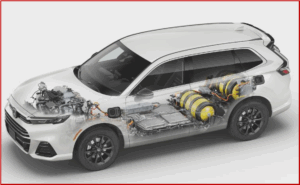
Click for more.
American Honda Motor Co. (NYSE: HMC) is recalling 388 Honda 2025 model-year CR-V Fuel Cell EV vehicles.* Coolant inside the fuel cell stack may leak into the fuel cell stack case, causing an internal short circuit. As such, these vehicles fail to comply with the requirements of Federal Motor Vehicle Safety Standard number 305, “Electric-powered vehicles: Electrolyte Spillage and Electrical Shock Protection.” [Unlike most automakers, Honda made the filing public via press release before the National Highway Traffic Safety Administration (NHTSA) made it public, usually on Monday mornings. – AutoCrat.]
“The fuel cell stack coolant leak can occur as a result of two potential causes: (1) insufficient verification during a process change to reduce the amount of adhesive sealant resulted in unfilled areas, shortened adhesive length, and reduced sealing performance of the FC stack assembly end joint, and (2) the supplier (Fuel Cell System Manufacturing Brownstown Township, MI) failed to establish a deburring process for the O-ring groove of the wobble joint, resulting in burrs which reduced sealing performance.
“Over time, these conditions can allow fuel cell stack coolant to enter the FC stack case and create an electrical short between the fuel cell stack bipolar plate and the support-bar housing, leading to the ground-fault warning,” Honda said in the required safety defect recall filing with the National Highway Traffic Safety Administration .
Driver Warnings
Multiple warnings will be displayed in the instrument cluster through the progressive stages of fuel cell stack coolant leakage before the loss of drive power.
- “Power System” warning will display when a high voltage ground fault is detected (DTC: P0AA6) and stored
- “FC insulating fluid low. See your dealer.” warning will display when the fuel cell stack coolant (insulating fluid) level has decreased in the reserve tank.
- “Power may be reduced. See your dealer” warning will display when air is mixed into the fuel cell stack coolant, and the FC power output is reduced to 20kW.
- “Do not drive” or “Stop driving when safe” will display when the fuel cell stack coolant temperature rises and the FC power generation has stopped.
Description of Remedy
“Dealer notification was scheduled to begin and end on or about 12/12/2025. Owner notification is scheduled to begin and end on or about 2/2/2026. Registered owners of all affected vehicles will be contacted by mail and asked to take their vehicle to an authorized Honda dealer. The dealer will replace the fuel stack assembly with an improved part. The remedy components use a rubber end unit seal, instead of adhesive, and wobble joints that have been deburred,” Honda said.
*AutoInformed on

About Ken Zino
Ken Zino, editor and publisher of AutoInformed, is a versatile auto industry participant with global experience spanning decades in print and broadcast journalism, as well as social media. He has automobile testing, marketing, public relations and communications experience. He is past president of The International Motor Press Assn, the Detroit Press Club, founding member and first President of the Automotive Press Assn. He is a member of APA, IMPA and the Midwest Automotive Press Assn.
He also brings an historical perspective while citing their contemporary relevance of the work of legendary auto writers such as Ken Purdy, Jim Dunne or Jerry Flint, or writers such as Red Smith, Mark Twain, Thomas Jefferson – all to bring perspective to a chaotic automotive universe.
Above all, decades after he first drove a car, Zino still revels in the sound of the exhaust as the throttle is blipped during a downshift and the driver’s rush that occurs when the entry, apex and exit points of a turn are smoothly and swiftly crossed. It’s the beginning of a perfect lap.
AutoInformed has an editorial philosophy that loves transportation machines of all kinds while promoting critical thinking about the future use of cars and trucks.
Zino builds AutoInformed from his background in automotive journalism starting at Hearst Publishing in New York City on Motor and MotorTech Magazines and car testing where he reviewed hundreds of vehicles in his decade-long stint as the Detroit Bureau Chief of Road & Track magazine. Zino has also worked in Europe, and Asia – now the largest automotive market in the world with China at its center.







Honda Recalls 2025 CR-V Fuel Cell EVs
Click for more.
American Honda Motor Co. (NYSE: HMC) is recalling 388 Honda 2025 model-year CR-V Fuel Cell EV vehicles.* Coolant inside the fuel cell stack may leak into the fuel cell stack case, causing an internal short circuit. As such, these vehicles fail to comply with the requirements of Federal Motor Vehicle Safety Standard number 305, “Electric-powered vehicles: Electrolyte Spillage and Electrical Shock Protection.” [Unlike most automakers, Honda made the filing public via press release before the National Highway Traffic Safety Administration (NHTSA) made it public, usually on Monday mornings. – AutoCrat.]
“The fuel cell stack coolant leak can occur as a result of two potential causes: (1) insufficient verification during a process change to reduce the amount of adhesive sealant resulted in unfilled areas, shortened adhesive length, and reduced sealing performance of the FC stack assembly end joint, and (2) the supplier (Fuel Cell System Manufacturing Brownstown Township, MI) failed to establish a deburring process for the O-ring groove of the wobble joint, resulting in burrs which reduced sealing performance.
“Over time, these conditions can allow fuel cell stack coolant to enter the FC stack case and create an electrical short between the fuel cell stack bipolar plate and the support-bar housing, leading to the ground-fault warning,” Honda said in the required safety defect recall filing with the National Highway Traffic Safety Administration .
Driver Warnings
Multiple warnings will be displayed in the instrument cluster through the progressive stages of fuel cell stack coolant leakage before the loss of drive power.
Description of Remedy
“Dealer notification was scheduled to begin and end on or about 12/12/2025. Owner notification is scheduled to begin and end on or about 2/2/2026. Registered owners of all affected vehicles will be contacted by mail and asked to take their vehicle to an authorized Honda dealer. The dealer will replace the fuel stack assembly with an improved part. The remedy components use a rubber end unit seal, instead of adhesive, and wobble joints that have been deburred,” Honda said.
*AutoInformed on
About Ken Zino
Ken Zino, editor and publisher of AutoInformed, is a versatile auto industry participant with global experience spanning decades in print and broadcast journalism, as well as social media. He has automobile testing, marketing, public relations and communications experience. He is past president of The International Motor Press Assn, the Detroit Press Club, founding member and first President of the Automotive Press Assn. He is a member of APA, IMPA and the Midwest Automotive Press Assn. He also brings an historical perspective while citing their contemporary relevance of the work of legendary auto writers such as Ken Purdy, Jim Dunne or Jerry Flint, or writers such as Red Smith, Mark Twain, Thomas Jefferson – all to bring perspective to a chaotic automotive universe. Above all, decades after he first drove a car, Zino still revels in the sound of the exhaust as the throttle is blipped during a downshift and the driver’s rush that occurs when the entry, apex and exit points of a turn are smoothly and swiftly crossed. It’s the beginning of a perfect lap. AutoInformed has an editorial philosophy that loves transportation machines of all kinds while promoting critical thinking about the future use of cars and trucks. Zino builds AutoInformed from his background in automotive journalism starting at Hearst Publishing in New York City on Motor and MotorTech Magazines and car testing where he reviewed hundreds of vehicles in his decade-long stint as the Detroit Bureau Chief of Road & Track magazine. Zino has also worked in Europe, and Asia – now the largest automotive market in the world with China at its center.