Click for more.
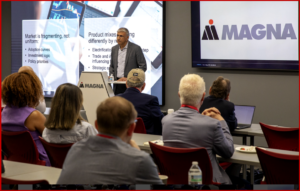
Magna (TSX: MG. NYSE: MGA) CEO Swamy Kotagiri spent some time today addressing the Automotive Press Association in Troy, Michigan. In keeping with my many years of covering Kotagiri, he was intelligent, logical, foresighted, humble and politically astute – politely sidestepping answering a question on the upcoming 2026 USMCA Trade Agreement renewal – befitting his leadership at the mega Canadian Tier One auto parts and components designer, developer and parts supplier. [Magna is the largest automobile parts manufacturer in North America by sales of original equipment parts. It has 350 manufacturing plants globally some with Unifor, UAW and German Metal Workers unions. The remarks have been lightly edited for space and clarity – AutoCrat.]*
“The biggest challenge in today’s automotive industry is not really anticipating change. It’s made in big capital allocation decisions, assumptions in markets that are constantly changing,” Kotagiri said. “Technology is moving, consumer demand is moving, policy is moving, and of course, geopolitics is influencing where and how we operate.
Click for more.
“And yet, under all these circumstances, the decisions we are making today will define the next decade, given the nature of our long-cycle industry .That’s the real tension in the system. The environment, I believe, is structurally less predictable than how this industry has historically operated in the past,”
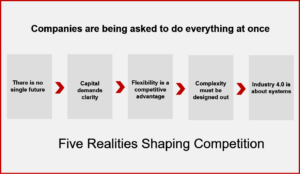
“So what that means in practice is that companies are being asked to do a lot of things or everything at once. We have to invest for long-term growth. We have to manage costs in the near term, navigate policy and regulatory shifts. And still, there’s your performance. And that is raising the bar significantly on the strategic judgment, I would say.
“From where we sit, there are five realities that are taking how companies compete, allocate capital, and ultimately win. So let me walk through this briefly, clearly, one by one.
First Point
“There is no single future. We are no longer moving towards one predictable outcome. We are navigating in multiple plausible futures or paths at a time, and you see that in the different adoption curves. Across regions, you see different investment logic across companies and obviously different policy priorities by margin. Electrification is a good example. The direction is clear for the long term. But the pace and the path are not uniform, and that creates fragmentation. Product mix evolves differently by region. We are seeing that investment timing varies. Industrial policies influence footprint decisions in real time.
“Historically, success came from getting the forecast right. Today’s success comes from staying effective when the forecast is wrong. So the shift is pretty fundamental from optimizing for one expected future to building systems that can perform across several realities. So that’s a different capability and increasingly a competitive one.
Second Point
This is my favorite. Capital demands clarity, and this is becoming more important, not less. Because in this environment, plans are constantly being tested by tariffs, by closing rules, by inflation, by incentives, demand shifts. All in all, here’s the key point. Capital doesn’t wait for clarity, unfortunately. So if clarity doesn’t show up, capital simply runs around ambiguity. So companies have to be very clear about what they’re optimizing for. Where will they invest?
And also importantly, where will they not? In other words, how will they remain disciplined? And that clarity is not just about numbers, it’s about credibility in showing that strategy, execution, and resource allocation are all connected as we talk through. In today’s environment, clarity comes less from certainty and more from alignment, transparency, and the discipline that I just talked about.
Third Point
“Flexibility is now a competitive advantage. For a long time, efficiency was a dominant logic in the industry, and for a good reason, of course. Scale, utilization, cost, which are all adding to efficiency, of course, still matter. But when assumptions change faster, I believe efficiency alone is not enough. The real advantage comes from building optionality into the system, which means product architectures that can adapt, manufacturing footprints that can absorb mix shifts, Supply chains that can hold under pressure.
“And at Magna, we see this in our manufacturing model. As an example, in many cases, we can support multiple programs and multiple propulsion types within the same facility. What that does is allow our customers to respond to demand shifts without completely resetting their investment base. So flexibility is not the opposite of discipline. In this environment, it is discipline because it reduces the cost of being wrong.
Fourth Point
“Complexity must be designed out. This is one of the biggest. The industry has tried to solve complexity late in the process through labor, through automation, through workarounds. But if complexity is designed into the system early, you carry the cost all the way through. So the historical question here has been, how do we automate a complex process? As you see the complexity and the human thought process that is needed to adapt based on what’s happening in real time, and if you superimpose the question of how do you automate that process versus looking at it differently a little bit, is how do you automate complexity by eliminating it up front? That is the powerful question. In other words, can you design the product differently, keeping in mind the current state of automation that you have?
“And the complexity that you are trying to address through automation is taken out in the design process in the product. So if you take what’s available today, now you can automate it. Right? The same was designed in a modular way. A lot of the complexity in the manual process is taken out. And some of these building blocks will become very amenable to the automation process that is there today. And that shift from automating complexity to eliminating it up front is very powerful because those early design decisions determine cost, quality, scalability, and ultimately competitiveness, which is so very important in our industry.
Industry 4.0 Is About Systems And Outputs
“There’s a lot of focus on AI, automation, data analytics, and so on. But the reality is these only create value when applied to specific constraints at scale.
- Define the problem, understand what the problem is you’re trying to solve.
- What is the objective?
- What is the outcome we expect?
- And then try to apply the tools that are available.
“So I would like to say the real price is not novelty, it’s measurable operational improvement. For example, in our unified factory approach, we coordinate material movements in real time, we link production schedules, inventory and logistics, we optimize decisions across the entire system.
“So the sequence, I believe, is critical. Understand the system, identify the constraint, define what better looks like before you even start, and then apply technology at scale. That’s how you create durable advantage.
Last point in closing, so when you step back, these realities lead to a simple conclusion:
- This industry has to operate differently than it should in a more stable era.
- We have to make decisions earlier.
- We have to simplify systems sooner, and
- Build organizations that can respond faster.
- The winners won’t be the ones who predict everything perfectly. They will be the ones who adapt faster and more consistently than everyone else,” said Kotagiri.
*AutoInformed on

About Ken Zino
Ken Zino, editor and publisher of AutoInformed, is a versatile auto industry participant with global experience spanning decades in print and broadcast journalism, as well as social media. He has automobile testing, marketing, public relations and communications experience. He is past president of The International Motor Press Assn, the Detroit Press Club, founding member and first President of the Automotive Press Assn. He is a member of APA, IMPA and the Midwest Automotive Press Assn.
He also brings an historical perspective while citing their contemporary relevance of the work of legendary auto writers such as Ken Purdy, Jim Dunne or Jerry Flint, or writers such as Red Smith, Mark Twain, Thomas Jefferson – all to bring perspective to a chaotic automotive universe.
Above all, decades after he first drove a car, Zino still revels in the sound of the exhaust as the throttle is blipped during a downshift and the driver’s rush that occurs when the entry, apex and exit points of a turn are smoothly and swiftly crossed. It’s the beginning of a perfect lap.
AutoInformed has an editorial philosophy that loves transportation machines of all kinds while promoting critical thinking about the future use of cars and trucks.
Zino builds AutoInformed from his background in automotive journalism starting at Hearst Publishing in New York City on Motor and MotorTech Magazines and car testing where he reviewed hundreds of vehicles in his decade-long stint as the Detroit Bureau Chief of Road & Track magazine. Zino has also worked in Europe, and Asia – now the largest automotive market in the world with China at its center.







Magna CEO Swamy Kotagiri Speaking on Decisions That Will Shape the Next Decade of Automotive Manufacturing
Click for more.
Magna (TSX: MG. NYSE: MGA) CEO Swamy Kotagiri spent some time today addressing the Automotive Press Association in Troy, Michigan. In keeping with my many years of covering Kotagiri, he was intelligent, logical, foresighted, humble and politically astute – politely sidestepping answering a question on the upcoming 2026 USMCA Trade Agreement renewal – befitting his leadership at the mega Canadian Tier One auto parts and components designer, developer and parts supplier. [Magna is the largest automobile parts manufacturer in North America by sales of original equipment parts. It has 350 manufacturing plants globally some with Unifor, UAW and German Metal Workers unions. The remarks have been lightly edited for space and clarity – AutoCrat.]*
“The biggest challenge in today’s automotive industry is not really anticipating change. It’s made in big capital allocation decisions, assumptions in markets that are constantly changing,” Kotagiri said. “Technology is moving, consumer demand is moving, policy is moving, and of course, geopolitics is influencing where and how we operate.
Click for more.
“And yet, under all these circumstances, the decisions we are making today will define the next decade, given the nature of our long-cycle industry .That’s the real tension in the system. The environment, I believe, is structurally less predictable than how this industry has historically operated in the past,”
“So what that means in practice is that companies are being asked to do a lot of things or everything at once. We have to invest for long-term growth. We have to manage costs in the near term, navigate policy and regulatory shifts. And still, there’s your performance. And that is raising the bar significantly on the strategic judgment, I would say.
“From where we sit, there are five realities that are taking how companies compete, allocate capital, and ultimately win. So let me walk through this briefly, clearly, one by one.
First Point
“There is no single future. We are no longer moving towards one predictable outcome. We are navigating in multiple plausible futures or paths at a time, and you see that in the different adoption curves. Across regions, you see different investment logic across companies and obviously different policy priorities by margin. Electrification is a good example. The direction is clear for the long term. But the pace and the path are not uniform, and that creates fragmentation. Product mix evolves differently by region. We are seeing that investment timing varies. Industrial policies influence footprint decisions in real time.
“Historically, success came from getting the forecast right. Today’s success comes from staying effective when the forecast is wrong. So the shift is pretty fundamental from optimizing for one expected future to building systems that can perform across several realities. So that’s a different capability and increasingly a competitive one.
Second Point
This is my favorite. Capital demands clarity, and this is becoming more important, not less. Because in this environment, plans are constantly being tested by tariffs, by closing rules, by inflation, by incentives, demand shifts. All in all, here’s the key point. Capital doesn’t wait for clarity, unfortunately. So if clarity doesn’t show up, capital simply runs around ambiguity. So companies have to be very clear about what they’re optimizing for. Where will they invest?
And also importantly, where will they not? In other words, how will they remain disciplined? And that clarity is not just about numbers, it’s about credibility in showing that strategy, execution, and resource allocation are all connected as we talk through. In today’s environment, clarity comes less from certainty and more from alignment, transparency, and the discipline that I just talked about.
Third Point
“Flexibility is now a competitive advantage. For a long time, efficiency was a dominant logic in the industry, and for a good reason, of course. Scale, utilization, cost, which are all adding to efficiency, of course, still matter. But when assumptions change faster, I believe efficiency alone is not enough. The real advantage comes from building optionality into the system, which means product architectures that can adapt, manufacturing footprints that can absorb mix shifts, Supply chains that can hold under pressure.
“And at Magna, we see this in our manufacturing model. As an example, in many cases, we can support multiple programs and multiple propulsion types within the same facility. What that does is allow our customers to respond to demand shifts without completely resetting their investment base. So flexibility is not the opposite of discipline. In this environment, it is discipline because it reduces the cost of being wrong.
Fourth Point
“Complexity must be designed out. This is one of the biggest. The industry has tried to solve complexity late in the process through labor, through automation, through workarounds. But if complexity is designed into the system early, you carry the cost all the way through. So the historical question here has been, how do we automate a complex process? As you see the complexity and the human thought process that is needed to adapt based on what’s happening in real time, and if you superimpose the question of how do you automate that process versus looking at it differently a little bit, is how do you automate complexity by eliminating it up front? That is the powerful question. In other words, can you design the product differently, keeping in mind the current state of automation that you have?
“And the complexity that you are trying to address through automation is taken out in the design process in the product. So if you take what’s available today, now you can automate it. Right? The same was designed in a modular way. A lot of the complexity in the manual process is taken out. And some of these building blocks will become very amenable to the automation process that is there today. And that shift from automating complexity to eliminating it up front is very powerful because those early design decisions determine cost, quality, scalability, and ultimately competitiveness, which is so very important in our industry.
Industry 4.0 Is About Systems And Outputs
“There’s a lot of focus on AI, automation, data analytics, and so on. But the reality is these only create value when applied to specific constraints at scale.
“So I would like to say the real price is not novelty, it’s measurable operational improvement. For example, in our unified factory approach, we coordinate material movements in real time, we link production schedules, inventory and logistics, we optimize decisions across the entire system.
“So the sequence, I believe, is critical. Understand the system, identify the constraint, define what better looks like before you even start, and then apply technology at scale. That’s how you create durable advantage.
Last point in closing, so when you step back, these realities lead to a simple conclusion:
*AutoInformed on
About Ken Zino
Ken Zino, editor and publisher of AutoInformed, is a versatile auto industry participant with global experience spanning decades in print and broadcast journalism, as well as social media. He has automobile testing, marketing, public relations and communications experience. He is past president of The International Motor Press Assn, the Detroit Press Club, founding member and first President of the Automotive Press Assn. He is a member of APA, IMPA and the Midwest Automotive Press Assn. He also brings an historical perspective while citing their contemporary relevance of the work of legendary auto writers such as Ken Purdy, Jim Dunne or Jerry Flint, or writers such as Red Smith, Mark Twain, Thomas Jefferson – all to bring perspective to a chaotic automotive universe. Above all, decades after he first drove a car, Zino still revels in the sound of the exhaust as the throttle is blipped during a downshift and the driver’s rush that occurs when the entry, apex and exit points of a turn are smoothly and swiftly crossed. It’s the beginning of a perfect lap. AutoInformed has an editorial philosophy that loves transportation machines of all kinds while promoting critical thinking about the future use of cars and trucks. Zino builds AutoInformed from his background in automotive journalism starting at Hearst Publishing in New York City on Motor and MotorTech Magazines and car testing where he reviewed hundreds of vehicles in his decade-long stint as the Detroit Bureau Chief of Road & Track magazine. Zino has also worked in Europe, and Asia – now the largest automotive market in the world with China at its center.