Click to enlarge.
Plante Moran shared its North American Production Outlook 2026 – 2033 forecast with the Society of Automotive Analysts this week. It is investigating at the mid-2026 point how electrification continues to influence auto industry direction as the year unfolds. The estimable mega-consulting firm that deals in audit, tax, consulting, and wealth management globally has a significant advisory presence in the auto industry. It says changes are coming later this decade and into the early 2030s.
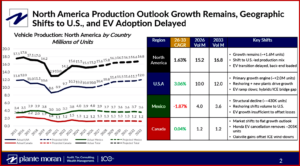
“The North American production volume outlook for growth remains, but we’re seeing some geographic shifts, mostly to the US. And amount of this growth will be encountered in the later years of our projections,” said Dan Lee, principal in strategy practice at the Southfield, MI office.” And that’s largely due to the delays in EV adoption that we’ve seen whether that’s planned to be paused or not.”
“In the US, volumes are increasing, largely due to shifting in production. For example, the Stellantis Belvedere plant is reopening and re-shoring volumes from Mexico with the Cherokee and Compass [Stellantis to Invest $13 Billion in U.S. Plants],… GM Orion [Chevrolet Silverado and GMC Sierra pickup trucks, as well as the Cadillac Escalade – AutoCrat.] and Fairfax are expanding. [GM Spending $30M at Fairfax to Flex EV and ICE Making] So that’s largely what’s driving growth within the U.S.”
“For Mexico we’re seeing USMCA tariff volume declining as OEMs are readjusting production strategy geographic locations… and within Canada it’s a bit of a mixed bag. We’ve seen investment from Ford with the Super Duty pickup truck volumes… So all in all, there is moderate growth for region with the U.S. dominating the volume gains over the seven-year forecast period.”
“When we look at OEM margins, comparing this from the last three years, we’ve seen quite a squeeze on their operational performance… and it’s a variety of factors, one of the largest being the tariffs…other margins directly impacted were from huge Electric Vehicle write offs. …There’s increasing pricing pressures – the average vehicle price is getting up to $50,000. The OEM’s are starting to feel those pressure pressures with MSRP cuts or promotions. [Vehicle Affordability – Price Increases Small as Incentives Grow] Higher interest rates also impacting sale prices and affordability for consumers. Consistent raw material inflation pricing, whether that’s plastics, commodities, metals, , is also impacting their bottom line… The gross margin on currently launched EVs probably tends to be lower than the traditional internal combustion engine vehicles or hybrids.
“Then there’s some global pressures for players operating in China and even to some extent Europe where they’re encountering very cost-competitive Chinese competition. … These are all factors that are really decreasing the industry margin levels across the major OEMs listed here from about 13% to 8% EBIT, a 5% fall within two years. [Chinese Owned Volvo Cars to Import Lynk & Co Cars in Europe, Nissan to Build Chinese Chery Vehicles in UK?, Chinese Dongfeng Voyah Vehicles Coming to EU Via Stellantis, Coming Soon Chinese-Built Jeeps?]
… The big EV write offs – over the last year we’ve seen OEMs pivot back to more of a multi powertrain strategy. Collectively there’s been $70 billion of EV impairments and I think you see that OEMs that have more of the exposure to North America where we’ve seen more volatile regular regulatory direction feel that impact struck more strongly. But on the opposite end when we look at the OEMs that haven’t reported any EV impairments, from perhaps a better strategy and less exposure to the US. These were really the main reasons that Toyota and BMW initially took that multi powertrain manufacturing strategy. Hyundai Kia have a very strong flexible global footprint where they’re producing multiple powertrain types in plants. [Magna CEO Swamy Kotagiri Speaking on Decisions That Will Shape the Next Decade of Automotive Manufacturing]
“Mercedes-Benz has been strong and cost discipline and really driving down the cost for their BEVs, and I think more realistic capacity planning on their powertrain volumes. [First Look – Mercedes-Benz 2027 C‑Class EV] Companies such as Mazda that were a little later coming in the roll out, just avoided committing major capital to alternative powertrain adoption.
“When we look at the powertrain trends, the growth story here is hybrids year-over-year are the one segment that’s continuing to grow. And that’s largely due to a proliferation offerings in the marketplace, particularly Subaru and the Toyota models have been driving the recent gains in share across powertrains…. [Dan Lee’s remarks were lightly edited for space, clarity and a non-auto-industry acronym-uninformed audience – AutoCrat.]

About Ken Zino
Ken Zino, editor and publisher of AutoInformed, is a versatile auto industry participant with global experience spanning decades in print and broadcast journalism, as well as social media. He has automobile testing, marketing, public relations and communications experience. He is past president of The International Motor Press Assn, the Detroit Press Club, founding member and first President of the Automotive Press Assn. He is a member of APA, IMPA and the Midwest Automotive Press Assn.
He also brings an historical perspective while citing their contemporary relevance of the work of legendary auto writers such as Ken Purdy, Jim Dunne or Jerry Flint, or writers such as Red Smith, Mark Twain, Thomas Jefferson – all to bring perspective to a chaotic automotive universe.
Above all, decades after he first drove a car, Zino still revels in the sound of the exhaust as the throttle is blipped during a downshift and the driver’s rush that occurs when the entry, apex and exit points of a turn are smoothly and swiftly crossed. It’s the beginning of a perfect lap.
AutoInformed has an editorial philosophy that loves transportation machines of all kinds while promoting critical thinking about the future use of cars and trucks.
Zino builds AutoInformed from his background in automotive journalism starting at Hearst Publishing in New York City on Motor and MotorTech Magazines and car testing where he reviewed hundreds of vehicles in his decade-long stint as the Detroit Bureau Chief of Road & Track magazine. Zino has also worked in Europe, and Asia – now the largest automotive market in the world with China at its center.







Mixed Results on Trump Auto Tariff, Policy Scorecards
Click to enlarge.
Plante Moran shared its North American Production Outlook 2026 – 2033 forecast with the Society of Automotive Analysts this week. It is investigating at the mid-2026 point how electrification continues to influence auto industry direction as the year unfolds. The estimable mega-consulting firm that deals in audit, tax, consulting, and wealth management globally has a significant advisory presence in the auto industry. It says changes are coming later this decade and into the early 2030s.
“The North American production volume outlook for growth remains, but we’re seeing some geographic shifts, mostly to the US. And amount of this growth will be encountered in the later years of our projections,” said Dan Lee, principal in strategy practice at the Southfield, MI office.” And that’s largely due to the delays in EV adoption that we’ve seen whether that’s planned to be paused or not.”
“In the US, volumes are increasing, largely due to shifting in production. For example, the Stellantis Belvedere plant is reopening and re-shoring volumes from Mexico with the Cherokee and Compass [Stellantis to Invest $13 Billion in U.S. Plants],… GM Orion [Chevrolet Silverado and GMC Sierra pickup trucks, as well as the Cadillac Escalade – AutoCrat.] and Fairfax are expanding. [GM Spending $30M at Fairfax to Flex EV and ICE Making] So that’s largely what’s driving growth within the U.S.”
“For Mexico we’re seeing USMCA tariff volume declining as OEMs are readjusting production strategy geographic locations… and within Canada it’s a bit of a mixed bag. We’ve seen investment from Ford with the Super Duty pickup truck volumes… So all in all, there is moderate growth for region with the U.S. dominating the volume gains over the seven-year forecast period.”
“When we look at OEM margins, comparing this from the last three years, we’ve seen quite a squeeze on their operational performance… and it’s a variety of factors, one of the largest being the tariffs…other margins directly impacted were from huge Electric Vehicle write offs. …There’s increasing pricing pressures – the average vehicle price is getting up to $50,000. The OEM’s are starting to feel those pressure pressures with MSRP cuts or promotions. [Vehicle Affordability – Price Increases Small as Incentives Grow] Higher interest rates also impacting sale prices and affordability for consumers. Consistent raw material inflation pricing, whether that’s plastics, commodities, metals, , is also impacting their bottom line… The gross margin on currently launched EVs probably tends to be lower than the traditional internal combustion engine vehicles or hybrids.
“Then there’s some global pressures for players operating in China and even to some extent Europe where they’re encountering very cost-competitive Chinese competition. … These are all factors that are really decreasing the industry margin levels across the major OEMs listed here from about 13% to 8% EBIT, a 5% fall within two years. [Chinese Owned Volvo Cars to Import Lynk & Co Cars in Europe, Nissan to Build Chinese Chery Vehicles in UK?, Chinese Dongfeng Voyah Vehicles Coming to EU Via Stellantis, Coming Soon Chinese-Built Jeeps?]
… The big EV write offs – over the last year we’ve seen OEMs pivot back to more of a multi powertrain strategy. Collectively there’s been $70 billion of EV impairments and I think you see that OEMs that have more of the exposure to North America where we’ve seen more volatile regular regulatory direction feel that impact struck more strongly. But on the opposite end when we look at the OEMs that haven’t reported any EV impairments, from perhaps a better strategy and less exposure to the US. These were really the main reasons that Toyota and BMW initially took that multi powertrain manufacturing strategy. Hyundai Kia have a very strong flexible global footprint where they’re producing multiple powertrain types in plants. [Magna CEO Swamy Kotagiri Speaking on Decisions That Will Shape the Next Decade of Automotive Manufacturing]
“Mercedes-Benz has been strong and cost discipline and really driving down the cost for their BEVs, and I think more realistic capacity planning on their powertrain volumes. [First Look – Mercedes-Benz 2027 C‑Class EV] Companies such as Mazda that were a little later coming in the roll out, just avoided committing major capital to alternative powertrain adoption.
“When we look at the powertrain trends, the growth story here is hybrids year-over-year are the one segment that’s continuing to grow. And that’s largely due to a proliferation offerings in the marketplace, particularly Subaru and the Toyota models have been driving the recent gains in share across powertrains…. [Dan Lee’s remarks were lightly edited for space, clarity and a non-auto-industry acronym-uninformed audience – AutoCrat.]
About Ken Zino
Ken Zino, editor and publisher of AutoInformed, is a versatile auto industry participant with global experience spanning decades in print and broadcast journalism, as well as social media. He has automobile testing, marketing, public relations and communications experience. He is past president of The International Motor Press Assn, the Detroit Press Club, founding member and first President of the Automotive Press Assn. He is a member of APA, IMPA and the Midwest Automotive Press Assn. He also brings an historical perspective while citing their contemporary relevance of the work of legendary auto writers such as Ken Purdy, Jim Dunne or Jerry Flint, or writers such as Red Smith, Mark Twain, Thomas Jefferson – all to bring perspective to a chaotic automotive universe. Above all, decades after he first drove a car, Zino still revels in the sound of the exhaust as the throttle is blipped during a downshift and the driver’s rush that occurs when the entry, apex and exit points of a turn are smoothly and swiftly crossed. It’s the beginning of a perfect lap. AutoInformed has an editorial philosophy that loves transportation machines of all kinds while promoting critical thinking about the future use of cars and trucks. Zino builds AutoInformed from his background in automotive journalism starting at Hearst Publishing in New York City on Motor and MotorTech Magazines and car testing where he reviewed hundreds of vehicles in his decade-long stint as the Detroit Bureau Chief of Road & Track magazine. Zino has also worked in Europe, and Asia – now the largest automotive market in the world with China at its center.