
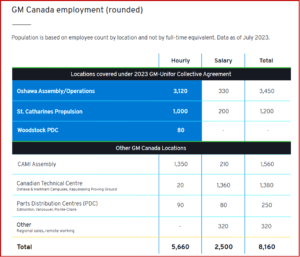
A new analysis presented to the Automotive Press Association today by consulting firm Anderson Economic Group (AEG)* estimates that a strike on all three automakers by 143,000 United Auto Workers (UAW) members could result in a total economic loss of more than $5 billion after 10 full days. The UAW contract expires on 14 Sept, and it covers 150,000 autoworkers at Ford, General Motors and Stellantis. Wage losses if a strike occurs are at ~$859 million. AEG calculated the total economic loss by estimating potential losses to UAW workers, the manufacturers, and to the auto industry more broadly if negotiations are not successful before the current contract expires in September.
“When the UAW went on strike against GM in 2019, Michigan experienced a single quarter recession,” said Patrick Anderson, AEG’s principal and CEO. That strike, which involved 48,000 workers at more than 50 plants, lasted six weeks. In 2023, there appears that at the moment there is the potential that a strike could involve more manufacturers, workers and plants, which makes theoretical comparisons difficult until there are more data points. “If that (all makers are struck) happens, even a short strike would impact economies throughout Michigan and across the nation,” said Anderson.* Continue reading







Public Charging Issues Could Hurt EV Growth
Click for more.
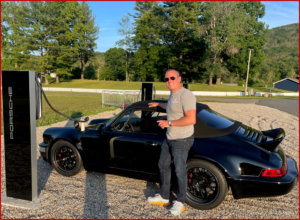
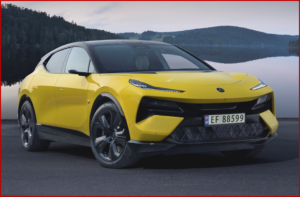
The stressed public vehicle charging infrastructure is falling further behind as automakers continue to introduce new electric vehicles (EVs). It’s not surprising then that overall satisfaction continues to decline, according to the J.D. Power 2023 U.S. Electric Vehicle Experience (EVX) Public Charging StudySM released this week.
“Though purported to be the wave of the future, satisfaction with DC (direct current) fast chargers has declined even further, dropping 20 points to 654 on a 1000-point scale. More troubling is that satisfaction in both charging station segments has declined in nearly every attribute measured in the study. Since consumer skepticism regarding public charging availability is the primary reason vehicle shoppers reject EVs, this performance could prove to be a further hindrance to EV acceptance,” Power said. Continue reading →