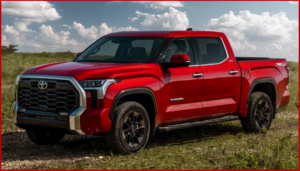
Click to Enlarge.
Toyota has previewed what it calls an “all new” Tundra pickup truck, which will be in its third generation when it debuts later this year as a 2022 model. That’s an if, perhaps a big if – if the runaway corona virus Delta variant in Texas and the semi-conductor supply crisis don’t abate.
A new twin-turbo 3.5-liter V6 engine is rated at 389 horsepower and 479 lb.-ft. of torque. When paired with a >marketing babble alert> ”brilliantly engineered bell-housing motor system called the i-FORCE MAX, the result is a combined performance output of 437 horsepower and a whopping 583 lb.-ft. of torque.” Both configurations use the same 10-speed automatic transmission.
SR, SR5, Limited, Platinum and 1794 models will eventually be available. TRD Pro will also return to the Tundra lineup, but it will only be offered with the i-FORCE MAX powertrain, whereas i-FORCE MAX will be an option on Limited, Platinum and 1794 models. Continue reading →




Lithium-Sulfur – Better than Lithium-Ion Battery?
A Silicon Valley startup is claiming a new electric vehicle battery – LytCell EV lithium-sulfur (Li-S) battery is designed to deliver three times the gravimetric energy density of conventional lithium-ion (Li-ion) batteries (claimed potentially at 900 Wh/kg). Moreover it also claims to outperform solid state batteries.
Whether this is a genuine breakthrough or just another silly-CON (Do you know the ways of San Jose? Privately held until the IPO?) remains to be validated by vehicle use on the road and ultimately adoption by major automakers. Lyten expects full production and market availability for ‘25-‘26 model year vehicles. Continue reading →