
Click for more information.
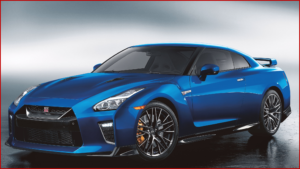
What was once unthinkable to German performance car makers continues today as two new versions of Japanese super-cars were announced. The 2023 Nissan GT-R is now on sale at elite US Nissan dealers with a starting Manufacturer’s Suggested Retail Price of $113,540. Toyota Gazoo Racing has also launched an updated GR Supra GT4* race car for the 2023 season with claimed enhanced braking, handling and engine performance. Toyota said it has extensively used “customer and driver feedback to improve the dedicated race car, which is already a champion in three regions, Japan, the United States and Europe, and has earned over 100 podium finishes.” (AutoInformed.com on: Daytona This Weekend Starts 2022 IMSA Racing Season)
The Nissan 2023 GT-R Premium’s 3.8-liter DOHC twin-turbo V6 is rated at 565 horsepower and 467 lb.-ft. of torque, linked with a standard dual-clutch, paddle-shift 6-speed transmission and the so-called ATTESA E-TS all-wheel drive system. Moreover, GT-R NISMO, $210,740, has the same turbochargers developed for the GT3 GT-R race car, increasing the engine’s output to 600 horsepower and 481 lb.-ft. of torque. It has a NISMO-tuned suspension, carbon fiber bodywork, larger Brembo® carbon-ceramic brakes. ** Continue reading


Stellantis Hordain to Build Hydrogen-powered, Electric and Combustion Engine Commercial Vehicles
Please click for more information.
Stellantis (NYSE: MTA / Euronext Paris: STLA) CEO Carlos Tavares during a visit to the Hordain site in the northern Hauts-de-France this week announced the mass production of Peugeot, Citroën and Opel light commercial vehicles in hydrogen-powered versions equipped with a fuel cell. Hordain is scaling up production of the Peugeot Expert, Citroën Jumpy and Opel Vivaro fuel-cell light-commercial vehicles to a so-called industrial level. Hordain employs 2440 people on three shifts, with daily production of 628 vehicles. The site assembled 144,650 vehicles in 2021 and produced its millionth “K-Zero”* in summer 2022.
Starting in 2024, the site Hordain will have a mini-mass production capacity of 5,000 vehicles per year of hydrogen-powered utility vehicles. This Stellantis said in a release reaffirms its goal to be the first mass-produced manufacturer of hydrogen-powered utility van vehicles. There is also a labor relations aspect to the move. Stellantis has 12 industrial sites in France, and unlike Ford Motor Company it has a stated “ethical desire not to separate its electric and internal combustion engine businesses, to engage all its employees in the energy transition.” Continue reading →