
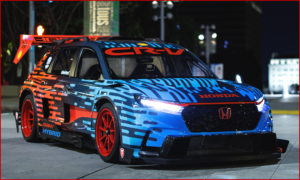
Click for more information.
The new Honda CR-V Hybrid Racer will debut at next month’s IndyCar season-opening Firestone Grand Prix of St. Petersburg. Partly a publicity ploy, and also a technology demonstrator, the vehicle combines a Honda Performance Division IndyCar drivetrain, racing suspension, Firestone high-performance tires with Honda CR-V Hybrid bodywork.
“This project vehicle is an INDYCAR ‘beast’ in Honda CR-V ‘sheep’s clothing’,” said David Salters, presumably with tongue in cheek, the president and technical director for Honda Performance Development, the North American racing arm of American Honda and Acura, referring to the code name of the project.
“The CR-V Hybrid Racer is our ‘rolling electrified laboratory,’ to investigate where the talented men and women of HPD and Honda could go with electrification, hybrid technology and 100% renewable fuels,” said Salters. “It epitomizes Honda’s fun-to-drive ethos, showcases electrification and it just rocks our car culture roots and racing heritage! We present the CR-V Hybrid Racer–aka ‘The HPD Beast’!” AutoInformed notes, wryly, that this isn’t in keeping with meeting the nicest people on a Honda, but it has, well, light comedy or entertainment value. Video click here Continue reading





First CHIPS for America Funding Applications Now Open
The US Department of Commerce’s National Institute of Standards and Technology today launched the first CHIPS for America funding opportunity for manufacturing incentives to “restore U.S. leadership in semiconductor manufacturing, support good-paying jobs across the semiconductor supply chain, and advance U.S. economic and national security.”
Awards will take the form of direct funding, federal loans, and/or federal guarantees of third-party loans. Awards are designed to complement – not replace – private investment and other sources of funding, and applicants are strongly encouraged to bring capital to the table. CHIPS for America awards will be made as soon as applications can be evaluated and negotiated. The automobile industry, of course, has been hobbled by interruptions in its supply of offshore-produced chips or semi-conductors.
Continue reading →