
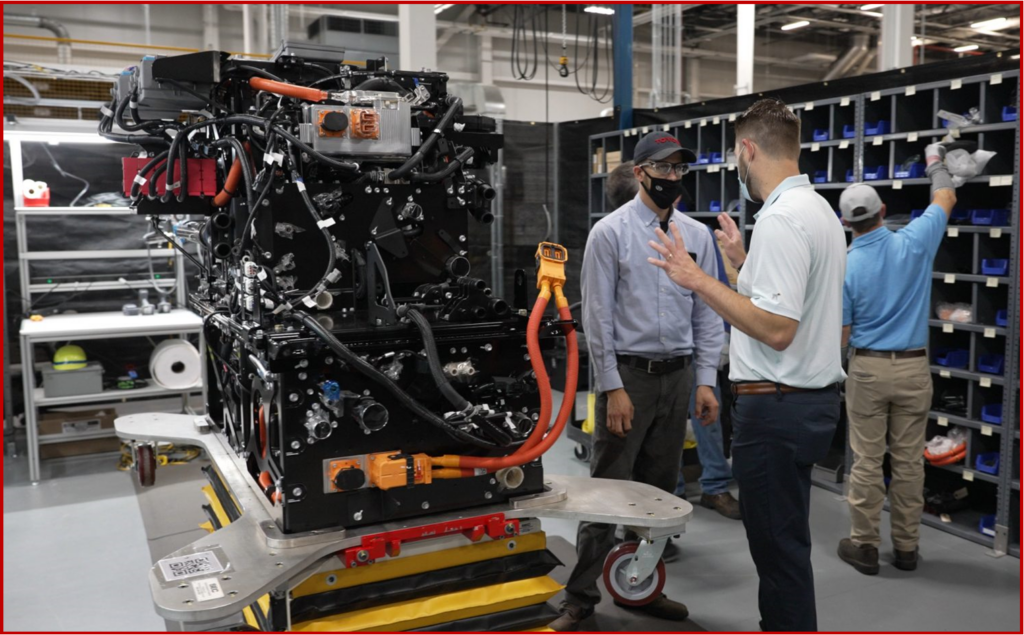
The dual fuel-cell modules are a key component of an overall Fuel Cell kit. They weigh approximately 1,400 pounds and can deliver up to 160kW of continuous power.
Toyota said today that starting in 2023, a dedicated line at Toyota Motor Manufacturing Kentucky (TMMK) will begin assembling integrated dual fuel cell (FC) modules destined for use in hydrogen-powered, heavy-duty commercial trucks. This will allow truck manufacturers to incorporate emissions-free fuel cell electric technology into existing platforms with the technical support of Toyota under the hood.
“We’re bringing our proven electric technology to a whole new class of production vehicles,” said Tetsuo Ogawa, president and chief executive officer, Toyota Motor North America. “Heavy-duty truck manufacturers will be able to buy a fully integrated and validated fuel cell electric drive system, allowing them to offer their customers an emissions-free option in the Class 8 heavy-duty segment.” Continue reading











US Auto Sales Forecast Down Again in August
Click to Enlarge.
New-vehicle retail and fleet sales for the month of August are expected to decline from August 2020 and decline from August 2019, according to a joint forecast from J.D. Power and LMC Automotive. August 2021 has one fewer selling day than August 2020 and three fewer selling days than August 2019. Comparing the same retail sales volume without adjusting for the number of selling days translates to a decrease of 17.6% from 2020 and a decrease of 30.0% from 2019.
Overall new-vehicle sales for August 2021, including retail and non-retail transactions, are projected to reach 1,094,500 units, a 13.7% decrease from August 2020 and a 25.3% decrease from August 2019. Comparing the same sales volume without adjusting for the number of selling days translates to a decrease of 17.0% from 2020 and a decrease of 33.3% from 2019. The seasonally adjusted annualized rate (SAAR) for total new-vehicle sales is expected to be 13.1 million units, down 2.1 million units from 2020 and down 4.0 million units from 2019.
Continue reading →