
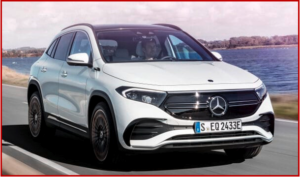
As confusing as this sounds, Mercedes actually has reduced the complexity of its EQA models.
A combination of Mercedes cash on the hood with taxpayer subsidies means its EQA compact EV in Germany is “entry level” starting at 37,970.50 euros for the EQA 250 including 19% VA. Rated at power of 140 kW, other variants will follow including a series of all-wheel-drive models with an additional electric powertrain (eATS) and an output of 200 kW or more, and a version with a range of more than 500 kilometers (WLTP). The EQA comes with one year of Mercedes me Charge included. For Mercedes me Charge customers in Europe, this includes ‘green charging’ during this period at no extra cost. The EQA is available to order now, with the first models reaching retailers in the spring.
The relatively low German price is based on discounts of 9000 euros: government share 6000 euros, Mercedes-Benz share 3000. If the EQA is used as a company car, only a quarter of the gross list price is subject to taxation for private use. The Mercedes-Benz Bank offers financing and leasing terms for both private and business customers. The EQA 250 with Business Package is available for leasing by business customers from 399 euros a month. The leasing offer is valid for orders placed by 31 March 2021, while stocks last. Continue reading



Ford Motor 2020 Loss $1.3 Billion. Microchip Shortage Looms
Click to Enlarge.
Ford Motor in the beginning yet again of another multiyear reorganization reported a $1.3 billion loss on $127.1 billion in revenue for 2020 and a $2.8 billion net loss on $36 billion in revenue for Q4.
Chasing General Motors, Ford said it would increase its planned investments in electric and autonomous vehicles to more than $22 billion and $7 billion in turn through 2025. GM caught the industry by surprise when it said it would have 30 new EVs globally during roughly that period. It was the latest Ford attempt to appease the capital markets which remain skeptical about the lackluster performance of the Dearborn based automaker. (See AutoInformed.com on Environmental About Face – General Motors Ditching Internal Combustion Engines by 2035. Carbon Neutral by 2040?) Continue reading →