
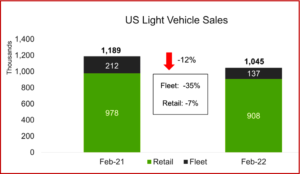
Click to Enlarge.
US Light Vehicle sales continued to struggle in February due to sparse inventories. According to the LMC Automotive consultancy, sales fell to 1.05 million units, down by -12% YoY. Only four of the main OEMs – Tesla, BMW, Mazda and Hyundai – had positive results during the month, which was the weakest February since 2011.
The annualized selling rate, aka SAAR, of 14.0 million units declined in both the monthly and annual comparisons. However, the February SAAR was still 1 million higher than the average rate during the second half of 2021. With the same number of selling days as in January, February’s daily average grew by ~2,000 units/day, to 43,600 units/day – it has floated above the 40,000-unit threshold since November 2021 after President Biden was elected and a recovery from the economic reverses and job losses from the Trump Administration began.








University of Michigan, Ford – EV Greenhouse Gas Reductions Greater than Others. Pickups Best Over Their Life Cycle?
Researchers found that switching an internal-combustion-engine vehicle to a BEV results in greater total tonnage of emissions reductions as the vehicle size increases, due to the greater fuel consumption of larger vehicles.
University of Michigan and Ford Motor Company researchers in a new study that evaluated the savings in greenhouse gas emissions between electric and gasoline-powered vehicles say light-duty, battery-electric vehicles have ~64% lower cradle-to-grave life cycle greenhouse gas emissions than internal-combustion-engine vehicles on average across the United States.
“This is an important study to inform and encourage climate action. Our research clearly shows substantial greenhouse gas emission reductions that can be achieved from transitioning to electrified powertrains across all vehicle classes,” said study senior author Greg Keoleian, a professor at the U-M School for Environment and Sustainability and director of the U-M Center for Sustainable Systems. Continue reading →