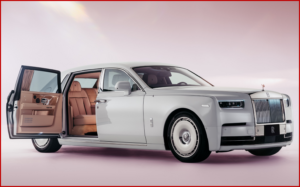
Click to enlarge.
Cherry blossoms are celebrated in the centuries-old Japanese tradition of “Hanami” or “flower viewing.” During Hanami, families and friends gather beneath the delicate pink blooms of cherry trees for picnics and celebrations, enjoying the transient beauty of the season, Rolls Royce noted today. A client in Japan wished to capture their cherished Hanami memories, spanning childhood and parenthood. Thus is the backstory of the latest custom or bespoke Phantom Cherry Blossom. This is a one-of-one Phantom commission said to be inspired by the fleeting beauty of the Sakura blooms and a Japanese client’s formative memories of this natural spectacle.
“Cherry blossoms are cherished in Japan as a symbol of the ephemeral nature of life and the beauty of transience. With this magnificent commission, we translate an internationally renowned moment into our pinnacle motor car, Phantom, with exquisite embroidery comprising more than 250,000 stitches. For the first time at Rolls-Royce, we have applied three-dimensional embroidery that gives the falling flower petals a tactile, sculptural quality. Developed using ancient Japanese stitching techniques, this motor car represents a deeply personal memory for the client and demonstrates the power of Bespoke in uniting individual meaning, heritage craftsmanship and modern artistry,” said Martina Starke, General Manager, Bespoke Design, Rolls-Royce Motor Cars. Continue reading →




Annals of Marketing – Cadillac Dining Experience
Click to enlarge.
Cadillac (NYSE: GM) said today that its limited-time dining experience “Cadillac of Reservations” is expanding to three more U.S. cities this spring and summer. More consumers will have the chance to enjoy a dining experience in the all-electric Cadillac Escalade IQ* at some of the buzziest restaurants including La Dolce Vita in Beverly Hills (April), COTE Korean Steakhouse in Miami (early summer) and State Bird Provisions in San Francisco (late summer).
“This expansion builds on the successful Cadillac x COQODAQ (New York City) collaboration in January, where a few lucky patrons enjoyed COQODAQ’s signature fried chicken dishes in the Executive Second Row of the Escalade IQ. The immersive five-course dining experience featured table settings on the vehicle’s stowable tray tables along with a song pairing for each dish played through the AKG [see footnote 1] studio reference 40-speaker audio system. Available massaging, heated and ventilated second row captain’s seats, and a virtual fireplace displayed on the available rear infotainment screens added to the comfortable atmosphere,” Cadillac said. Continue reading →