
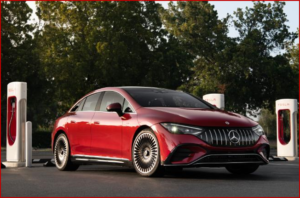
Click on a Supercharger for more.
Mercedes-Benz said today that drivers can use Tesla Superchargers in North America starting in 2024, in an attempt to expand electric vehicle sales appeal by providing full access to all major charging networks. The move follows other major automakers already in the process of plugging in to the network – notably Ford and GM – since there are more than 12,000 Tesla Superchargers across North America right now. Mercedes-Benz will be the first German automaker to implement the so-called NACS ports into its new electric vehicles starting in 2025 as part o an attempt to have one universal charging system hookup.
As part of a phased transition, Mercedes-Benz will initially offer an adapter (these can be clumsy to use – AutoCrat) that enables the company’s existing CCS BEVs to charge on the NACS network from 2024 onwards. Even though more public charging stations are in operation than ever, customer satisfaction with public Level 2 charging declined from last year, dropping to 633 (on a 1,000-point scale) from 643 in 2021, while satisfaction with the speedier DC (direct current) fast charger segment remains flat at 674, J.D. Power told AutoInformed last August. Continue reading






US States Lagging Badly on EV Adoption Policies
Click to see more of the problem.
While some states are clearly leading and strengthening policies to enable widespread use of electric cars, trucks, and buses, all states will have to significantly step up their efforts to enable a full transition, says a new report from the American Council for an Energy-Efficient Economy (ACEEE). The 2023 State Transportation Electrification Scorecard evaluates states’ policies to encourage electric vehicle (EV) adoption. Only nine states scored more than half the points available. (AutoInformed: Watt? Electric Cars Cause Another Great Generational Divide)
“We are seeing incremental progress, not transformational progress. States will have to move far more aggressively to do their part to enable the electric vehicle transition that the climate crisis demands,” said Peter Huether, senior research associate at ACEEE and the lead writer of the report. “Auto manufacturers are expanding their EV options and consumers are increasingly choosing them, but supportive state policies are needed to ensure that the electric grid is ready and that all households and businesses, including those in under-served communities, can use EVs and have adequate access to charging.” Continue reading →