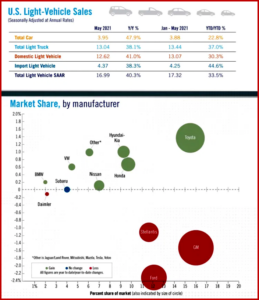
Click to Enlarge.
U.S. new light-vehicle sales were okay in May 2021, but fell from April’s highs. May’s Seasonally Adjusted Annual Rate, aka SAAR, was 17 million units. However, April’s SAAR was revised upward to 18.8 million units. May 2021’s SAAR was up 40.3% from May 2020’s, when light-vehicle sales had just begun to recover from April 2020’s pandemic lows under the previous “drink bleach” administration.
A 17 million-unit SAAR in conventional auto-exec-think would be celebrated as strong: “Even as the historic sales pace slowed slightly, this was the strongest May since 2015, and several brands celebrated their best-ever monthly volume. The annualized rate fell from 18.8 million units in April to 17.2 million units last month, in line with the SAAR registered in both 2018 at17.2 million units and 2019 at 17.4 million units,” said consultancy LMC. (April Sales Shower US Market More than 18 Million Times, US New Vehicle Sales in May Forecast as Record Setting. Global Sales are Another Matter Entirely)
But there is more going on here, AutoInformed opines, given current market conditions. While automakers and the business press have been chasing the semi-conductor shortage, many claim May’s drop in sales are the effects of a supply and demand imbalance. However, the vehicle mix of highly-equipped vehicles, plentiful low-interest-rate money, and the headlong rush into electric vehicles – priced above an average working person’s ability to carry the loan – are starting to make light vehicles un-affordable to the working and middle classes. For example Ford Motor set record electrified vehicle sales – up 184 % on F-150 PowerBoost Hybrid, Mustang Mach-E, Escape and Explorer Hybrid models Continue reading →

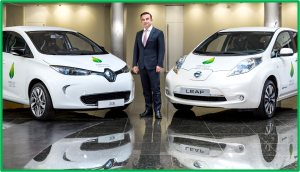










US Battery Electric Vehicle Market – Progress or Proliferation? Tesla has a 75% Share. Is the Nissan LEAF a Best Buy?
Click to Enlarge.
The Nissan LEAF was the first modern pure EV when it launched in 2010. (EPA Says Nissan Leaf Gets 106 MPGe) Since then the US battery electric vehicle market has added roughly 20 different models with prices ranging from ~$21,000 to more than $140,000. The question is whether this is progress or just proliferation? Well, as always, for consumers it depends on what you consider.
“Among the entry-level models (priced below $25,000), the Nissan Leaf has a similar base price as a decade ago, although its electric range has doubled as a result of advancements in lithium-ion battery packs and e-motor proficiency,” observes Matt Lucki, Senior Analyst, Powertrain Forecasts, The Americas at LMC Consultancy. Continue reading →