
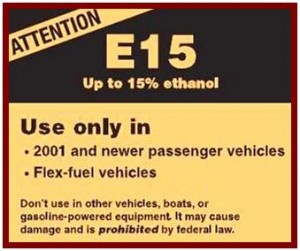
An E15 pump label.
The U.S. Environmental Protection Agency today issued an emergency fuel waiver to allow E15 gasoline – gasoline blended with 15% ethanol – to be sold during the summer driving season. This allows the states of Iowa, Kansas, Missouri, Nebraska, and Nine Tribal Nations to sell the fuel that otherwise would be banned for the summer. Estimates show that on average, E15 is about $0.25 a gallon cheaper than E10. (read AutoInformed previously on: EPA Emergency Order Allows Summer Sale of E15 Gasoline)
“Under President Biden’s leadership, EPA is taking action to protect Americans from fuel supply challenges resulting from ongoing conflict overseas by ensuring consumers have more choices at the pump,” said Administrator Michael S. Regan.* “Allowing E15 sales during the summer driving season will increase fuel supply, while supporting American farmers, strengthening our nation’s energy security, and providing relief to drivers across the country.” Continue reading









NHTSA Probing Whether Ford Fire Recall is Adequate
The National Highway Traffic Safety Administration said just days after this recall was posted by AutoInformed that The Office of Defects Investigation (ODI) reviewed Ford Motor Company’s proposed remedy for recall 24V-187 and started an investigation to evaluate the adequacy and safety consequences of the remedy described in recall 24V-187 (AutoInformed: Ford Again Recalls Bronco Sport and Escape SUVs for Fires)
“ODI evaluated information from Ford concerning the recall remedy for the involved vehicles. Ford issued recall 24V-187 on March 8, 2024, which concerns certain model year (MY) 2022-2023 Ford Bronco Sport and MY 2022 Ford Escape vehicles equipped with 1.5L engines. Recall 24V-187 states that a fuel injector may crack resulting in liquid fuel and/or fuel vapor migration to, and accumulation near, ignition sources that may cause an under hood fire, fuel odor both outside and inside of the vehicle, and increase the risk of injury. Recall 24V-187 further states that a cracked fuel injector in the engine allows for fuel to leak at a high rate into the cylinder head, which can travel out via a drain hole and down onto hot surfaces on the exhaust and/or turbo system. Continue reading →